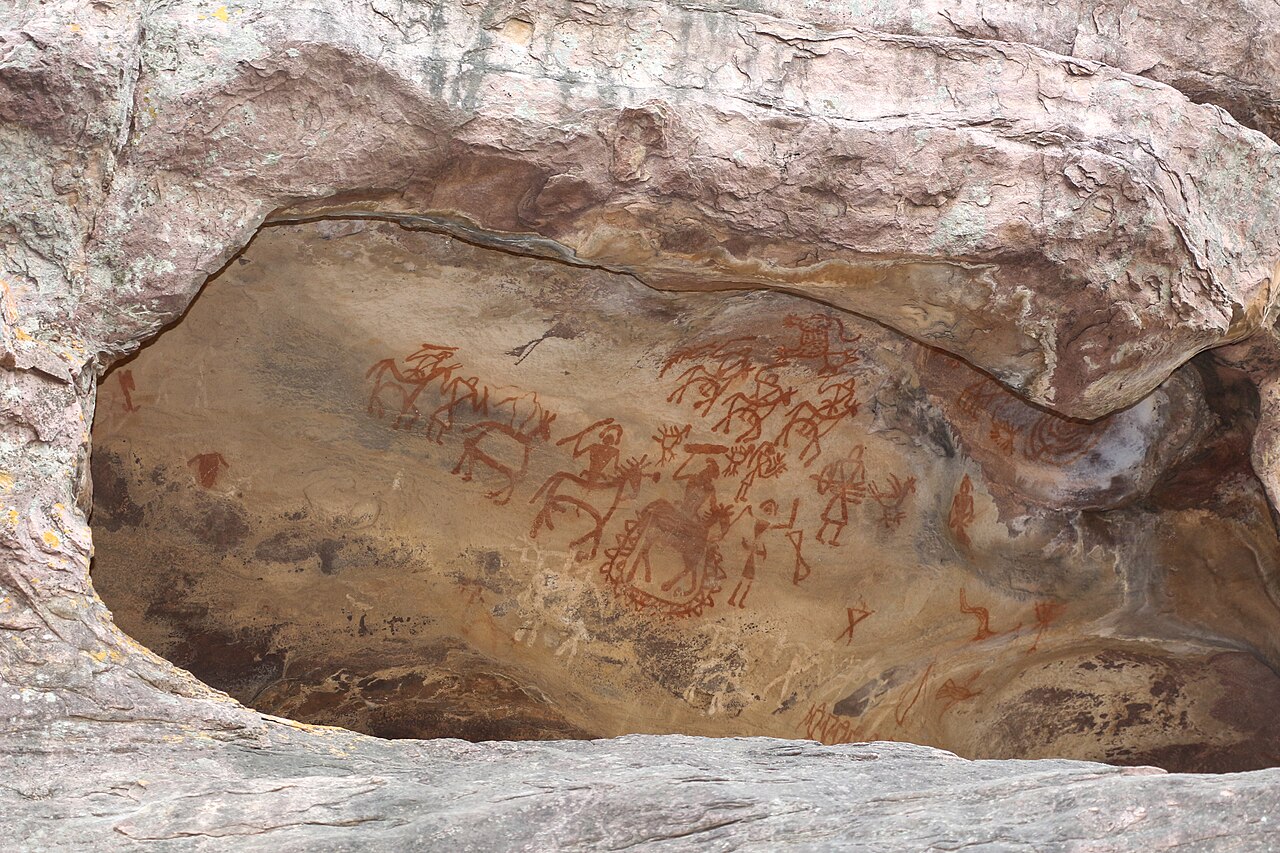
The Rock Shelters of Bhimbetka (भीमबेटका शैलाश्रय), inscribed by UNESCO in 2003, is a complex of approximately 750 rock shelters (natural sandstone caves and overhangs formed by differential weathering of the Vindhya hill sandstone in the Vindhya Range approximately 45 km south of Bhopal, Madhya Pradesh) that contain some of the oldest known rock art in India and one of the most extensive prehistoric rock art complexes in Asia — paintings created from approximately 30,000 BCE (Upper Palaeolithic period) through the Mesolithic (approximately 10,000–2,500 BCE), Chalcolithic, and historical periods up to approximately 200 BCE, in a continuous sequence of human occupation and artistic production spanning approximately 100,000 years from at least the Acheulean period (when Middle Palaeolithic stone tools dating to approximately 700,000–100,000 BCE were found in the lowest levels of the shelter floors — establishing Bhimbetka as one of the earliest known human occupation sites in South Asia) to the beginning of recorded history. Of the 750 shelters, approximately 500 contain paintings; the 15 shelters constituting the “rock art area” designated for UNESCO tourism and access were selected as the most visually representative. The dominant artistic tradition is Mesolithic: broad-painted hunting scenes in red and white ochre depicting human figures (hunters in active running poses, groups in apparent dance formations, archers with bows) pursuing deer (chital, sambar), wild boar, bison (gaur), rhinoceros, and elephants — animals of the Vindhya hill forest ecosystem that surrounded the Bhimbetka shelters during the Mesolithic occupation, the same ecosystem (Vindhyan dry deciduous forest) that surrounds the shelters today and within which the Ratapani Tiger Reserve (approximately 15 km southeast of Bhimbetka) still harbours tigers and leopards.
Bhimbetka’s prehistoric art landscape and the Madhya Pradesh heritage corridor Rock Art zone · Vindhya forest · Sanchi · Bhopal · Ratapani — 0 to 90 km
The Bhimbetka shelters are set within the Ratapani Wildlife Sanctuary (approximately 890 km²), a protected forest area that preserves the Vindhyan dry deciduous ecosystem of the shelters’ prehistoric context — the same forest through which the Mesolithic people of Bhimbetka hunted, gathered, and produced their paintings on the sandstone walls of the natural caves. The specific geological formation that creates the shelter complex (naturally eroded sandstone boulders and overhangs on the Vindhya ridge, many with almost horizontal ceiling surfaces that provided natural canvas space and some protection from rain, oriented facing southeast to maximise morning light for the painters working in the shelter interiors) is visible in the current landscape as large rounded boulders protruding from the Vindhyan forest. The most important shelters for rock art quality include the “Zoo Rock” (a single shelter containing paintings of approximately 50 different animal species in overlapping layers from different periods, each species identifiable by its anatomical characteristics — the superimposition of later paintings on earlier ones in the same shelter, repeated over thousands of years, creating the palimpsest that is the characteristic visual quality of Bhimbetka’s rock art); the “Auditorium Cave” (the largest shelter, with paintings spanning from the Palaeolithic to the historical period, the largest individual rock canvas at Bhimbetka at approximately 20 m × 10 m); and the “Red Elephant” shelter (with Chalcolithic-period paintings in a distinctive pictographic style that connects to early Indian pictographic traditions). The colour palette (predominantly red ochre — a red iron oxide pigment, haematite, found naturally in the Vindhyan sandstone — and white, derived from limestone or kaolinite clay; occasional green from malachite; manganese oxide for black) has maintained its visibility for 10,000–30,000 years through the specific chemistry of the iron oxide bonding with the silica of the sandstone surface, creating a partially mineralised paint layer that is more durable than the organic binders used in later historical painting traditions.
Sanchi (UNESCO 1989, approximately 90 km north of Bhimbetka and 46 km north of Bhopal — see separate CHO article) is the most historically important complement to a Bhimbetka visit — the most important and best-preserved early Buddhist site in India, with the Great Stupa of Emperor Ashoka and its four carved torana gateways, providing the counterpoint to the Bhimbetka prehistoric paintings: from 30,000-year-old Palaeolithic hunting scenes to 3rd-century BCE Buddhist imperial architecture in a single two-site day from Bhopal. Bhopal (the Madhya Pradesh state capital, 45 km north of Bhimbetka) is the base for both sites — the Taj-ul-Masajid (one of the largest mosques in India, construction begun by the Bhopal Nawab Shah Jahan Begum in 1878 CE and never fully completed — a massive Mughal revival mosque with two tapering minarets now used for the city’s Friday congregation) and the Madhya Pradesh Tribal Museum (Bhopal) provide additional cultural context for the Bhimbetka visit.
Practical information
Bhimbetka is 45 km south of Bhopal on National Highway 46 (the Bhopal–Hoshangabad road). By road from Bhopal (approximately 1 hour by hired car or taxi). There is no regular bus service to the site from Bhopal. Bhopal has a domestic airport (Raja Bhoj Airport, BHO) with connections to Delhi, Mumbai, Hyderabad, and other cities; the railway junction (Bhopal Junction) has direct trains from Delhi (approximately 6 hours by Shatabdi Express), Mumbai, and Indore. Bhimbetka is managed by the Archaeological Survey of India. The site is open daily (except Mondays) 07:00–18:00. Admission fees apply (Indian and foreign visitor rates). A licensed guide (available at the entry gate) is strongly recommended — the rock paintings require expert identification and interpretation; without guidance, many paintings are difficult to locate or interpret in the dim shelter interiors. Allow approximately 3–4 hours for a proper visit of the 15 accessible shelters. The path through the shelter complex is approximately 1.5 km with gentle gradients over the boulder terrain. Best visiting months: October–March (comfortable temperatures; summer reaches 42°C in the exposed Vindhyan landscape). Combine with Sanchi (90 km north of Bhimbetka, 46 km north of Bhopal) for a full-day Madhya Pradesh UNESCO circuit. No accommodation at the site; stay in Bhopal.
Frequently Asked Questions
How old are the Bhimbetka rock paintings and what do they depict?
The Bhimbetka rock paintings span an extraordinary chronological range — from the Upper Palaeolithic period (approximately 30,000 BCE, the earliest identified paintings using techniques of dating that include contextual stratigraphy of the cave floor deposits at the base of the paintings, analysis of the superimposition sequences, and comparison with datable Palaeolithic assemblages elsewhere) through the Mesolithic (approximately 10,000–2,500 BCE, the most numerous and visually elaborate painting phase), the Chalcolithic (approximately 2,500–1,000 BCE, the transition period), and the early historical periods (approximately 700–200 BCE, the latest identified paintings). The Palaeolithic paintings (relatively rare at Bhimbetka — possibly 5–10% of the total paintings) tend to be large-scale (1–2 m), in red ochre, depicting single animals in profile — a large bison, a rhinoceros, an elephant — with minimal narrative composition. The Mesolithic paintings (the most numerous, most technically accomplished, and most narratively complex — approximately 60–70% of the total paintings by area and number) show a specific compositional revolution: the large single-animal paintings of the Palaeolithic are replaced by complex multi-figure narrative scenes with human hunters in active poses (the figures typically 10–20 cm in height, highly stylised but with clear anatomical differentiation of species, and in active postures — running, dancing, carrying loads, fighting — that give a compelling sense of kinetic energy). The subjects of the Mesolithic paintings at Bhimbetka include: hunting scenes (the most common subject — groups of hunters with bows, spears, and traps pursuing deer, bison, and boar; the depictions of hunting techniques are a valuable ethnographic record of Mesolithic subsistence strategies in the Vindhyan forest ecosystem); animal portraits (individual animals in high detail, particularly the Indian bison/gaur, the sambar deer, and the chital deer — the depictions are sufficiently anatomically accurate to be identified to species level, providing paleontological confirmation of the animal communities present in the Vindhyan forest during the Mesolithic); communal ritual scenes (figures in apparent dance formations, with arm movements suggesting choreographic patterns; figures wearing elaborate headdresses; scenes that have been interpreted as shamanic ritual or community ceremony); warfare scenes (rare in the earliest periods but increasingly frequent in later Mesolithic paintings — groups of armed figures facing each other across a compositional boundary, with casualties depicted); and geometric and abstract motifs (cup marks, circular patterns, and geometric compositions that appear alongside figurative paintings and that multiply in frequency in the Chalcolithic and later periods). The Chalcolithic paintings (approximately 20–25% of the total) show a transition in style: the figures become more schematic and symbol-like, the compositions more geometric, and new subjects appear (domestic animals including cattle and goats alongside the wild animals of the earlier periods — a compositional change that parallels the transition from purely hunter-gatherer subsistence to early agropastoral economies in central India during the Chalcolithic period). The ability to identify these different “schools” or periods of painting at Bhimbetka rests on the analysis of superimposition sequences (where later paintings were added over earlier ones, establishing a relative chronology), stylistic comparison with datable sites elsewhere in South Asia, and the limited absolute dating evidence from the shelter floor excavations conducted by the Indian archaeologist V.S. Wakankar (who discovered the Bhimbetka site in 1957 CE and conducted the first systematic surveys and excavations from 1957 to 1972 CE).
Who discovered Bhimbetka and how was the site preserved for millennia?
The Bhimbetka rock shelter complex was documented for the first time by the Indian archaeologist V.S. Wakankar (Vishnu Shridhar Wakankar, 1919–1988 CE, an archaeologist and musician from Ujjain who had trained under A.H. Dani and had an interest in prehistoric rock art from his study of European cave art) in 1957 CE — the site was not previously unknown to local people (the Gondwana tribal communities of the Bhopal region knew the shelters as “Bhim’s kitchen”, Bhimbaithika in Gondi, associating them with the mythological hero Bhima of the Mahabharata who was said to have cooked in the caves during the Pandavas’ forest exile), but the rock paintings had not been systematically studied or documented before Wakankar’s visit. Wakankar was travelling by train between Bhopal and Itarsi when he noticed the rock formation of the Vindhyan sandstone outcrops from the train window, alighted at the nearest station, and walked to the boulder cluster — where he immediately identified the paintings in the first shelters he entered. The subsequent excavations (1957–1972) recovered stone tools, bone fragments, and charcoal from the shelter floors that established the occupation sequence from the Acheulean period (Middle Palaeolithic, approximately 700,000–100,000 BCE, on the basis of the Lower Palaeolithic tool typology of the Acheulean handaxe assemblages in the lowest stratigraphic levels) through the historical period. The extreme longevity of the paintings’ survival — up to 30,000 years in conditions of seasonal monsoon humidity and heat — is explained by two factors: the mineralogy of the pigment (red ochre, iron oxide, which forms a chemical bond with the silica of the sandstone surface rather than simply adhering mechanically, creating a partially mineralised paint layer that resists moisture, biological growth, and UV radiation far more effectively than organic pigments); and the shelter geometry (the natural overhang of the sandstone boulders protects the ceiling and upper wall surfaces from direct rain, reducing the hydrological erosion that is the primary destroyer of open-air rock art; the specific orientation of the most important painted shelters, facing southeast, limits direct afternoon sun exposure that would bleach lighter pigments). The site’s protection as an Archaeological Survey of India monument from 1972 onward and UNESCO inscription in 2003 has added fencing, anti-vandalism measures, and visitor management infrastructure — a significant improvement from the pre-1972 situation where the shelters were accessible to local villages and some paintings had been partially defaced by visitors chalking over them to make them more visible for photography.
EXCERPT: Rock Shelters of Bhimbetka, UNESCO-inscribed in 2003, contains some of India’s oldest rock paintings (approximately 30,000 BCE to 200 BCE) in 750 Vindhyan sandstone shelters near Bhopal — Palaeolithic bison and rhinoceros, Mesolithic hunting scenes with 50 animal species on a single overhang, pigment still vivid after 10,000+ years of monsoon.
META: UNESCO World Heritage Sites near Rock Shelters of Bhimbetka Madhya Pradesh India: Buddhist Monuments at Sanchi 90 km north (UNESCO 1989), Khajuraho Group of Monuments 450 km north (UNESCO 1986) — Madhya Pradesh UNESCO heritage circuit Bhimbetka prehistoric art to Sanchi Buddhist monuments, Vindhya Range rock art South Asia.
Sources
- S1 — UNESCO World Heritage Centre — Rock Shelters of Bhimbetka (Ref. 925) — https://web.archive.org/web/20230601000000/https://whc.unesco.org/en/list/925/
- S2 — UNESCO World Heritage Centre — Statement of Outstanding Universal Value (Ref. 925) — https://whc.unesco.org/en/list/925/
Spotted an error? Write to [email protected] and we correct it the same day.