
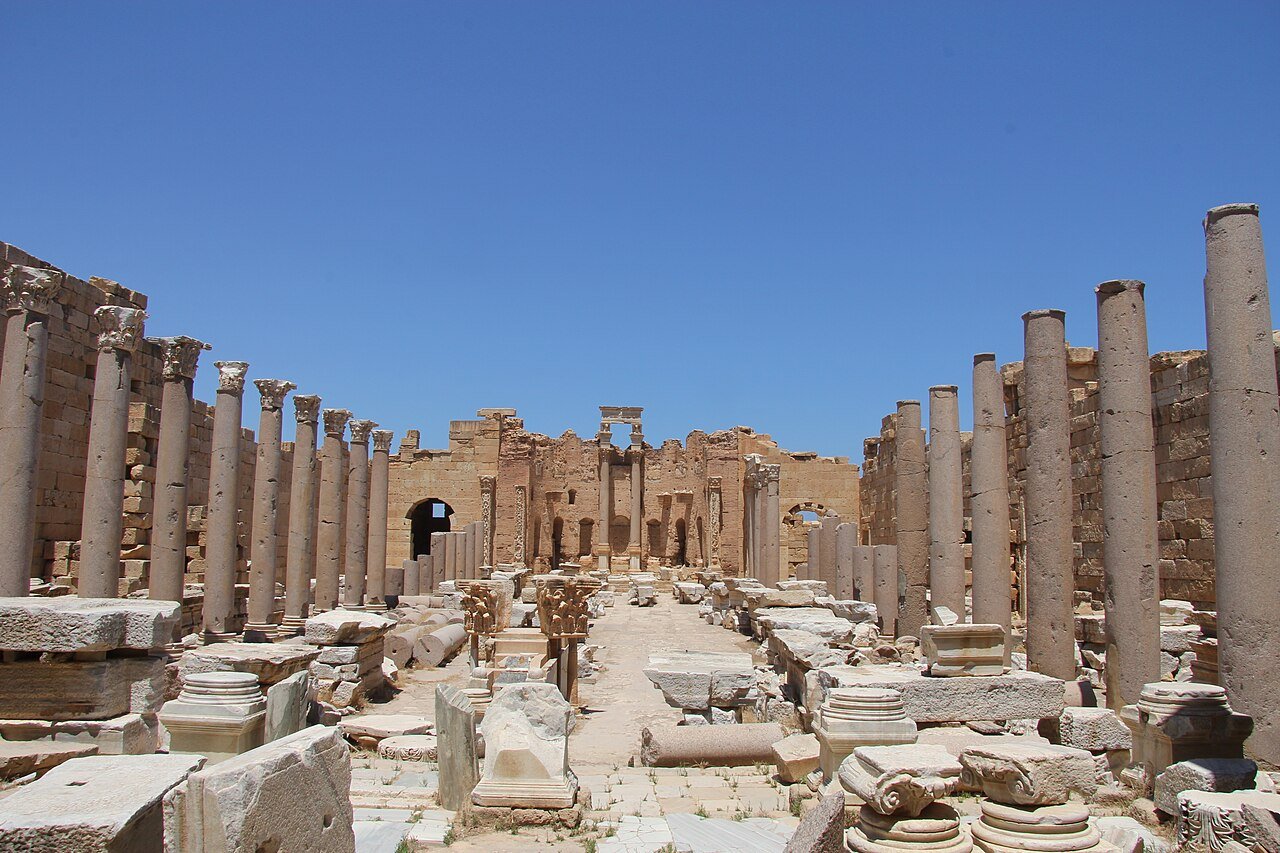
Leptis Magna, inscribed as a UNESCO World Heritage Site in 1982, stands on the Libyan coast 120 kilometres east of Tripoli as one of the most completely preserved Roman cities anywhere in the ancient world. Founded by Phoenician traders from Tyre in the 7th century BCE as a staging post for trans-Saharan caravan routes, the city reached its spectacular zenith when one of its native sons became emperor of Rome — and repaid his hometown with a building programme of extraordinary ambition.
From Phoenician Trading Post to Imperial Showpiece 120 km east of Tripoli, near Khoms
Leptis Magna began as a Phoenician commercial outpost, strategically positioned where caravan routes from sub-Saharan Africa met the Mediterranean sea lanes. Its natural harbour sheltered ships laden with ivory, gold dust, slaves, and wild animals destined for Roman arenas. The city passed into the Carthaginian sphere of influence, and after Rome’s defeat of Carthage it became a prosperous ally — paying tribute in olive oil rather than coin, a measure of the agricultural wealth its hinterland produced.
The city’s extraordinary destiny was sealed on 11 April 145 CE, when Lucius Septimius Severus was born within its walls. Rising through the military ranks, Severus seized power in 193 CE following the assassination of Pertinax, becoming the first African-born emperor of Rome. His attachment to Leptis was personal and visible. From 200 to 216 CE he lavished resources on his birthplace that no other provincial city had ever received from a reigning emperor.
The Severan Forum, measuring 100 metres by 60 metres, was enclosed by colonnades of cipollino marble columns imported from Greece, with elaborately carved medallions of Medusa heads and vine scrolls running along the entablature. The adjoining Severan Basilica — a vast three-aisled hall with a nave measuring 41 metres by 17 metres — featured pilasters carved with scenes from the labours of Hercules and the myths of Dionysus on one end, and Severus’s own dynastic imagery on the other. These pilasters, now in the Tripoli National Museum, rank among the finest pieces of Roman provincial sculpture in existence.
The Arch of Septimius Severus, erected in 203 CE to mark the emperor’s triumphant visit home, took the unusual form of a tetrapylon — a four-faced arch commanding the intersection of the city’s two main streets. Its relief panels depicted scenes from Severus’s military campaigns in Mesopotamia and Parthia. A Colonnaded Street of granite columns sourced from Aswan in Egypt connected the forum complex to the older harbour quarter, demonstrating the empire-wide supply chains that a determined emperor could mobilise even for a city of regional rather than imperial significance.
The Pre-Severan City and Its Remarkable Survival Site open to visitors with special permits; access varies with security conditions
The Severan building programme was so dominant that it risks overshadowing the city’s earlier monuments, which are themselves exceptional. The Theatre, begun around 1-2 CE and enlarged through the first century, held an audience of approximately 5,000 and remains the most complete Roman theatre anywhere in Africa. Its stage building retains the original architectural orders, and performances could theoretically still be staged there today.
The Old Forum predates the Severan complex by two centuries. Here stand the temples of Rome and Augustus, of Liber Pater (a Carthaginian deity assimilated into the Roman pantheon), and of Hercules — demonstrating the religious continuity between Phoenician, Carthaginian and Roman Leptis. Nearby, the Hunting Baths of the late 2nd century CE are arguably the site’s most visually arresting surprise: their vaulted ceilings preserve vivid polychrome frescoes of lion and leopard hunts, rendered in ochre, red and black against white plaster. These frescoes survived because the baths fell into disuse and were buried under sand before the paintings could deteriorate.
The same desert that consumed the city is responsible for its survival. After raids by Libyan tribes in the 4th century disrupted the city’s economy, and the Arab conquest of the 7th century CE completed its abandonment, Leptis Magna was gradually buried under Saharan dune sand. This natural preservation sealed pavements, sculpture, mosaic floors and architectural details that would otherwise have been quarried for building material — as happened to so many Roman cities across North Africa and the Middle East.
Italian archaeologists, operating under the colonial administration of Libya from 1920 onward, conducted systematic excavations that revealed the extraordinary state of preservation. They worked here for over four decades, uncovering the Severan complex and consolidating standing structures. Since Libya’s revolution in 2011 and the subsequent period of instability, large-scale excavation has halted and international tourism has essentially ceased, though the site itself has not been inscribed on UNESCO’s World Heritage in Danger list. The ruins stand intact, protected by their remoteness as much as by any active management.
Practical Information
Leptis Magna lies on the Mediterranean coast near the town of Khoms, 120 kilometres east of Tripoli along the coastal highway. In normal times, visitors travelled from Tripoli by private vehicle or organised tour, with journey times of roughly 1.5 hours. The site has its own small museum on the grounds, though the finest sculptures are held in the Tripoli National Museum.
As of mid-2026, travel to Libya remains subject to significant security restrictions and most Western governments advise against non-essential travel to the country. Visitors who do reach the site should obtain all relevant permissions through the Libyan Department of Antiquities in advance. There is no reliable public transport link to the site; a private vehicle and guide familiar with current local conditions is essential.
The best time to visit, when access conditions permit, is October to April, when temperatures on the coast are mild (18–25°C). Summer months bring intense heat and the sirocco wind from the south. Entry fees and opening hours have fluctuated with the political situation; check current conditions through your country’s foreign ministry and through specialist heritage tour operators before planning any visit.
Those unable to travel to Libya will find a significant representation of the site’s sculpture in the Tripoli National Museum, and the British Museum in London holds a number of pieces excavated during the Italian period.
Frequently Asked Questions
What makes Leptis Magna’s Roman ruins more significant than other sites in North Africa?
The distinction lies in both the scale of the city’s monuments and the extraordinary quality of their preservation. Leptis Magna was not simply a typical provincial Roman city; it was the birthplace of Emperor Septimius Severus, and he invested resources in its rebuilding that were simply not available to any other provincial centre. The result is a concentration of imperial Roman architecture — the Severan Forum, the Severan Basilica, the Arch of Septimius Severus — executed in the finest materials available across the entire empire, from Aswan granite to Greek cipollino marble to Phrygian purple stone.
Comparable North African sites, including Volubilis in Morocco and Timgad in Algeria, are remarkable in their own right, but neither received the direct patronage of a reigning emperor at the height of imperial power. The sculptural decoration at Leptis Magna — the Medusa medallions, the hunting and mythological scenes on the Basilica pilasters, the hunt mosaic floors — is of a quality that rivals anything found in Rome itself.
The second factor is preservation. The sand that buried the city for over a millennium protected it from the stone-robbing that stripped so many Roman sites of their building material. When Italian archaeologists began systematic excavation in 1920, they found pavements still in place, column shafts still upright, and painted plaster still adhering to walls. The Hunting Baths frescoes, for instance, would simply not exist had the city remained inhabited and the building been converted to other uses, as happened to nearly every comparable Roman bath complex elsewhere.
Was Leptis Magna really used as a filming location for the movie Gladiator?
The connection between Leptis Magna and the 1999 Ridley Scott film Gladiator is factual, though the specifics require some clarification. Scott used the ruins of Leptis Magna as a location for several sequences, drawn by the site’s exceptional state of preservation and the authentic scale of its Roman architecture. The theatre and forum areas provided a visual authenticity that would have been extremely difficult to replicate on a set or with CGI at the level available in the late 1990s.
The choice was also historically resonant: Gladiator’s narrative centres on the reign of Marcus Aurelius and the succession of Commodus, a period immediately preceding the birth of Septimius Severus, Leptis Magna’s most famous son. The film’s Roman sequences thus carried a geographic connection to the city, even if the plot did not explicitly acknowledge it.
The film’s use of the site gave Leptis Magna a renewed international profile at a time when Libya was still emerging from the international isolation of the Gaddafi era, and contributed to a brief increase in heritage tourism in the early 2000s before the 2011 revolution made visits impractical for most international travellers.
Who were the Phoenicians who founded Leptis Magna, and why did they choose this location?
The Phoenicians were a Semitic maritime trading people based along the eastern Mediterranean coast, in what is today Lebanon and northern Israel. Their city-states — principally Tyre, Sidon and Byblos — ran commercial networks that reached from the Levant to the Atlantic coast of Spain, founding trading colonies wherever they found a combination of safe harbour, freshwater supply, and productive agricultural hinterland.
Leptis Magna, which the Phoenicians called Lpqy (the Roman name is a Latinisation of this), was established around the 7th century BCE at a point where the North African coastline offered exactly these conditions: a natural harbour, the seasonal river Wadi Lebda providing freshwater, and fertile land for olive cultivation. The location also made it the natural Mediterranean terminus for caravan routes that crossed the Sahara from sub-Saharan Africa, bringing commodities including gold, ivory and enslaved people northward to the sea.
The founding city of Tyre had a particular tradition of planting daughter colonies at these strategic intervals — Carthage itself was founded by Tyrians in the 9th century BCE. Leptis Magna became part of the Carthaginian commercial zone after Carthage’s power grew to dominate the western Mediterranean, and it was this Carthaginian connection that eventually brought it into conflict, and then alliance, with Rome during and after the Punic Wars of the 3rd and 2nd centuries BCE.
Sources
- S1 — Ward-Perkins, J. B. The Severan Buildings of Lepcis Magna: An Architectural Survey. Society for Libyan Studies, 1993. ISBN 978-0-9508363-6-2.
- S2 — Mattingly, David J. Tripolitania. University of Michigan Press, 1994. ISBN 978-0-472-10658-5.
Spotted an error? Write to editorial@culturalheritageonline.com and we correct it the same day.
_(8288918733).jpg)