
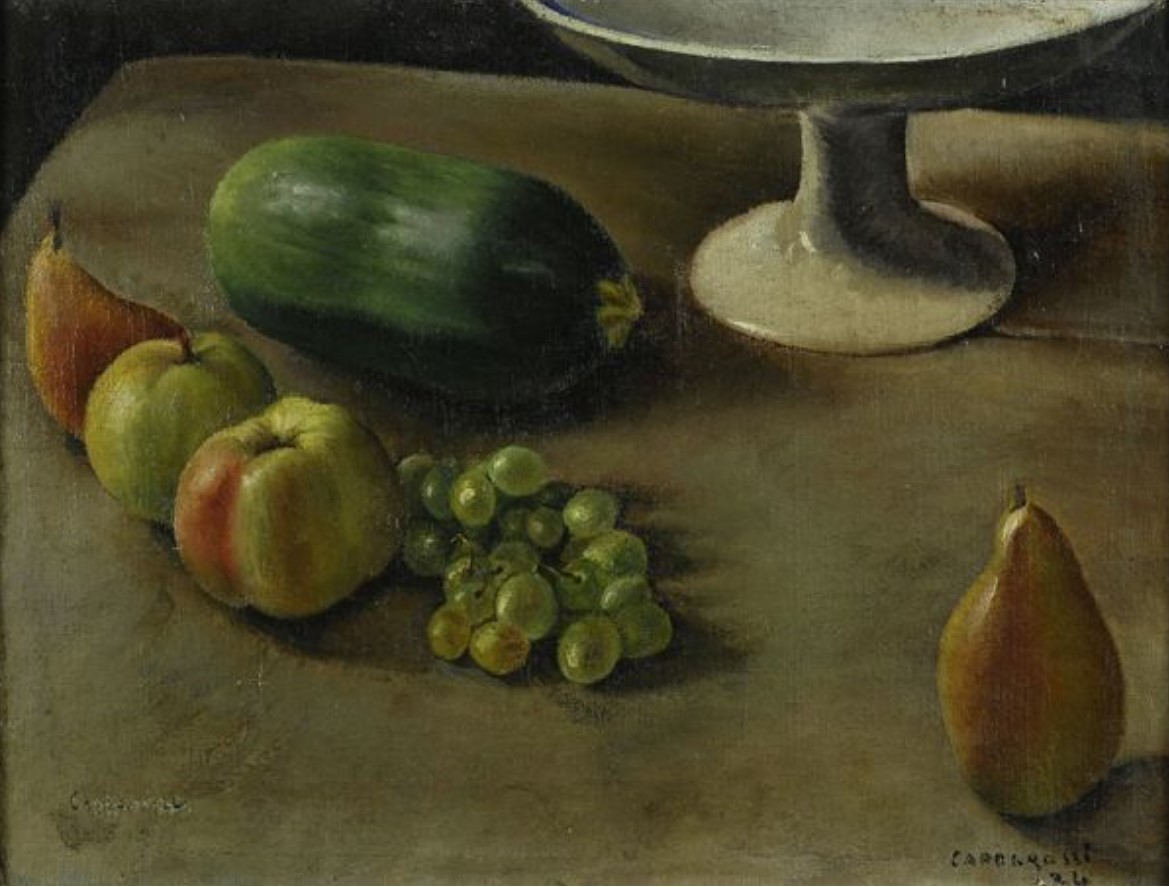
Natura morta is a still life painting by Giuseppe Capogrossi, completed in 1924. The work dates from the artist’s formative period, shortly after he abandoned his law studies in 1923–1924 to pursue painting formally at the Accademia di Belle Arti di Roma under the instruction of Felice Carena.
Capogrossi would become a significant figure in twentieth-century Italian art, later associated with the Scuola romana and advancing toward abstraction in the postwar years. This 1924 still life represents his engagement with figurative practice during the interwar decades, before his artistic direction shifted toward modernist abstraction in the 1950s.
About Giuseppe Capogrossi
Capogrossi was born in Rome in 1900. After obtaining his law degree, he committed himself to painting and studied at the Accademia di Belle Arti di Roma. In 1927 he travelled to Paris with fellow artist Fausto Pirandello, a journey that proved formative to his artistic development. Throughout the 1930s he participated in major exhibitions across Rome, Venice, Milan and Paris, gaining recognition within the Roman school movement. In 1933 he signed the Manifesto del Primordialismo Plastico, and in 1934 was selected for the Exhibition of Contemporary Italian Painting at the Western Art Museum in San Francisco. Following World War II, his work evolved toward abstraction, and in 1950 he co-founded Gruppo Origine with Mario Ballocco and Alberto Burri.
Details
- Creator: Giuseppe Capogrossi
- Year: 1924
- Genre: Still life (natura morta)
- Period: Italian interwar modernism, Roman school
On video
Explore more: 509 heritage places in Roma
Frequently asked questions
Who was Giuseppe Capogrossi?
Capogrossi (1900–1972) was an Italian painter born in Rome who initially studied law before turning to art at the Accademia di Belle Arti di Roma. He became associated with the Roman school in the 1930s and later transitioned to abstract painting, co-founding Gruppo Origine in 1950.
What period does this work represent in Capogrossi’s career?
This 1924 still life was painted early in Capogrossi’s artistic practice, shortly after he began formal study at the academy and before his 1927 formative trip to Paris. It represents his engagement with figurative subjects during the interwar years.
Why is this painting historically significant?
The work documents Capogrossi’s artistic beginnings within the context of Italian modernism and the Roman school movement of the 1920s and 1930s, before his later evolution toward abstraction became his defining characteristic.
Sources
- S1 — Pontiggia, Elena. Il Novecento Italiano. Abscondita, 2003. ISBN 978-88-8416-048-5.
- S2 — Ciucci, Giorgio. Gli architetti e il fascismo: architettura e città 1922-1944. Einaudi, 2002. ISBN 978-88-06-16310-5.
Spotted an error? Write to editorial@culturalheritageonline.com and we correct it the same day.


