
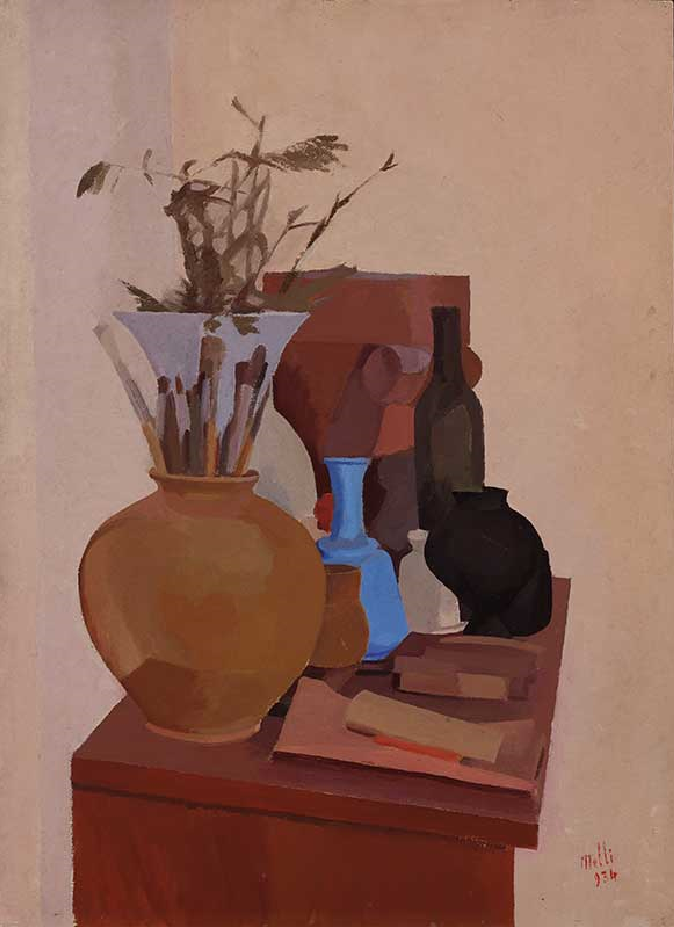
Composizione di oggetti is a still-life composition created by Roberto Melli in 1934. Melli (1885–1958) was an Italian painter and sculptor associated with the Scuola Romana, the influential artistic movement that emerged in Rome in the early twentieth century.
Melli’s career developed across multiple media and contexts. After initial training as an engraver and xylographer in Genoa, he relocated to Rome in 1910, where he participated in the first Scuola Romana exhibition in 1913. He maintained artistic independence while engaging with contemporary movements; in 1915 he co-founded the Gruppo Moderno Italiano alongside Vittorio Costantini, Cipriano Efisio Oppo, and Guglielmo Pizzirani, and contributed to the influential magazine Valori plastici in 1918. This work dates to a period of mature artistic practice, before his public activity was interrupted during the Fascist era.
About Roberto Melli
Born in Ferrara to a Jewish merchant family, Melli developed his artistic practice through apprenticeship and collaboration with fellow artists including painter Giorgio De Vincenzi and sculptor Giovanni Prini. His friendships with Giuseppe Capogrossi and Emanuele Cavalli, and his role in signing the Manifesto del Primordialismo Plastico, positioned him within a network of progressive artistic voices in twentieth-century Rome.
Details
- Artist: Roberto Melli
- Year: 1934
- Movement: Scuola Romana
- Medium: Painting (still life)
Frequently asked questions
Who was Roberto Melli?
Roberto Melli (1885–1958) was an Italian painter and sculptor active in the Scuola Romana. Born in Ferrara, he trained as an engraver and xylographer before moving to Rome in 1910, where he became a central figure in modern Italian art circles and co-founded the Gruppo Moderno Italiano.
What was the Scuola Romana?
The Scuola Romana was an influential artistic movement that began in Rome in 1913. Melli participated in its first exhibition and remained engaged with the group’s evolving practice throughout his career.
When was this work created?
This composition dates to 1934, a period of mature artistic production in Melli’s practice, before his public activity was interrupted during the Fascist era.
Sources
- S1 — Pontiggia, Elena. Il Novecento Italiano. Abscondita, 2003. ISBN 978-88-8416-048-5.
- S2 — Bossaglia, Rossana. Il Novecento italiano. Electa, 1995. ISBN 978-88-435-6178-0.
Spotted an error? Write to editorial@culturalheritageonline.com and we correct it the same day.


