
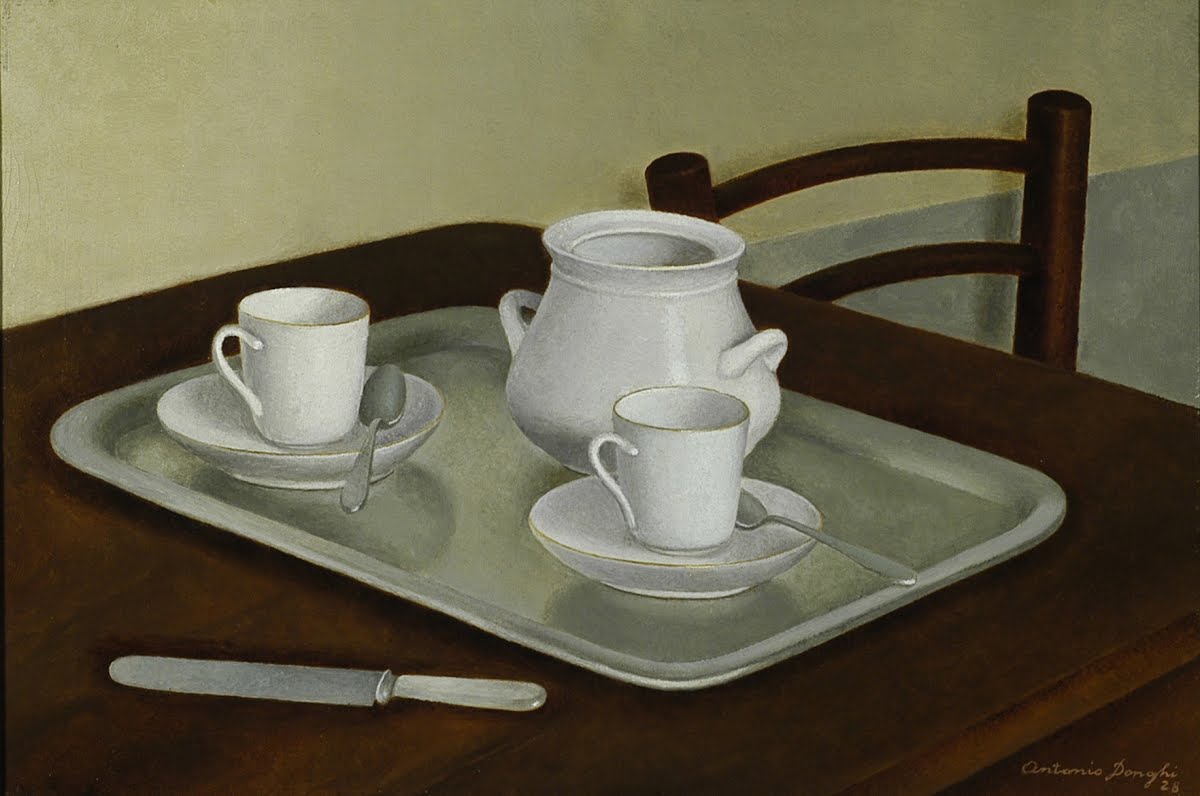
Still Life with Cups is a painting by Italian artist Antonio Donghi, completed in 1928. The work exemplifies Donghi’s refined approach to still-life composition during a period when he stood among Italy’s most accomplished figurative painters.
Donghi’s still lifes characteristically feature humble domestic objects arranged with deliberate symmetry and clarity. His compositions echo the disarming simplicity of naive art while demonstrating rigorous technical control. The artist favored strong compositional structure and spatial precision, qualities that aligned him with the neoclassical and magic realist tendencies emerging in Italy during the 1920s. Critics of the period drew parallels between Donghi’s work and that of Henri Rousseau and Georges Seurat, noting similar touches of subtle humor beneath scenes of contemporary life.
About Antonio Donghi
Born in Rome in 1897, Donghi studied at the Instituto di Belle Arti before establishing himself as a leading figure in Italy’s neoclassical movement after World War I. In 1925, critic Franz Roh identified him among the major Italian artists working in the magic realist tendency. The following year, Donghi won First Prize in an International Exhibit at the Carnegie Institute in Pittsburgh, cementing his international reputation at the height of his career.
Details
- Artist: Antonio Donghi
- Year: 1928
- Movement: Neoclassicism, magic realism
- Subject: Still life with domestic objects
On video
Frequently asked questions
Who was Antonio Donghi?
Antonio Donghi (1897–1963) was an Italian painter known for scenes of popular life, landscapes, and still lifes. He became one of Italy’s leading figures in the neoclassical movement of the 1920s and was recognized by critic Franz Roh as a major practitioner of magic realism.
What characterizes Donghi’s still-life paintings?
Donghi’s still lifes typically depict humble domestic objects such as small vases of flowers, arranged with disarming symmetry reminiscent of naive art while demonstrating extremely refined technique and strong compositional clarity.
What recognition did Donghi achieve during the 1920s?
In 1925, Franz Roh named Donghi among the major Italian artists in the new magic realism movement. In 1927, he won First Prize in an International Exhibit at the Carnegie Institute in Pittsburgh.


