
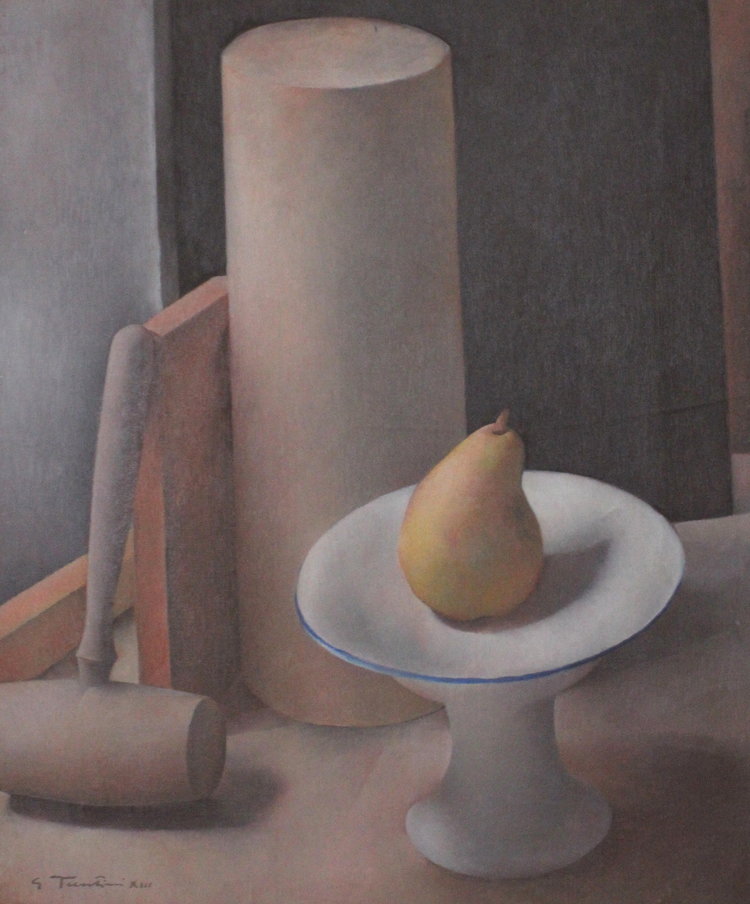
This still-life painting was created by Guido Trentini in 1935. Born in Verona in 1889, Trentini developed a distinctive artistic language that evolved significantly across his career, moving from postimpressionist influences toward a more restrained and synthetic approach.
The 1930s represented a mature phase in Trentini’s practice. By this decade, his work had shed the vibrant chromatic intensity of his youth in favor of a more austere and rigorous pictorial language. This compositional severity reflected broader artistic currents in interwar Italian painting, where simplified forms and controlled tonality became vehicles for visual expression.
About Guido Trentini
Trentini studied at the Accademia Cignaroli in Verona under Baldassare Longoni and Alfredo Savini. His encounter with Felice Casorati at the 1910 Venice Biennale marked a turning point, introducing decorative and symbolic dimensions to his work. In 1922, he won first prize at the Venice Biennale for his painting La Lettura (now in the Brussels Royal Museum). Appointed professor at the Accademia Cignaroli in 1924, he taught numerous students and remained active until his death in Verona in 1975.
Details
- Artist: Guido Trentini (1889–1975)
- Date: 1935
- Medium: Painting (still life)
- Movement: Italian Interwar period, characterized by simplified and rigorous composition
On video
Explore more: 35 heritage places in Verona
Frequently asked questions
Who was Guido Trentini?
Guido Trentini was an Italian painter born in Verona in 1889. A student of the Accademia Cignaroli, he won first prize at the 1922 Venice Biennale and later became a professor at his alma mater, teaching influential students including Renato Birolli.
How did Trentini’s style change over time?
In his early career, Trentini’s work showed postimpressionist influences and vibrant color. From the 1920s onward, his painting became progressively more austere, with simplified forms, synthetic composition, and a darker, more rigorous palette that characterized his mature work in the 1930s.
What is significant about the 1935 period in Trentini’s career?
By 1935, Trentini had fully established the restrained, structured approach that defined his interwar practice, moving away from the decorative chromaticism of his youth toward a more controlled and austere artistic language.
Sources
- S1 — Pontiggia, Elena. Il Novecento Italiano. Abscondita, 2003. ISBN 978-88-8416-048-5.
- S2 — Ciucci, Giorgio. Gli architetti e il fascismo: architettura e città 1922-1944. Einaudi, 2002. ISBN 978-88-06-16310-5.
Spotted an error? Write to editorial@culturalheritageonline.com and we correct it the same day.


