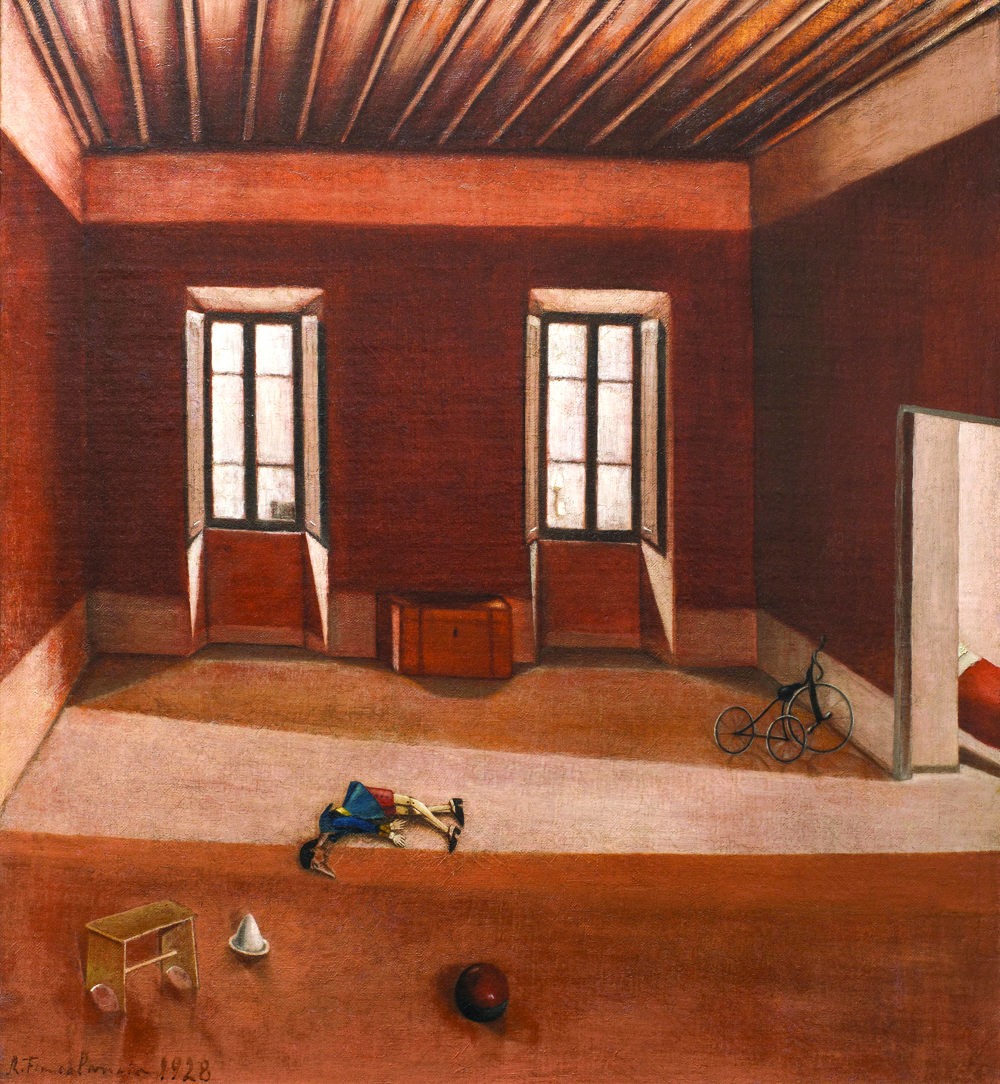
La stanza dei giochi is a painting by Riccardo Francalancia, created in 1928. Francalancia (1886–1965) was born in Assisi and became one of the most significant figures of the Valori Plastici movement, a major development in twentieth-century Italian art.
Francalancia was among the movement’s founders in the immediate postwar period. Gathered around the journal Valori Plastici, directed by critic Mario Broglio, the movement sought to move beyond Futurist polemic and replace nineteenth-century descriptive tendencies in Italian art by reviving the values of form understood as metaphysical volume in the manner of the quattrocento. The group included artists of the calibre of Giorgio de Chirico, Giorgio Morandi, and Carlo Carrà. From his early work, Francalancia demonstrated an inclination toward still lifes and landscapes of realistic character, which incorporated elements of primitivity.
About Riccardo Francalancia
Francalancia studied at the Collegio degli Scolopi in Spello and later at the Scuola diplomatico-coloniale of the University of Rome. Around 1910 he frequented Roman cultural circles, including those of the Bragaglia brothers and the Caffè Aragno, leading to his collaboration with the journal La Ronda. Critic Mario Broglio encouraged his artistic development throughout his career.
Details
- Creator: Riccardo Francalancia
- Year: 1928
- Movement: Valori Plastici
- Genre: Painting
On video
Frequently asked questions
Who was Riccardo Francalancia?
Riccardo Francalancia (1886–1965) was an Italian painter born in Assisi and a leading exponent of the Valori Plastici movement. He was one of the movement’s founders in the postwar period and worked primarily in still life and landscape painting.
What was the Valori Plastici movement?
Valori Plastici was an Italian art movement of the immediate postwar period, centred on a journal of the same name directed by Mario Broglio. It sought to restore classical form and quattrocento-inspired metaphysical volume to Italian art, moving away from nineteenth-century descriptivism and Futurist polemic.
What subjects did Francalancia paint?
Francalancia was known for still lifes and landscapes executed in a realistic manner, often incorporating elements of primitivity and demonstrating his commitment to formal clarity and volumetric construction.
Sources
- S1 — Pontiggia, Elena. Il Novecento Italiano. Abscondita, 2003. ISBN 978-88-8416-048-5.
- S2 — Ciucci, Giorgio. Gli architetti e il fascismo: architettura e città 1922-1944. Einaudi, 2002. ISBN 978-88-06-16310-5.
Spotted an error? Write to editorial@culturalheritageonline.com and we correct it the same day.