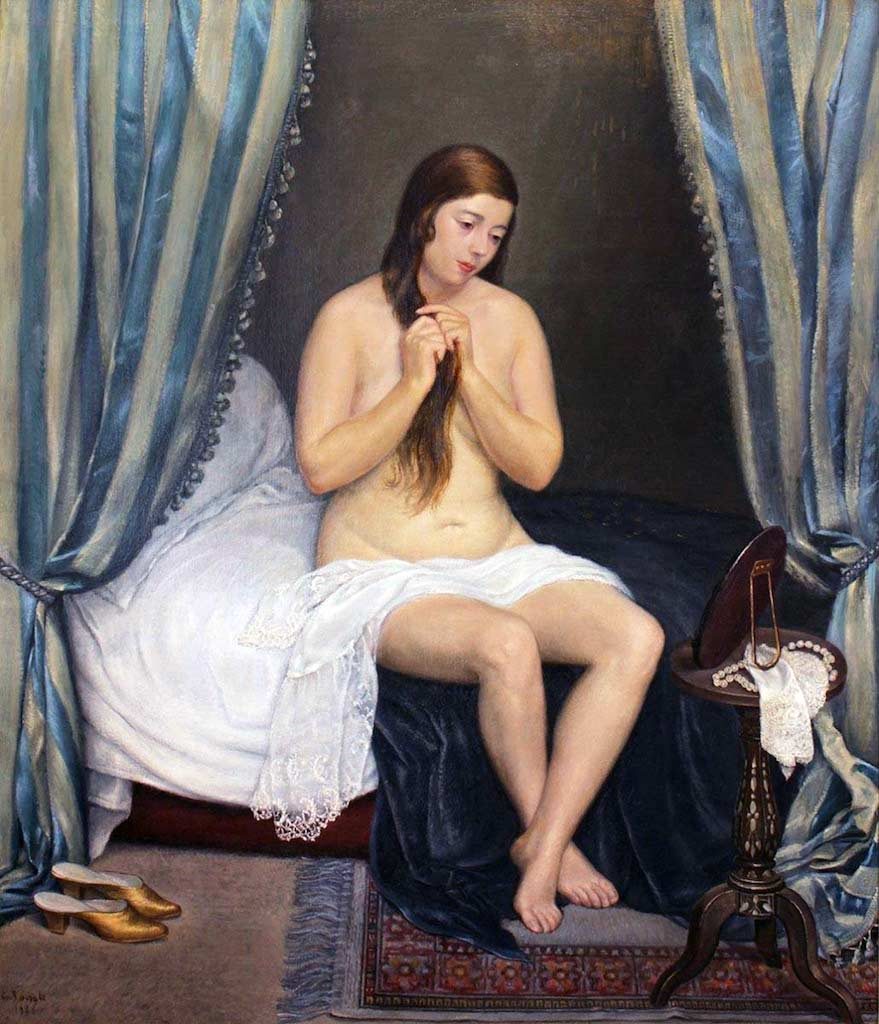
Danae is a painting by Carlo Socrate completed in 1929. Socrate was an Italian painter and scenographer whose career spanned the early and mid-twentieth century.
Socrate was born in Mezzana Bigli in 1889 and trained under painter Giovanni Costetti in Rome, where he encountered the work of French Impressionists and Post-Impressionists, particularly Paul Cézanne. His exposure to avant-garde movements was deepened through his work as a stage designer for Sergei Diaghilev’s Ballets Russes, where he collaborated with artists including André Derain and Pablo Picasso. These formative experiences shaped his approach to form, colour, and composition throughout his career.
The painting takes as its subject Danae, a figure from classical mythology. Socrate’s treatment of the mythological theme reflects the artistic currents of the period in which the work was created, during a moment of significant artistic experimentation in Italy.
About Carlo Socrate
Carlo Socrate (1889–1967) was an Italian painter and scenographer based primarily in Rome. His early training under Costetti connected him to Impressionist and Post-Impressionist traditions, while his work in theatre design and exposure to modernist practitioners informed his artistic practice throughout his life.
Details
- Artist: Carlo Socrate
- Year: 1929
- Subject: Mythological figure
- Medium: Painting
Frequently asked questions
Who was Carlo Socrate?
Carlo Socrate (1889–1967) was an Italian painter and stage designer born in Mezzana Bigli. He trained in Rome under Giovanni Costetti and worked as a scenographer for Sergei Diaghilev’s Ballets Russes, collaborating with modernist artists including Picasso and Derain.
What is the subject of the painting?
Danae is drawn from classical mythology. The work reflects Socrate’s engagement with traditional subjects filtered through early twentieth-century artistic innovation.
When was the painting created?
The painting dates to 1929, a period in which Socrate was working in Rome.
Sources
- S1 — Pontiggia, Elena. Il Novecento Italiano. Abscondita, 2003. ISBN 978-88-8416-048-5.
- S2 — Ciucci, Giorgio. Gli architetti e il fascismo: architettura e città 1922-1944. Einaudi, 2002. ISBN 978-88-06-16310-5.
Spotted an error? Write to editorial@culturalheritageonline.com and we correct it the same day.