
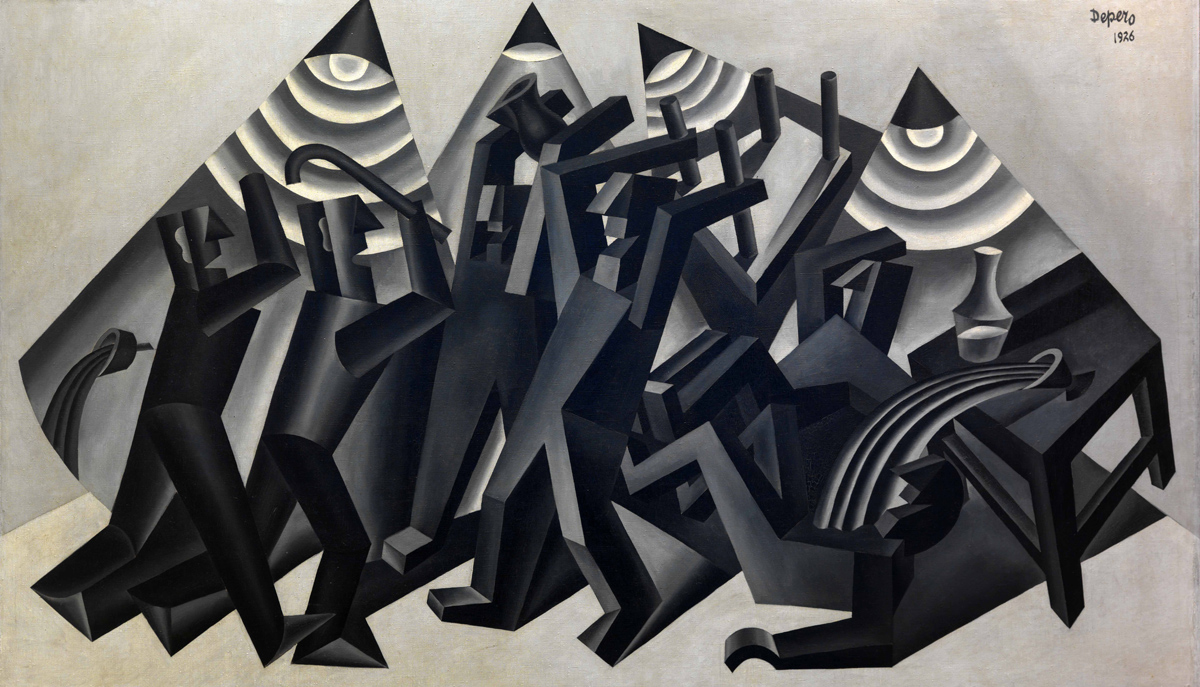
La Rissa is a painting created in 1926 by Fortunato Depero, an Italian Futurist painter, sculptor, writer, and graphic designer. The work reflects the Futurist movement’s preoccupation with dynamic abstraction and the transformation of natural forms into energetic visual equivalents.
Depero’s artistic practice developed within the radical contexts of early twentieth-century modernism. After discovering Futurism through a 1913 reading of Lacerba, he relocated to Rome in 1914 and worked with Giacomo Balla. In 1915, Depero co-authored the manifesto Ricostruzione futurista dell’universo (Futurist Reconstruction of the Universe), which articulated the movement’s ambition to create abstract equivalents for all forms and elements of the world, seeking to render the universe “more joyful” through comprehensive visual and formal recreation. This philosophical framework shaped his approach to painting, sculpture, and design throughout his career.
About Fortunato Depero
Born in 1892 in the Trentino region (then part of the Austro-Hungarian Empire), Depero grew up in Rovereto, where he began exhibiting work while apprenticed to a marble worker. His exposure to Futurist theory proved transformative, establishing his identity as a central figure in the movement’s development and its expansion beyond painting into theatre, costume design, and graphic arts.
Details
- Created: 1926
- Creator: Fortunato Depero
- Movement: Italian Futurism
- Medium: Painting
On video
Frequently asked questions
Who created La Rissa?
Fortunato Depero, an Italian Futurist painter, sculptor, and graphic designer born in 1892, created the work in 1926.
What artistic movement does this work belong to?
La Rissa exemplifies Italian Futurism, a movement Depero engaged with after 1913 and developed further through the 1915 manifesto Ricostruzione futurista dell’universo, which he co-authored with Giacomo Balla.
What was Depero’s artistic philosophy?
Depero sought to create abstract equivalents for all forms and elements of the universe, aiming to make the world “more joyful” through integral visual and formal reconstruction—a principle central to his painting, sculpture, and design work.
Sources
- S1 — Menegazzi, Luigi. Il manifesto italiano: 1882-1925. Electa, 1995. ISBN 978-88-435-5134-7.
- S2 — De Fusco, Renato. Storia del design. Laterza, 2002. ISBN 978-88-420-6623-1.
Spotted an error? Write to editorial@culturalheritageonline.com and we correct it the same day.


