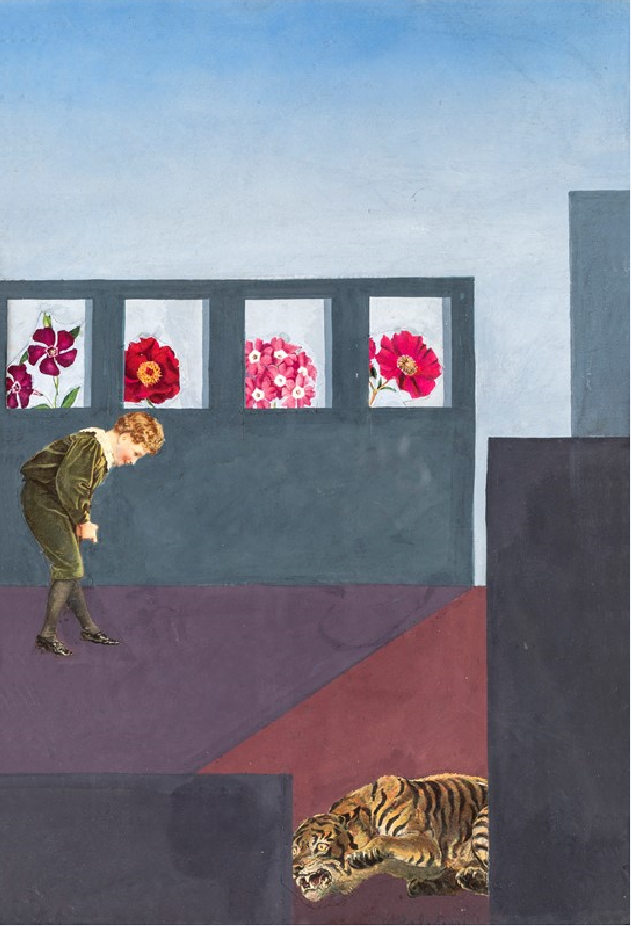
Il bambino e la tigre is a painting created by Vinicio Paladini in 1925. The work was made during a pivotal moment in the artist’s career, following his departure from the Futurist movement in 1923 and preceding his development of the Imaginist movement in the second half of the decade.
Paladini, born in Moscow in 1902 to an Italian father and Russian mother, had relocated to Rome by 1903. In the early 1920s, he engaged with Futurism through the lens of socialist theory, collaborating closely with Ivo Pannaggi on experimental works including the “Futurist Mechanical Dance” staged in 1922. Their shared “Manifesto of Futurist Mechanical Art” sought to theorize connections between industrial labour and artistic innovation. When Filippo Tommaso Marinetti reworked and republished the manifesto in 1923 while publicly embracing Fascism, Paladini publicly disavowed the revised version and left the movement.
About Vinicio Paladini
Paladini was an Italian architect, painter, and art theorist whose career spanned multiple avant-garde movements. His work reflected engagement with both European modernism and Soviet artistic theories, positioning him as a significant if unconventional figure in interwar Italian culture.
Details
- Creator: Vinicio Paladini (1902–1971)
- Date: 1925
- Movement: Transition from Futurism to Imagism
Frequently asked questions
Who was Vinicio Paladini?
Vinicio Paladini was an Italian architect, painter, and art theorist born in Moscow in 1902. He was associated with Futurism in the early 1920s before departing from the movement in 1923 and subsequently developing the Imaginist movement.
Why did Paladini leave Futurism?
Paladini departed from Futurism in 1923 after Filippo Tommaso Marinetti republished and substantially reworked the “Manifesto of Futurist Mechanical Art” that Paladini had co-signed. Paladini publicly disavowed Marinetti’s revised version, and Marinetti’s public embrace of Fascism contributed to their ideological divergence.
What artistic direction did Paladini pursue after Futurism?
In the second half of the 1920s, Paladini launched the Imaginist movement, which represented a new phase in his artistic practice distinct from his earlier Futurist engagement.
Sources
- S1 — Pontiggia, Elena. Il Novecento Italiano. Abscondita, 2003. ISBN 978-88-8416-048-5.
- S2 — Menegazzi, Luigi. Il manifesto italiano: 1882-1925. Electa, 1995. ISBN 978-88-435-5134-7.
Spotted an error? Write to editorial@culturalheritageonline.com and we correct it the same day.