
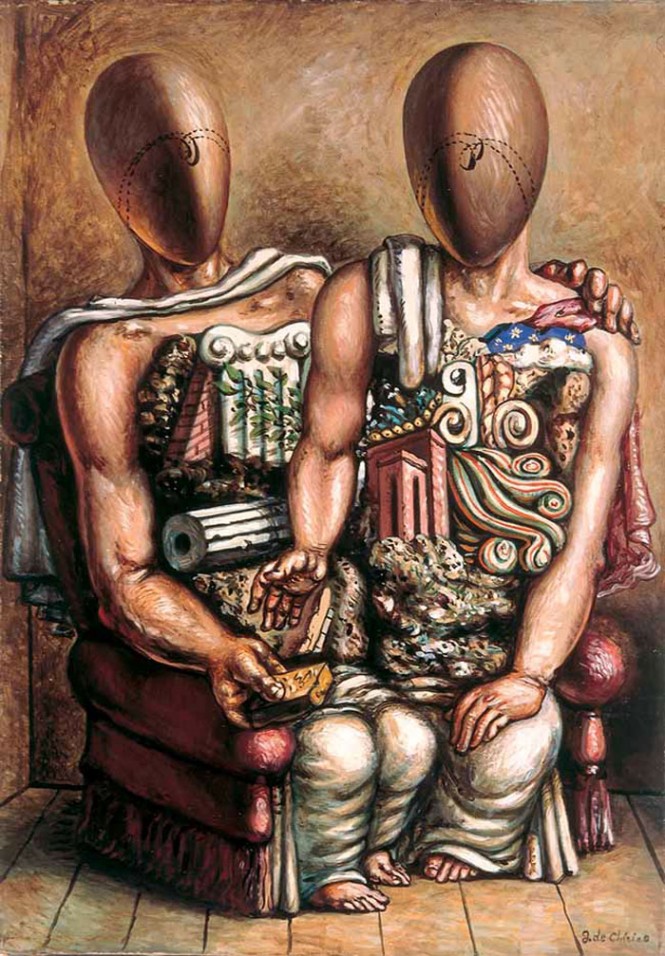
Archeologi is a painting by Giorgio de Chirico, created in 1936. De Chirico, a Greek-Italian artist and writer born in Volos, Greece, founded the Metaphysical Art movement in the years before World War I, work that would profoundly influence the Surrealists. His paintings characteristically employ Roman arcades, elongated shadows, mannequins, trains, and unsettling perspective to construct dreamlike, philosophically charged spaces.
De Chirico’s visual vocabulary drew from his study of Arthur Schopenhauer and Friedrich Nietzsche, as well as the classical mythology of his Greek birthplace. Archeologi, like much of his oeuvre from this period, invokes archaeological themes and the weight of historical memory through composition and symbolic form. The painting exemplifies the artist’s sustained exploration of space, temporality, and the rational order underlying human perception.
About Giorgio de Chirico
De Chirico was a prolific painter and writer whose Metaphysical Art movement emerged as a decisive influence on twentieth-century modernism. His philosophical approach to painting, rooted in classical imagery and contemporary anxiety, established a visual language that bridged Renaissance perspective with modern alienation.
Details
- Artist: Giorgio de Chirico
- Year: 1936
- Movement: Metaphysical Art
- Medium: Painting
On video
Frequently asked questions
Who was Giorgio de Chirico?
Giorgio de Chirico was a Greek-Italian artist and writer born in Volos, Greece. He founded the Metaphysical Art movement before World War I, whose influence extended to Surrealism and modern painting broadly.
What is Metaphysical Art?
Metaphysical Art is the movement de Chirico founded, characterized by enigmatic spaces, classical architectural elements, mannequins, and illogical perspective designed to evoke philosophical inquiry and psychological unease.
What themes appear in de Chirico’s work?
De Chirico’s paintings often feature Roman arcades, long shadows, trains, and mannequins arranged in dreamlike compositions. His imagery reflects his engagement with Schopenhauer and Nietzsche, and the classical mythology of his Greek heritage.
Sources
- S1 — Pontiggia, Elena. Il Novecento Italiano. Abscondita, 2003. ISBN 978-88-8416-048-5.
- S2 — Bossaglia, Rossana. Il Novecento italiano. Electa, 1995. ISBN 978-88-435-6178-0.
Spotted an error? Write to editorial@culturalheritageonline.com and we correct it the same day.


