
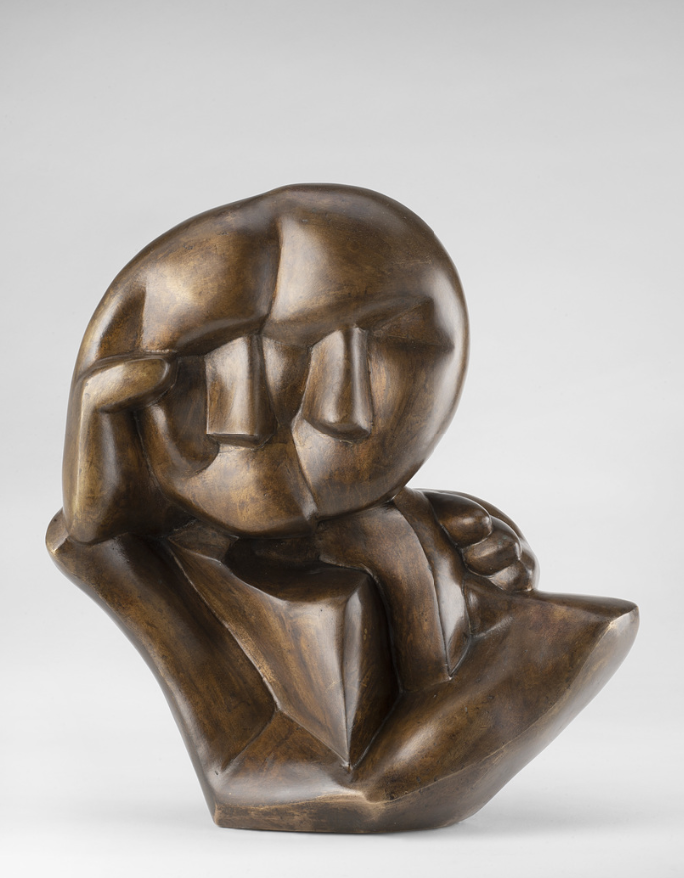
Doppio volto is a sculpture by Mino Rosso, created circa 1931. The work represents the artist’s sculptural synthesis achieved through rhythmic interpenetration of volumes and the interplay of solid and void forms.
Rosso was a leading figure in Turin’s Futurist circle from 1926, working alongside Fillia, Ugo Pozzo, and other avant-garde artists. His Paris years brought direct contact with modernist sculptors and painters including Ossip Zadkine, Fernand Léger, and Gino Severini, significantly shaping his aesthetic approach. His sculptural practice during this period combined architectural rigor with Futurist dynamism, emphasizing spatial complexity through formal relationships rather than representational narrative.
About Mino Rosso
Mino Rosso (1904–1963) was an Italian sculptor and painter born in Castagnole Monferrato and active primarily in Turin. He participated in major exhibitions including the Venice Biennale (1930, 1932, 1936, 1938, 1940, 1960) and the Rome Quadriennale (1931, 1935). After World War II, he turned increasingly toward painting, exploring geometric form and expressionist intimacy while maintaining Futurist principles.
Details
- Artist: Mino Rosso
- Date: circa 1931
- Medium: Sculpture
- Movement: Italian Futurism
- Exhibition history: Participated in Venice Biennale and Rome Quadriennale during the 1930s
Frequently asked questions
Who was Mino Rosso?
Mino Rosso (1904–1963) was an Italian sculptor and painter who joined Turin’s Futurist group in 1926 and exhibited internationally at the Venice Biennale and Rome Quadriennale throughout the 1930s and beyond.
What artistic approach defines Doppio volto?
The work exemplifies Rosso’s sculptural philosophy of architectural synthesis through rhythmic interpenetration of volumes and the dynamic interplay between solid forms and void spaces.
How did Paris influence Rosso’s practice?
During his time in Paris, Rosso engaged directly with major modernist artists including Zadkine, Léger, and Severini, experiences that strengthened his formal vocabulary and international artistic perspective.
Sources
- S1 — Panzetta, Alfonso. Dizionario degli scultori italiani dell'Ottocento e del primo Novecento. Umberto Allemandi, 2003. ISBN 978-88-422-1158-7.
- S2 — Bossaglia, Rossana. I maestri della scultura italiana del primo Novecento. Electa, 1997. ISBN 978-88-435-6178-0.
Spotted an error? Write to editorial@culturalheritageonline.com and we correct it the same day.


