
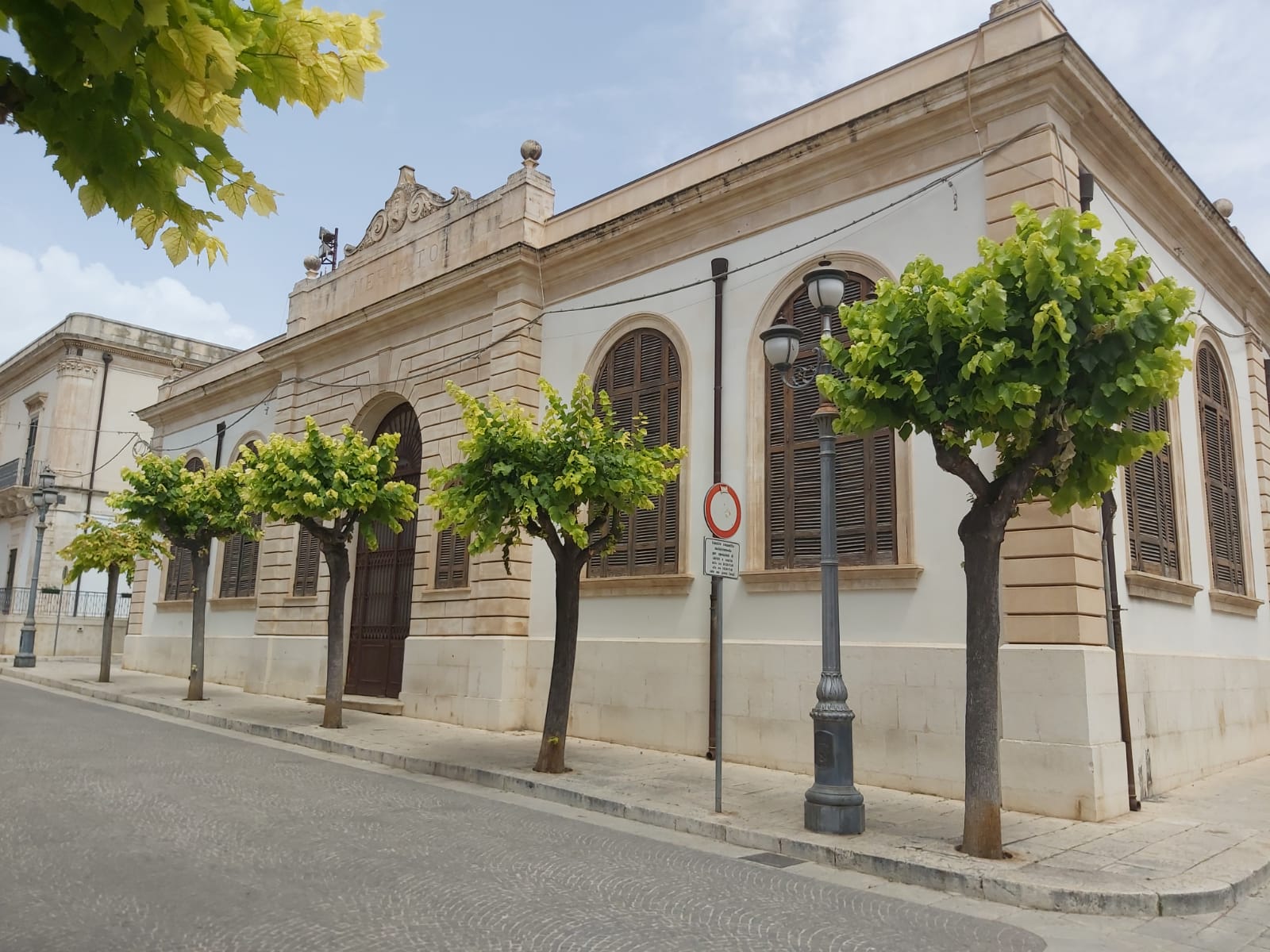
Ispica’s covered market went up over the first three decades of the twentieth century and was finished in 1932, one of the social buildings the regime placed at the centre of small Sicilian towns. The plan states its purpose plainly: rooms for craft workshops and shops, arranged around a porticoed court of about 600 square metres, on the pattern of the market at Ortigia in Syracuse.
Then the town grew and trade moved elsewhere. The market lost the role it had been built for, was abandoned, and without maintenance the fabric decayed.
A second life as a study centre
The 1980s brought recovery and conversion: the building became a Centro Studi Polivalente. Mezzanines of wood and iron were slotted into the corner rooms of the portico and the side rooms, which were tall enough to take a second level, and the recovered spaces became exhibition rooms and small conference halls. The central court was roofed with a tubular metal frame carrying plexiglass panels, so the whole building could be used in winter, and a rainwater system was laid at the same time. The portico itself later served as a permanent exhibition space, and part of the complex was given over to the municipal police.
Damage, and a restoration that undid the 1980s
A tornado struck in 2002. In September 2003 the flood that hit south-eastern Sicily across the provinces of Siracusa and Catania did further damage and left the roof precarious, and the building was abandoned a second time.
The restoration that followed was carried out under the post-earthquake law 433/1991 and aimed at seismic improvement. The iron-and-wood mezzanines came out, giving the rooms their original height back. The perimeter walls and the corner heads were consolidated, and eight tie-rods were inserted and grouted into place. The roof was rebuilt with Sicilian tiles, the rainwater channels were recessed into the thickness of the wall, and the degraded stonework was restored. In the court, the clouded plexiglass was replaced and a sliding section added so that air can move through the building in summer.
Details
- Finished: 1932, after construction spread across the first three decades of the century
- Where: Ispica, province of Ragusa, Sicily
- Size and model: about 600 square metres, on the pattern of the Ortigia market in Syracuse
- Original use: covered market with craft workshops and shops
- Later uses: Centro Studi Polivalente from the 1980s; exhibition space; municipal police offices
- Restoration: seismic improvement under law 433/1991, after the 2002 tornado and the 2003 flood
Frequently asked questions
When was the market built?
Construction ran through the first thirty years of the twentieth century and was completed in 1932.
What was changed in the 1980s, and why was it removed?
The 1980s conversion inserted wood-and-iron mezzanines to create exhibition and conference rooms. The later restoration took them out to return the interiors to their original height.
What is the building used for now?
It has served as a multipurpose centre for culture, meetings and commercial activity; part of it has also housed municipal police offices.
Sources
- S1 — Trigilia, Lucia. L'architettura del Novecento in Sicilia orientale. Lombardi Editore, 1992. ISBN 978-88-8094-012-8.
- S2 — Nifosì, Paolo. Ispica tra barocco e liberty: architettura e paesaggio. Edizioni Kalós, 2006. ISBN 978-88-89224-27-4.
Spotted an error? Write to editorial@culturalheritageonline.com and we correct it the same day.


