
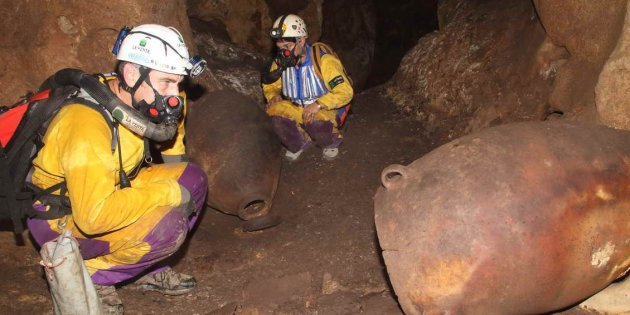
Excavations conducted in Sicily’s Monte San Calogero region, reported in January 2019, have revealed traces of wine dating to 6000 BCE, fundamentally challenging existing understanding of prehistoric Sicily and Mediterranean culture. The discovery was made by a team of archaeologists led by Davide Tanasi of the University of South Florida, who documented the findings in an article published in The Conversation titled “Prehistoric Wine Discovered in Inaccessible Caves Forces Rethinking of Ancient Sicilian Culture.”
The Discovery and Its Significance
Within the caves of Monte Kronio, located in the province of Agrigento, archaeologists found jars and vessels containing traces of wine from the Copper Age. Analysis of samples using modern scientific techniques confirmed the presence of alcoholic liquid, making this Sicilian wine the oldest known in Europe and the entire Mediterranean region. Previously, researchers believed the earliest wine production originated in southern Anatolia and the Transcaucasian region. This discovery displaces that assumption, establishing Italy—specifically Sicily—as the first region in the Western world where wine was cultivated.
Implications for Prehistoric Society
The findings necessitate substantial revision of current understanding regarding prehistoric agriculture and commerce. Scholars had doubted that Copper Age Sicilians possessed irrigation techniques adequate for grape cultivation. The wine’s presence also suggests the existence of advanced trade networks during this period. Sicilians, despite living on an island poor in raw metals, possessed numerous metal artifacts by 6000 BCE. These items, likely sourced from the Peloponnese and regions where metals were manufactured, would have been exchanged for Sicilian wine—indicating a sophisticated economic system far more developed than previously believed.
Religious and Cultural Context
The presence of wine in the caves of Monte Kronio supports the hypothesis that the site functioned as a prehistoric sanctuary where divination and purification rituals were performed. This interpretation aligns with ancient Greek tradition: in Homer’s epics, wine is represented as a magical substance capable of altering human consciousness. The archaeological evidence, combined with environmental conditions in the caves—where humidity regularly reaches 100 percent and temperatures climb to 37 degrees Celsius—reveals that inhabitants occupied these cavities as early as 6000 BCE and maintained sophisticated cultural practices far removed from common perceptions of primitive life.
Explore more: 20 heritage places in Agrigento
Frequently asked questions
How old is the wine discovered in Sicily?
The wine discovered at Monte San Calogero dates to 6000 BCE, making it 8000 years old and the oldest known wine in Europe and the Mediterranean region.
Who led the archaeological team that made this discovery?
The excavation team was led by Davide Tanasi of the University of South Florida, working in caves in the province of Agrigento.
What does this discovery reveal about Bronze Age trade?
The presence of metal artifacts in metal-poor Sicily suggests that wine was traded in exchange for manufactured goods from regions like the Peloponnese, indicating advanced commercial networks existed in the Copper Age.


