
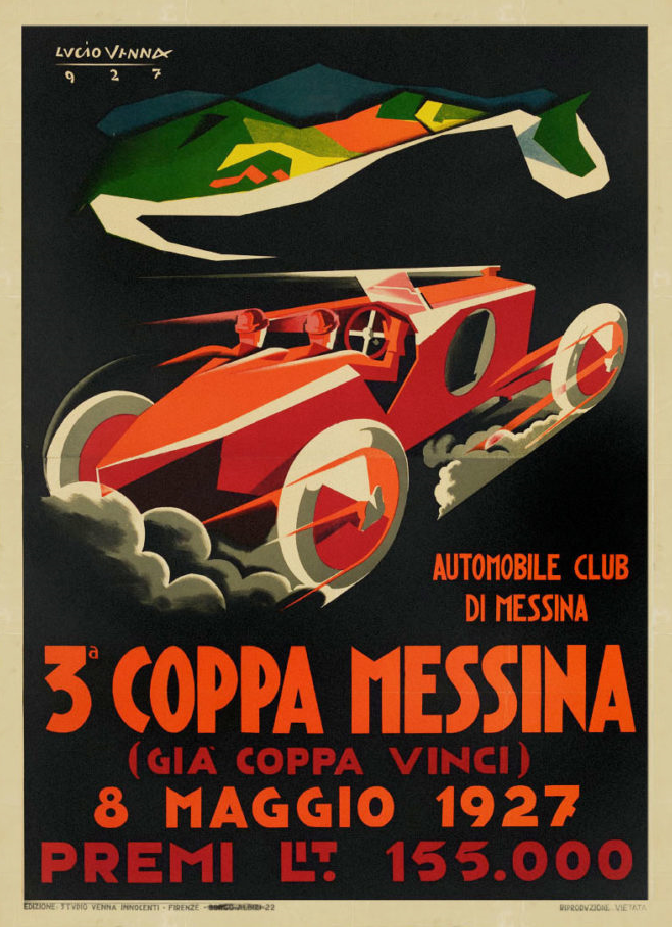
This advertising poster was created by Lucio Venna in 1927. Venna, the pseudonym of Giuseppe Landsmann (1897–1974), was an Italian painter and exponent of the Futurist movement.
Born in Venice on 28 December 1897, Venna left his native city at fifteen to pursue painting. He arrived in Florence in May 1912, where he came under the influence of painter Emilio Notte in 1913. Notte became his mentor and lifelong collaborator, initiating Venna into artistic practice during the city’s dynamic cultural moment. Venna remained active in the Futurist movement through his career, working across painting and commercial graphic design.
About Lucio Venna
Venna adopted his artistic pseudonym early in his Florentine period. He maintained a productive relationship with Emilio Notte that shaped his artistic direction. His work spanned both fine art and applied commercial design, reflecting the Futurist interest in integrating art with modern visual culture.
Details
- Creator: Lucio Venna (pseudonym of Giuseppe Landsmann)
- Year: 1927
- Object type: Advertising poster
- Movement: Futurism
- Birth: Venice, 28 December 1897
- Death: Florence, 4 September 1974
Frequently asked questions
Who was Lucio Venna?
Lucio Venna was the artistic pseudonym of Giuseppe Landsmann, an Italian painter and Futurist exponent born in Venice in 1897. He moved to Florence at fifteen and studied under painter Emilio Notte beginning in 1913.
What movement did Venna belong to?
Venna was an exponent of Futurism, the Italian avant-garde movement. He remained active in this movement throughout his career, which extended until his death in Florence in 1974.
What types of work did Venna create?
Venna worked in both fine art and commercial graphic design, including advertising posters such as this 1927 example, reflecting the Futurist interest in applying modern artistic principles to everyday visual culture.
Sources
- S1 — Menegazzi, Luigi. Il manifesto italiano: 1882-1925. Electa, 1995. ISBN 978-88-435-5134-7.
- S2 — De Fusco, Renato. Storia del design. Laterza, 2002. ISBN 978-88-420-6623-1.
Spotted an error? Write to editorial@culturalheritageonline.com and we correct it the same day.


