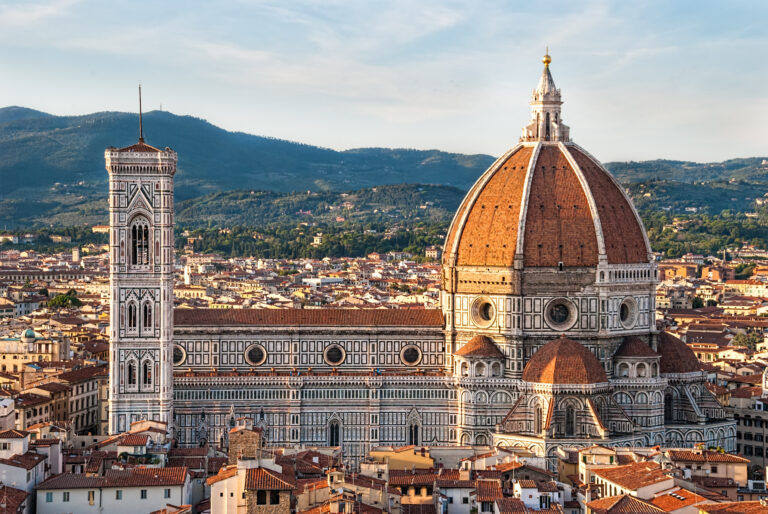
Eleven stops in 8.1 kilometres on a flat island: ceramic-clad hotels from the Belle Époque, the Rationalist buildings of the film festival, a 1915 airfield and the oldest Jewish cemetery in Europe.
An island with two seasons of style
The Lido is eleven kilometres of sandbar between the lagoon and the Adriatic, and for about forty years it was the address where Europe took its summer. The hotels went up first, between 1900 and 1913, in the Liberty idiom with ceramic and iron. Then the film festival arrived in 1932 and the municipality built it a permanent home, which is where the island’s second architecture comes from: Rationalist travertine, 1936 to 1938, on the site of an old Austrian fort. Between the two runs a flat, walkable strip 8.1 kilometres long, and the roadbook collects eleven stops along it, from the vaporetto landing to the airfield at the northern end.
The hotel with a ceramic skin
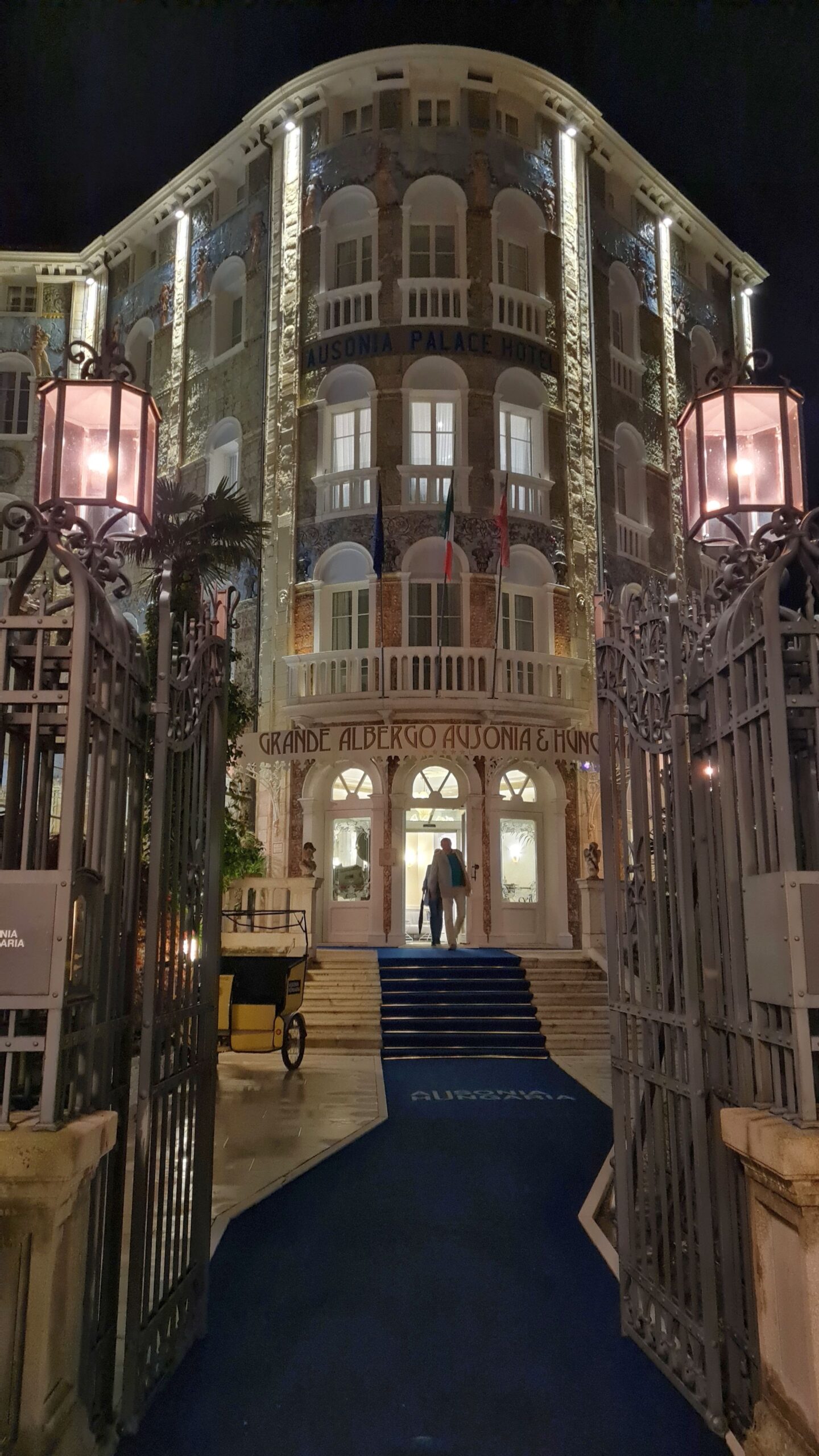
Ausonia & Hungaria stands on the Gran Viale Santa Maria Elisabetta, the boulevard that runs from the vaporetto stop to the beach, and it is the first thing that tells you what the Lido was for. The hotel opened in 1907; the exterior was completed in 1913 by the ceramist Luigi Fabris of Bassano, who covered the facade in glazed panels, and the Liberty interiors followed the same programme. It is still a five-star hotel, which means the exterior is best seen from the street and the inside from the lobby.
A few minutes away, Villa Margherita shows the residential version of the same moment: a compact four-storey block, 245 square metres to the floor, twelve metres high, crowned by a terrace roof with a columned balustrade, an ovoid window at the centre of the main facade and mixtilinear decoration around the windows. It is the kind of house that the Lido’s professional and mercantile families built once the hotels had made the island respectable.
The hotel that made the Lido fashionable
Hotel Excelsior, completed in 1908 to designs by Giovanni Sardi, is the building usually credited with turning the Lido from a strip of fishing villages and farms into the seasonal address of Mitteleuropean leisure. The vocabulary is Italian Liberty with a Moorish revival accent — arches, glazed tilework, four hundred rooms facing the sea — and by 1912 the island was the canonical Adriatic resort. The Excelsior also anchored the film festival from its foundation in 1932, and the Sala Grande and the seafront terraces are still the social centre of the first days of September. It operates as a Marriott Luxury Collection hotel; the lobby and the seafront promenade are open to non-guests.
Grand Hotel des Bains, opened on 5 July 1900 by the brothers Raffaello and Francesco Marsich, is the other half of that story. Thomas Mann stayed in the summer of 1911 and left with the notes for Death in Venice; Visconti filmed the novella here in 1971. The hotel has been closed since 2010, its conversion into flats interrupted, with a restoration of about two hundred million euros announced in 2025 by COIMA and Eagle Hills.

The festival, built in travertine
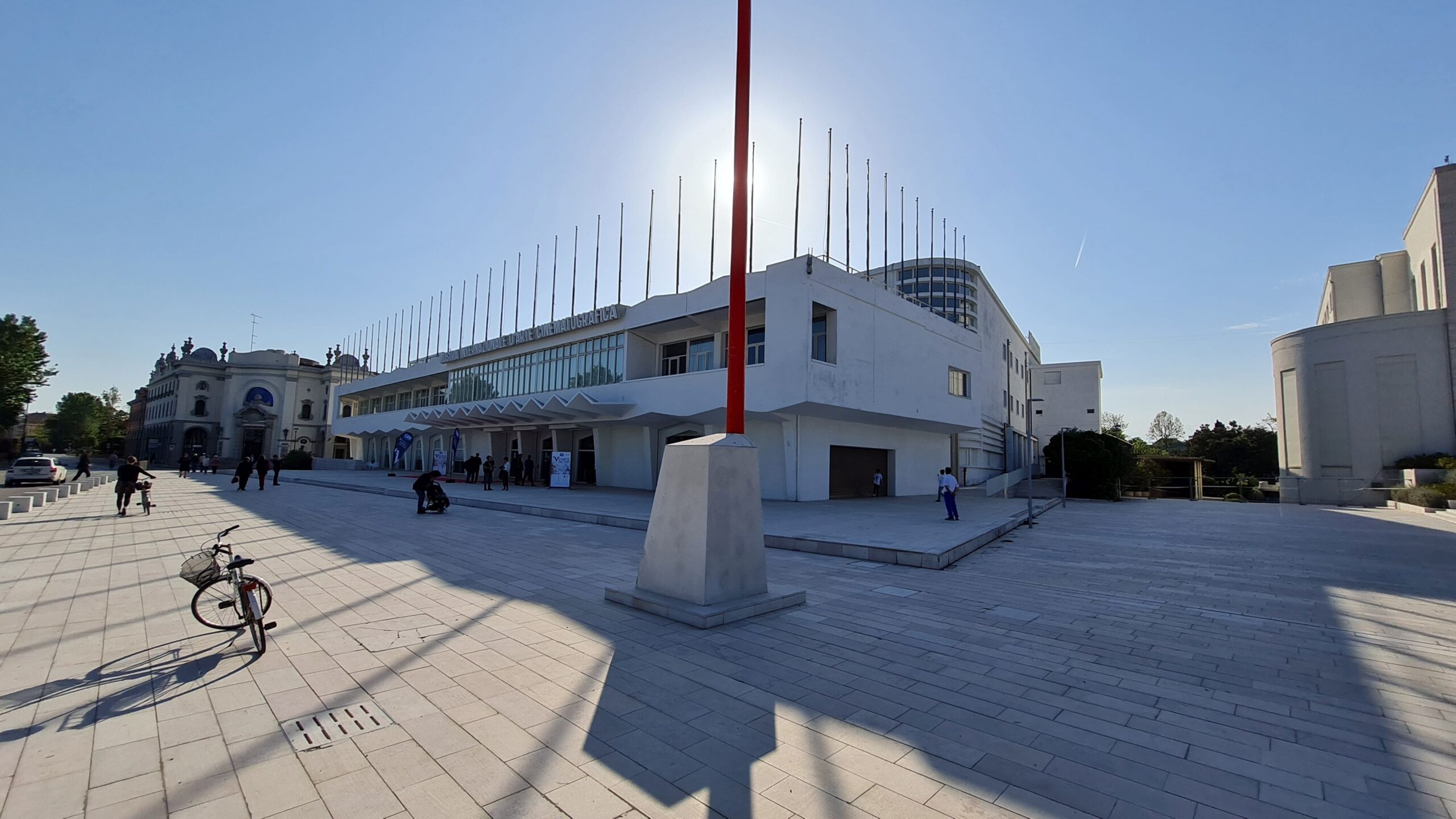
The Palazzo del Cinema was commissioned in the mid-1930s because the Mostra, founded in 1932 on the terrace of the Excelsior, had outgrown its improvised setting. Luigi Quagliata designed it in 1936 within the urban framework set by Eugenio Miozzi, the city’s chief engineer, and it opened on 10 August 1937 on ground previously occupied by the Austrian Fort of the Quattro Fontane. The Sala Grande seats 1,032; the building was expanded by Quagliata himself in 1952 and is still the permanent venue of the festival.
Next to it, the Palazzo del Casinò was Miozzi’s own project, 1936 to 1938: the centre of a symmetrical three-building ensemble facing the Adriatic, with the cinema on one side and a mirror block on the other, all of it on the site of the dismantled fort. The casino opened shortly after the cinema, became the summer gaming house of the city, and is now the Venice Congress Centre, which the festival still uses every year. The travertine front, with its central portal of four fluted pilasters, is the most photographed wall on the island after the hotels.
The older island underneath
Two stops sit outside the resort story. The Jewish Cemetery on the Riviera San Nicolò was established between 1386 and 1389, when the Venetian republic granted the community burial rights on the Lido, and it remained the only Jewish burial ground in the republic for about four centuries. Its Hebrew name, Bet Ha-Chajim, means House of Life. The tombstones, in Romanesque, Baroque and classicising forms, are the oldest surviving Jewish funerary material in the lagoon.
The Barracks Guglielmo Pepe belong to the same older layer: the Lido was a military site long before it was a resort. Doge Enrico Dandolo housed roughly forty thousand Crusaders here in 1202 during the Fourth Crusade; Vettor Pisani built earthworks and wooden towers in the Chioggia War of 1378–79 to block the Genoese; the compound as it stands dates from 1591, and the Turkish threat of the early sixteenth century had already rebuilt the older Castel Vecchio opposite Sant’Andrea into a crenellated stronghold. The army stayed until the twentieth century, which is why the island’s northern end still feels emptier than the beachfront.
The airfield at the end
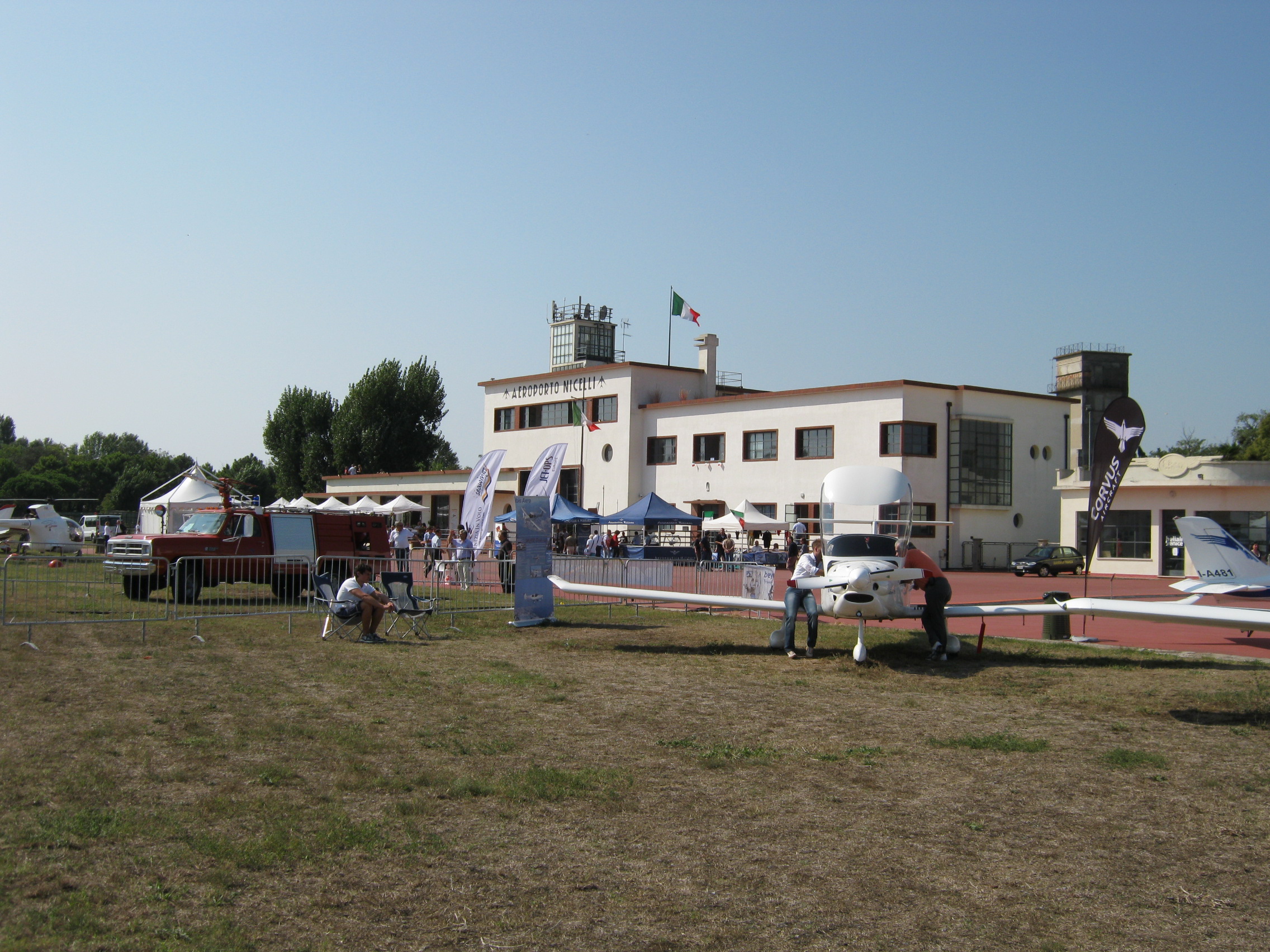
Venice-Lido Airport opened in 1915 for the aerial defence of the lagoon, one of the oldest surviving aerodromes in Italy, and took the name of Giovanni Nicelli, a decorated ace of the First World War. Between the wars it hosted air races and exhibitions, and it was known as Venice-San Nicolò before the renaming. Small aircraft still use it, and the terminal — with its sign, its cylindrical glazed control tower and the curved brick ramp winding around its base — is a piece of 1930s aviation architecture that has survived almost intact because the airfield never grew.
Walking the island
The order on the Lido itinerary page runs from the Gran Viale northwards and back along the seafront, 8.1 kilometres and about three and a half hours at an easy pace: the two ceramic hotels, the Excelsior, the des Bains, the cemetery and the barracks, the two festival buildings and the airfield, with the villas between them. The island is flat throughout, buses run along the Gran Viale, and the vaporetto from Venice lands at Santa Maria Elisabetta, which is the natural start. The Excelsior and the Ausonia are working hotels: the exteriors are for everyone, the interiors for guests.
Sources
- Ausonia Hungaria · https://culturalheritageonline.com/places/ausonia-hungaria/
- Villa Margherita · https://culturalheritageonline.com/places/villa-margherita/
- Jewish Cemetery of Venice · https://culturalheritageonline.com/places/jewish-cemetery-of-venice-judischer-friedhof-universitas-judeorum/
- Venice-Lido Giovanni Nicelli Airport · https://culturalheritageonline.com/places/aeroporto-di-venezia-lido-giovanni-nicelli/
- Barracks Guglielmo Pepe · https://culturalheritageonline.com/places/barracks-guglielmo-pepe/
- Grand Hotel des Bains · https://culturalheritageonline.com/places/grand-hotel-des-bains/
- Hotel Excelsior Venezia Lido · https://culturalheritageonline.com/places/hotel-excelsior-lido-venezia/
- Palazzo del Casinò del Lido di Venezia · https://culturalheritageonline.com/places/palazzo-del-casino-lido-venezia/
- Palazzo del Cinema del Lido di Venezia · https://culturalheritageonline.com/places/palazzo-cinema-lido-venezia-quagliata/
- Liberty and Rationalist Architecture in Venice Lido · https://culturalheritageonline.com/itineraries/liberty-rationalist-architecture-venice-lido/
Spotted an error? Write to [email protected] and we correct it the same day.