

Curated Itinerary
Art Déco in New York: A Walking Tour of Midtown
Six Art Deco buildings between Grand Central and 57th Street: the Helmsley Building, the Chrysler, the Daily News Building, 30 Rockefeller Plaza, Radio City and the Fuller Building.
Take this route into Google Maps
From Helmsley Building / New York Central Building (1929), 230 Park Avenue, Midtown Manhattan, New York to Fuller Building (1929), New York, in the order we curated them.
➤ Turn on the navigator in Google MapsIt opens in the Google Maps app with every stop already loaded, in the order we put them in. From there the route is yours: pick how you travel — on foot, by bike, by public transport or by car — change where you start and where you end, drag the stops into a different order, and add places of your own along the way.
Midtown holds the densest run of Art Deco in the world, and it fits in a single walk: from Park Avenue through Grand Central to Rockefeller Center, with the Chrysler on the way.
What you see
Start at the Helmsley Building (Warren & Wetmore, 1929), the 35-storey block that straddles Park Avenue and closes its vista with a gilded crown. A block east, the Chrysler Building (William Van Alen, 1930) lifts its crown of stainless-steel sunbursts above 42nd Street; across the street, the Daily News Building (Hood & Howells, 1930) keeps a revolving globe in its lobby.
Rockefeller Center follows: 30 Rockefeller Plaza (Raymond Hood, 1933) and Radio City Music Hall (1932), with Donald Deskey’s gold arcs opening above the stage like a rising sun. The walk closes at the Fuller Building (1929) on East 57th Street.
How to do it
On foot, six stops, 3.4 kilometres measured on the streets, about three hours with the lobbies. The route stays between 42nd and 57th Streets, and the two Rockefeller Center stops are a minute apart.
When to go
Early morning or late afternoon, when the low sun catches the setbacks and the stainless steel. Avoid the office rush between five and six.
Read the article
The magazine has a longer piece on this walk, with a photograph of each building and the history behind it: Art Deco in New York, six buildings from Park Avenue to 57th Street.
Step by step
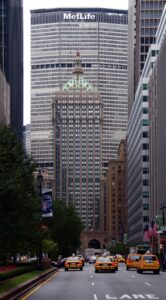
Helmsley Building / New York Central Building (1929), 230 Park Avenue, Midtown Manhattan, New York
The building that closes the vista of Park Avenue — a 35-story Art Deco tower straddling the world's most famous urban corridor, designed by Warren & Wetmore…
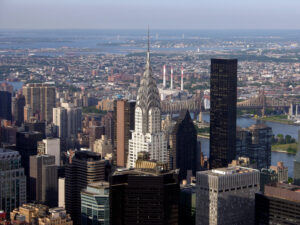
Chrysler Building — New York
William Van Alen's 1930 skyscraper held the title of world's tallest for approximately seventeen months before losing it to the Empire State Building — but…
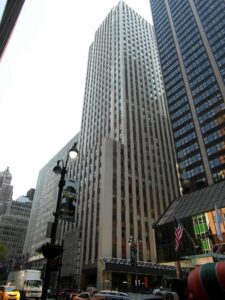
Daily News Building
The Daily News Building at 220 East 42nd Street is one of Midtown Manhattan's defining Art Deco skyscrapers, designed by Raymond Hood and John Mead Howells…

30 Rockefeller Plaza — New York
The central tower of Rockefeller Center — Raymond Hood's slab of Indiana limestone, 260 metres of carved stone rising straight from the sunken plaza — is the…

Radio City Music Hall — New York
Donald Deskey's interiors for the 6,000-seat theater at Rockefeller Center were described at opening as the most complete expression of Art Déco in America…
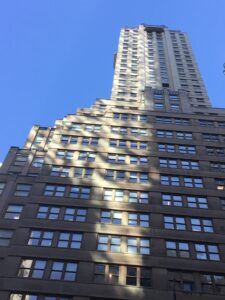
Fuller Building (1929), New York
At the corner of 57th Street and Madison Avenue, the Fuller Building stands apart from its midtown neighbors through a striking black-and-white facade and an…
Download for tour navigation
PDF is the stop list with GPS, to print or keep on the phone. GPX for Garmin / Komoot / OsmAnd. KML for Google Earth and Maps.
Walk it with the navigator on
It opens in the Google Maps app with every stop already loaded, in the order we put them in. From there the route is yours: pick how you travel — on foot, by bike, by public transport or by car — change where you start and where you end, drag the stops into a different order, and add places of your own along the way.
To keep the route in the app instead of opening it once, download the KML above and import it into Google My Maps — Create a new map, then Import: the route then sits among your own maps in Google Maps, with the stops and our notes attached to each one.