
Between the early 1930s and the late 1950s the petrol station became a building type of its own, and some of the architects who designed one treated it as a showcase: a canopy, a kiosk and a sign, placed on the road where every driver would see them. Many were demolished when fuel brands changed their image. A few survive, some still selling fuel, others turned into cafés, offices or workshops. This is a walk through ten of them, from Pennsylvania to Eritrea, including two that are gone.
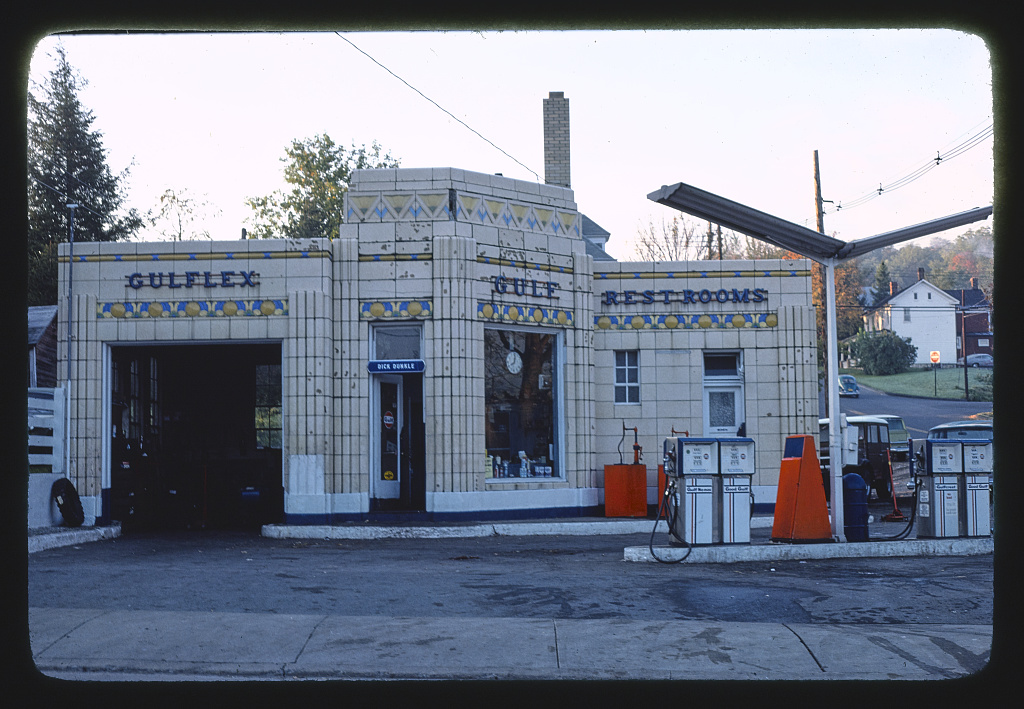
Art Deco on the Lincoln Highway Bedford, Pennsylvania, 1933
Dunkle’s Gulf stands on Pitt Street in Bedford, on the old Lincoln Highway. It was built in 1933 and is faced in glazed terracotta, with bands of coloured Art Deco ornament across the top and the Gulf name in blue letters. The photographer John Margolies, who spent decades recording roadside America, photographed it in 1977 for his survey now held by the Library of Congress. On Cultural Heritage Online the same American decade is represented by the Canute Service Station in Oklahoma, the Sinclair station in Tulsa, the Master Service Station in Waterloo, Iowa and the Champlin station in Sayre.
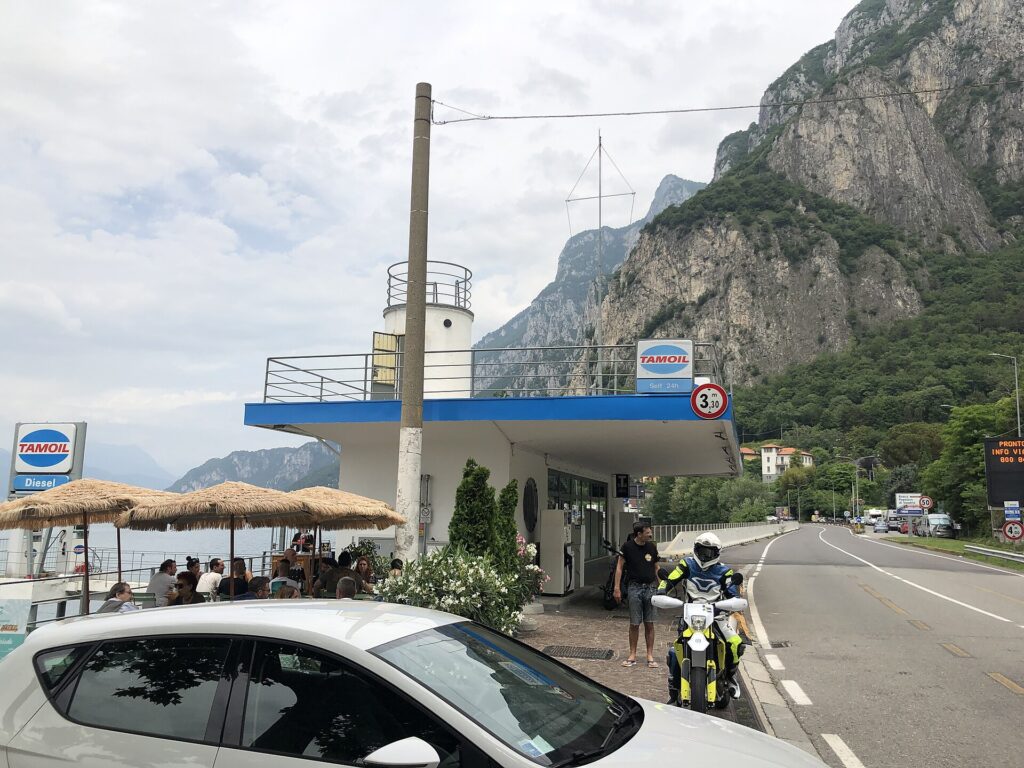
A deck on the lake Lecco, Italy, 1930s
On the Lungolario Piave in Lecco, right on the shore, Mario Cereghini built a service station that looks like the bridge of a lake steamer: a flat canopy edged with railings, and a small cylindrical tower rising above it like a funnel. The Lombardy heritage catalogue dates it to 1933 and names Cereghini alone; other accounts give 1936 and add Enrico Agostino Griffini. It is still a filling station, today under the Tamoil brand.
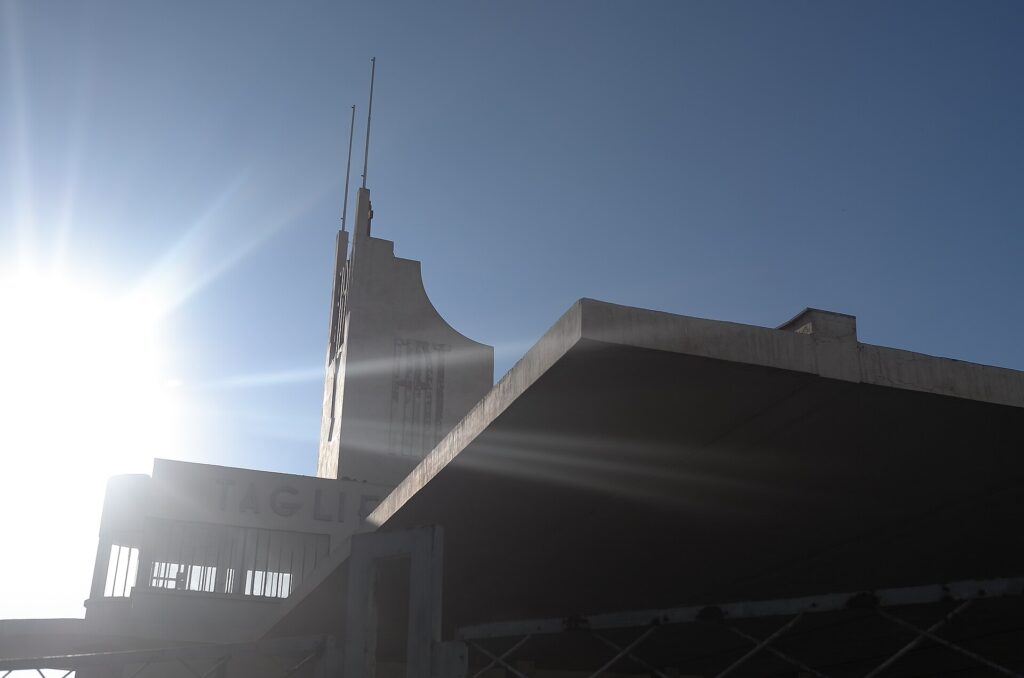
Wings over Asmara Asmara, Eritrea, 1938
The boldest of all is the Fiat Tagliero service station in Asmara, designed by Giuseppe Pettazzi and completed in 1938. A central tower carries two long concrete wings that reach out on either side without a single pillar. A story told in Asmara, and repeated by the Museo Fisogni, says the builders would not remove the props under the wings until Pettazzi threatened them with a revolver. Whether or not it happened, the wings are still there. The building was restored in 2003 and is part of Asmara’s modernist city, inscribed on the UNESCO World Heritage List in 2017.
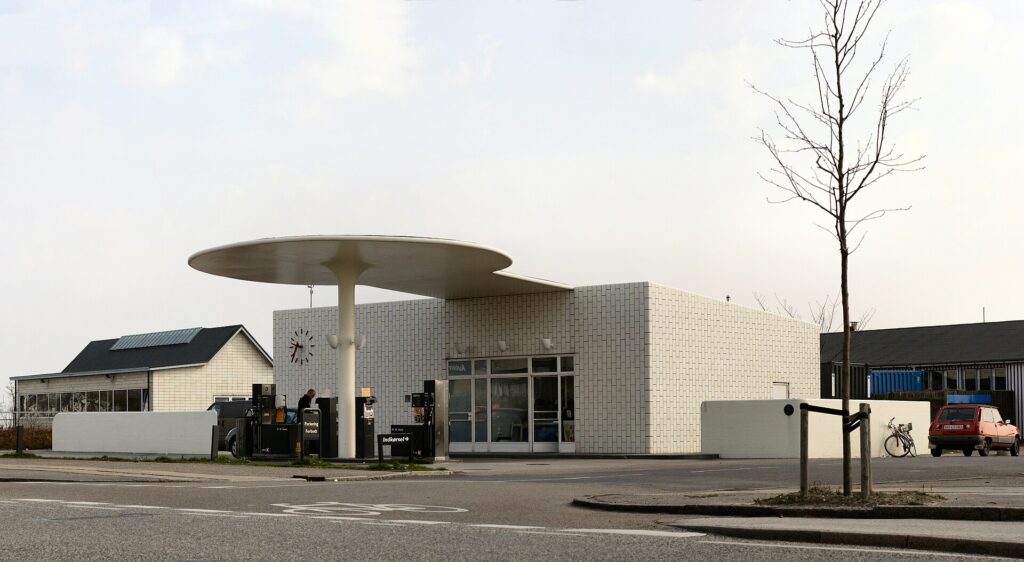
Jacobsen’s umbrella Skovshoved, Denmark, 1939
On the coast road north of Copenhagen, Arne Jacobsen built the Skovshoved station in 1939 as part of his plan for the Bellevue seafront. The building is clad in white ceramic tiles, and a thin oval concrete canopy rests on one slender column, like an open umbrella over the pumps. Denmark listed it in 1986. Around 2002 the canopy was renewed and the large glass front replaced. The car wash no longer works and the kiosk is now an ice-cream café, but the station still sells fuel.
After the war Neuss, Germany, 1948
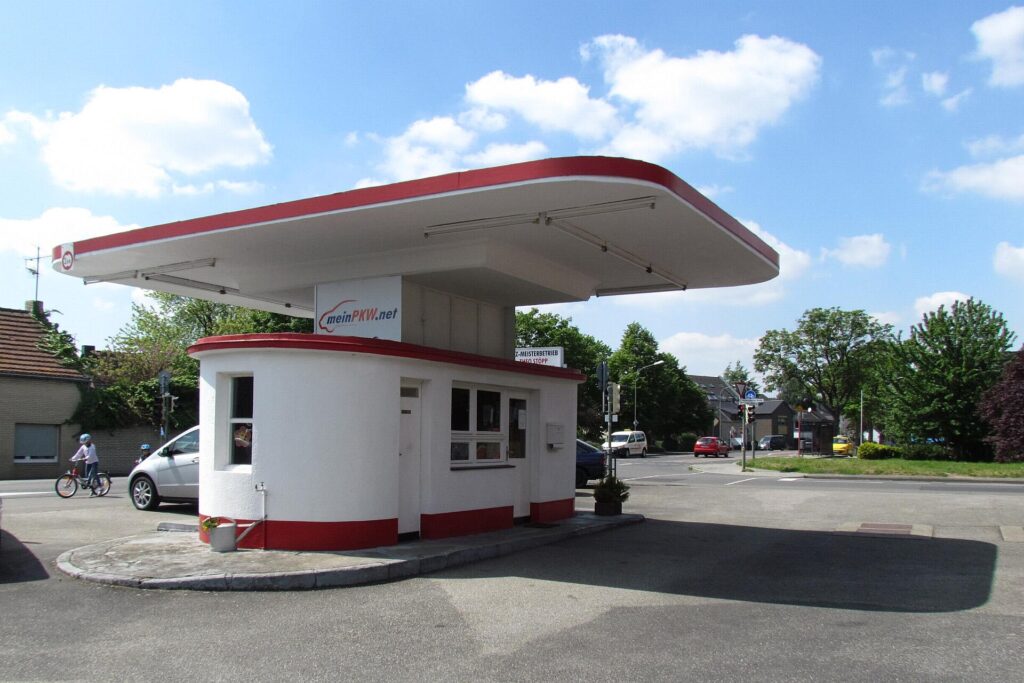
In Neuss-Grimlinghausen, at Volmerswerther Straße 71, the architect Philip Schmitz built a small petrol station for DAPG, the German company that later became Esso, in 1948. A rounded white kiosk banded in red sits under a wide flat roof that projects far beyond it. The station stopped selling fuel in 2000 and was entered on the city’s list of monuments the same year.
Milan, and the ones that are gone Milan and Sesto San Giovanni, 1949-1953
In Milan, at Piazzale Accursio, Mario Bacciocchi designed an AGIP station with offices above it between 1951 and 1953. The city first rejected the project, objecting among other things to how far the canopy projected, and approved it only after a revision. The rounded front and the long cantilevered canopies made the building read, in the words of the Lombardy heritage catalogue, like the deck of a ship with the wings of a jet. It sold fuel until the mid-1980s and then housed a tyre workshop. In 2017 Michele De Lucchi restored it for Garage Italia, putting the neon back under the canopies as in the 1950s.
Others have not survived. In Sesto San Giovanni the engineer Aldo Favini built a station for the Aquila brand in 1949, roofed by an undulating concrete vault only five centimetres thick; it has been demolished. In Prague, Josef Gočár designed stations for the Fanto company in the 1930s; the one at Klárov was pulled down in the early 1970s to make way for the metro, and none of his stations is left.
Totems and serrated roofs France and the Netherlands, 1955-1957
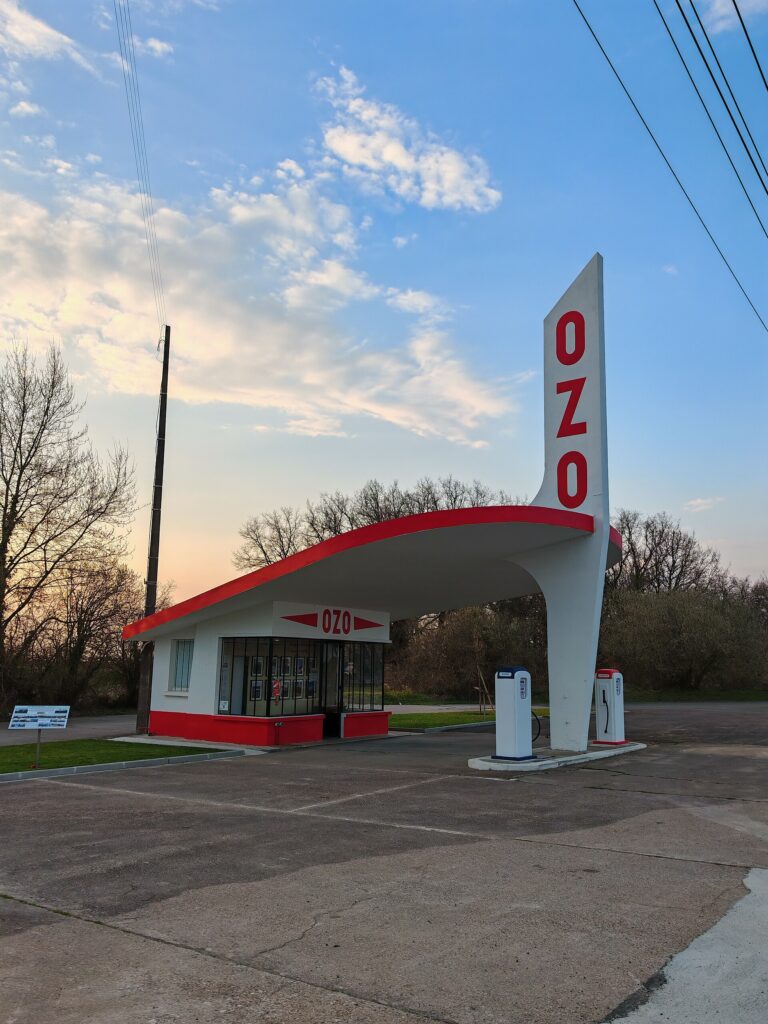
By the mid-1950s the sign had become architecture. At Sainte-Maure-de-Touraine, on the old national road 10, the OZO Bellevue station designed by Paul Lagneau in 1955-56 is dominated by a tall red and white totem that curves down into the canopy. France gave it the label for remarkable contemporary architecture in 2016, and a local association restored it and reopened it in September 2024.
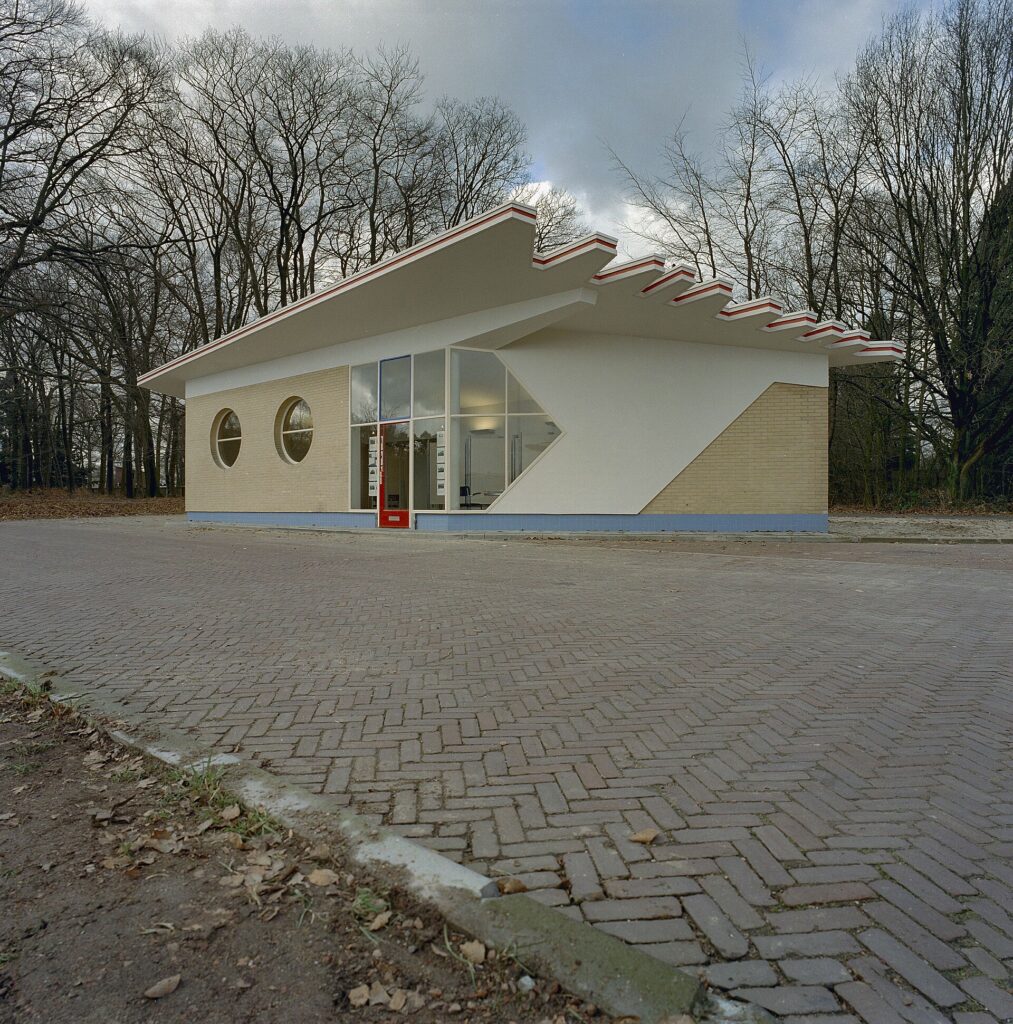
In Arnhem, at Apeldoornseweg 105, Sybold van Ravesteyn designed a station for Purfina between 1955 and 1957: a wedge-shaped plan, round porthole windows and a roof edge cut into a row of serrations. It lost its original function in 1994, became offices, and was restored in 2000-2001. It is a municipal monument, one of the few survivors of the many stations van Ravesteyn designed across the Netherlands.
Sources
- Lombardia Beni Culturali, Stazione di servizio AGIP, Piazzale Francesco Accursio, Milano (1951-1953, Mario Bacciocchi; the planning dispute, the use until the mid-1980s) and Stazione di servizio Lungolario Piave, Lecco (1933, Mario Cereghini; still a service station)
- Artribune, Milano, la stazione Agip di Bacciocchi di De Lucchi, December 2017: the restoration for Garage Italia and the neon canopies
- Wikivoyage, Il razionalismo sul Lago di Como: the Lecco station, Cereghini and Griffini, 1936
- Museo Fisogni, Fiat Tagliero di Asmara: Pettazzi, 1938, the story of the revolver, the 2003 restoration; Domus, Le stazioni di servizio: un’evoluzione di stile, 2023: UNESCO 2017
- Slots- og Kulturstyrelsen, Fredede og bevaringsværdige bygninger, Kystvejen 24, Gentofte: Arne Jacobsen, 1939, listed 8 July 1986, the restoration around 2002, the present use
- Rheinische Industriekultur, Tankstelle, Neuss: Philip Schmitz, 1948, DAPG, monument protection 2000
- Fondazione Aldo Favini, Stazione di servizio carburanti: Sesto San Giovanni, 1949, the five-centimetre vault
- Kam v Hradci Králové, and vysehradskej.cz: Gočár’s Fanto stations in Prague and their demolition
- Wikipedia (French), Station-service OZO Bellevue: Paul Lagneau, 1955-56, the 2016 label, the reopening in 2024
- architectuur.org, Tankstation Purfina, Arnhem: van Ravesteyn, 1955-57, municipal monument, offices since 1994, restoration 2000-01
- Pennsylvania Bucket List, Dunkle’s Gulf Station: Bedford, 1933, the Lincoln Highway; Library of Congress, John Margolies Roadside America photograph archive
This article started from a set of images of petrol stations gathered from the web and sent to us by a reader. Those images are not reproduced here, because we could not trace who took them: they served only to identify the buildings. The photographs published above are all free-licensed and credited to their authors.


_(55132814908).jpg)


_9-007_Tankstelle,_Volmerswerter_Stra%C3%9Fe_71_(Neuss-Grimlinghausen).jpg)

