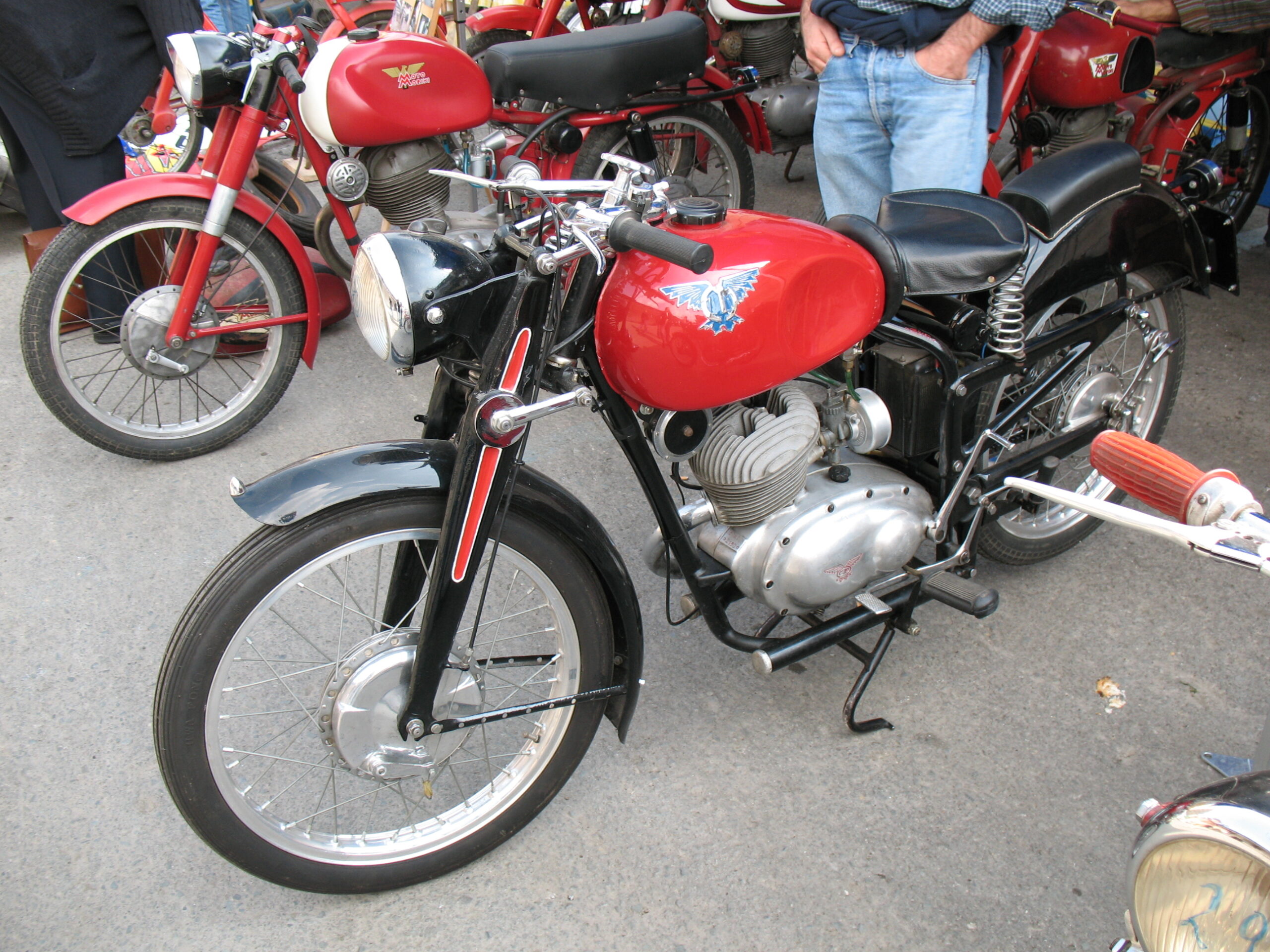
In 1924, inside a modest brick workshop in the working-class Bolognina district on Via Fioravanti, brilliant designer Mario Mazzetti joined forces with fearless test rider and mechanic Alfonso Morini, Angelo Mattei, and Giuseppe Salvia to create MM (*Mazzetti & Morini*). Armed with sheer mechanical ingenuity and hand-cast aluminum crankcases, MM built lightweight racing motorcycles that consistently defeated Europe’s industrial giants, establishing Bologna as the beating heart of world motorcycling.

The Overhead Valve Revolution: Dominating the 175cc Class
Interwar Bologna was a hotbed of mechanical passion. Mario Mazzetti (1895–1964) understood that superior power-to-weight ratios—not sheer engine displacement—decided road races over dusty, unpaved Italian terrain. In 1924, MM debuted a 125cc two-stroke machine, swiftly followed by a revolutionary 175cc single-cylinder overhead-valve (OHV) engine that produced remarkable rpm for its era.
With Alfonso Morini (1898–1969) crouched over the fuel tank, MM notched sensational victories at the Grand Prix of Nations in Monza and the grueling Milan-Taranto long-distance road race. In 1927, Morini broke six world speed records at Monza aboard an MM 125cc, averaging over 122 km/h. MM’s blue-and-silver racing livery became feared on racetracks across Europe, proving that Bolognese artisans could out-engineer established British and German factories.
The Cradle of the Motor Valley
MM was not merely a racing stable; it was the fertile nursery from which the entire Emilian motorcycle district sprang. In 1937, Alfonso Morini amicably separated from Mazzetti to establish his own celebrated marque, Moto Morini. While MM ceased motorcycle production in 1957 following Mazzetti’s retirement, its DNA lives on in the metallurgical and design standards of the Motor Valley.
Historical MM competition motorcycles are preserved in prestigious institutions like the Museo del Patrimonio Industriale di Bologna and private motor museums in Sant’Agata Bolognese, revering the small workshop on Via Fioravanti where modern Italian motorcycle supremacy first took flight in 1924.
Competizioni motociclistiche e campioni delle due ruote in Emilia
Cinegiornale dell'Archivio Luce che riprende i circuiti stradali emiliani, le corse motociclistiche delle 175cc e i tecnici al lavoro sui motori da competizione. (Fonte: Archivio Storico Istituto Luce Cinecittà)
Interactive 360° Heritage View: Historic MM Workshop Site
Historical Location: Via Fioravanti 31 / Via Ercolani, 40129 Bologna BO, Italy (Coordinates: 44.50553, 11.34566)
Historical Archive Gallery