
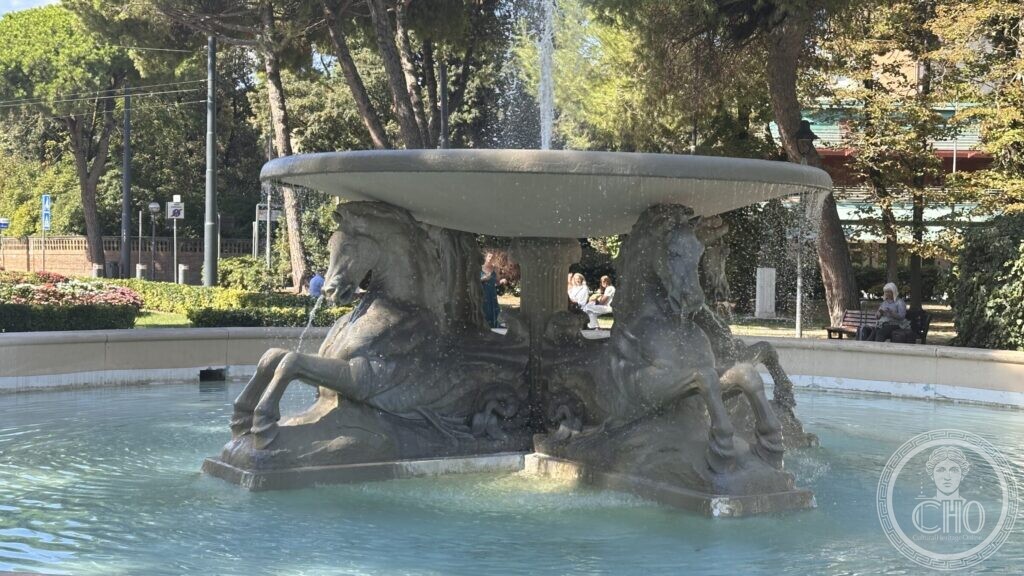
Unveiled in 1928, broken up in 1954, its horses scattered between a fire station and a park. It took until 1983, and two people who would not let it go, to put it back.
At a glance
The Fountain of the Four Horses stands among the stone pines of Parco Federico Fellini, at the sea end of viale Principe Amedeo and a step from the Grand Hotel. It was carved by a Rimini sculptor, Filogenio Fabbri, and unveiled on 29 June 1928: a wide circular basin standing for the sea, four horses rising out of it and spouting water from their nostrils, an upper bowl carried on their heads, and a single jet through the middle. It is one of the images the city uses for itself — which makes it stranger that for nearly thirty years it did not exist.
Key facts
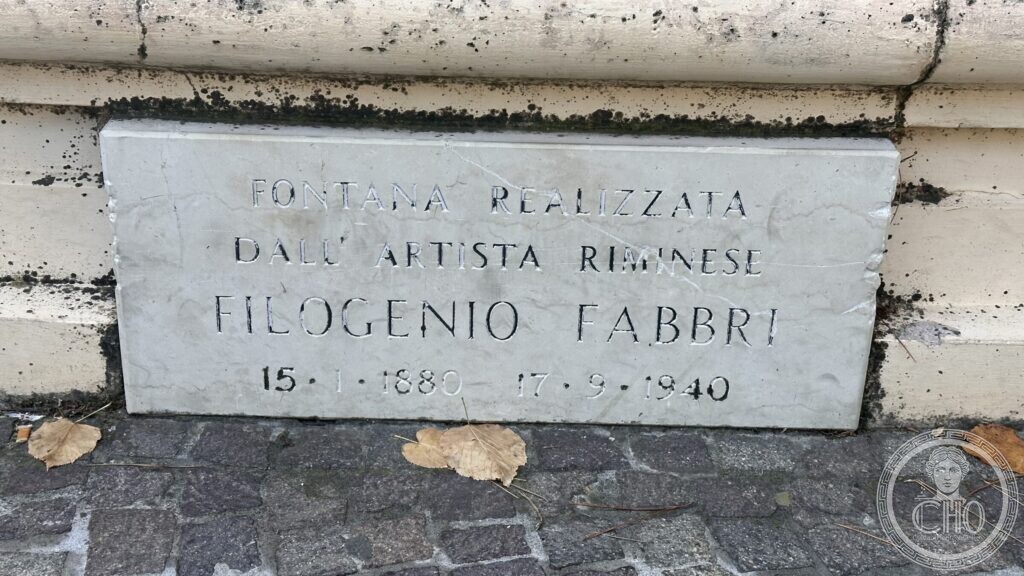
- Sculptor: Filogenio Fabbri of Rimini (15 January 1880 – 17 September 1940), named on a plaque at the foot of the basin
- Unveiled: 29 June 1928
- Dismantled: the fountain removed after the front passed in 1945; the great basin demolished in September 1954
- Where the horses went: to the fire station in via Dario Campana, then three of them to Parco Marecchia
- Put back: 1983, after a long campaign by Umberto Bartolani and Fausta Fabbri, the sculptor’s daughter
- Restorer: Ugo Stentori, recorded on a plaque of 1987
- Where: Parco Federico Fellini, Piazzale Fellini, Rimini Marina Centro
- Coordinates: 44.071193, 12.576531 — Google Maps
History
By the 1920s the gardens behind the Rimini seafront were the formal front room of a bathing resort that had been in business since the middle of the previous century. The fountain built at their centre was the work of Filogenio Fabbri, a sculptor born in Rimini in 1880, and it was unveiled on 29 June 1928.
It came through the war. Standing in the middle of the gardens, it took no damage from the bombing that flattened much of Rimini — and then it was taken apart anyway. After the front passed through in 1945 the fountain was dismantled, and in September 1954 the great basin was demolished outright. The horses were carted off to the fire station in via Dario Campana; three of them ended up in Parco Marecchia, and one, by one account, on the land beside the aqueduct. The city’s own tourist board records the sequence without explaining it.
Getting it back was the work of two people. Umberto Bartolani and Fausta Fabbri, the sculptor’s daughter, campaigned for years for the fountain to be reassembled where it belonged. In 1983 it was. Four years later a plaque was set into the base for Ugo Stentori, who carried out the restoration of the horses and the main basin.
What you see
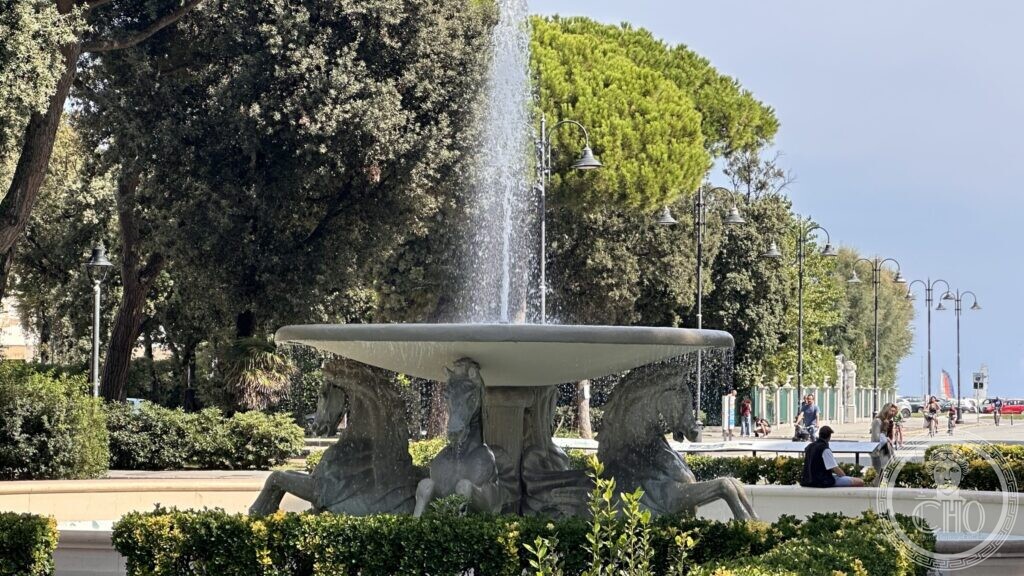
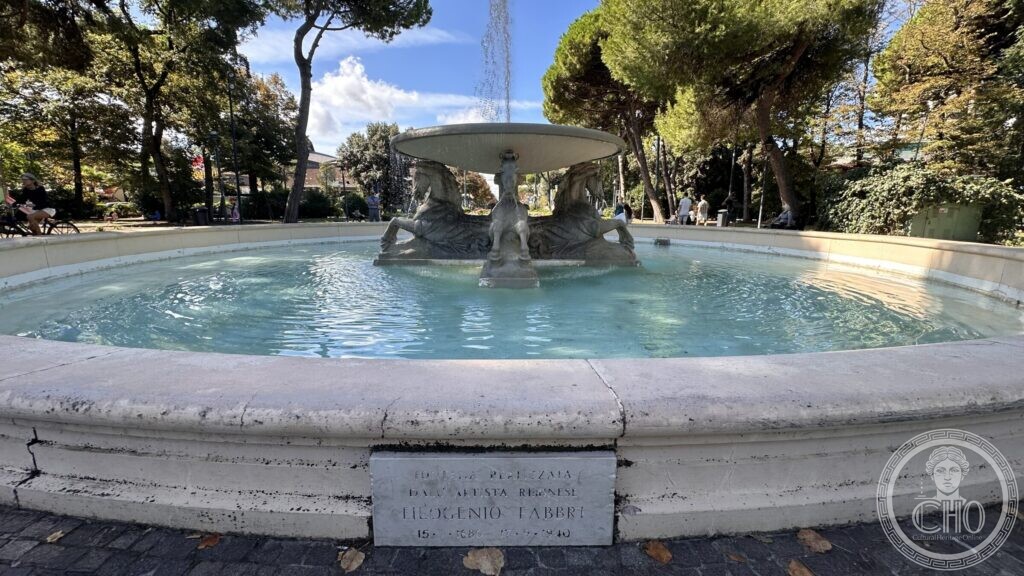
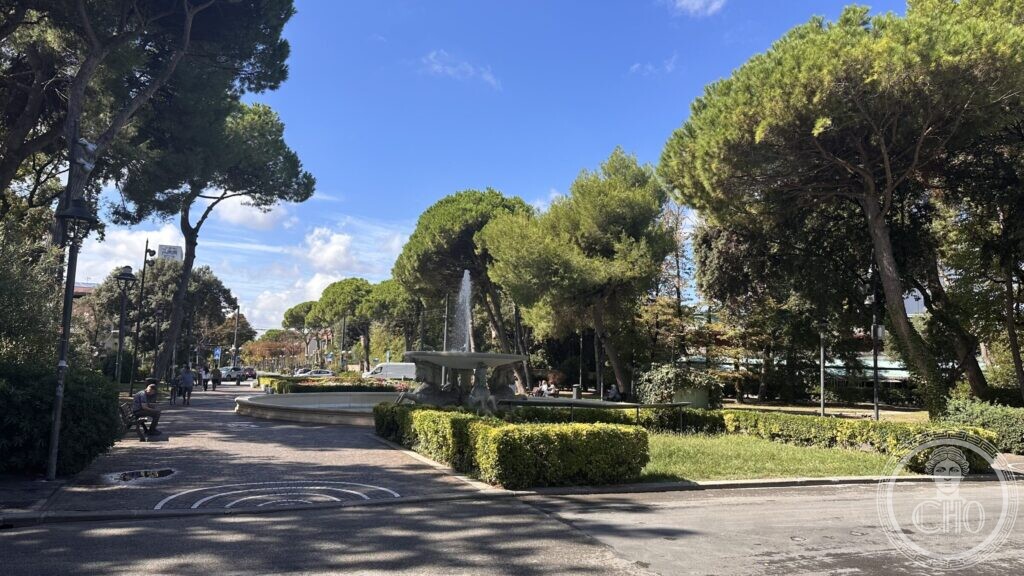
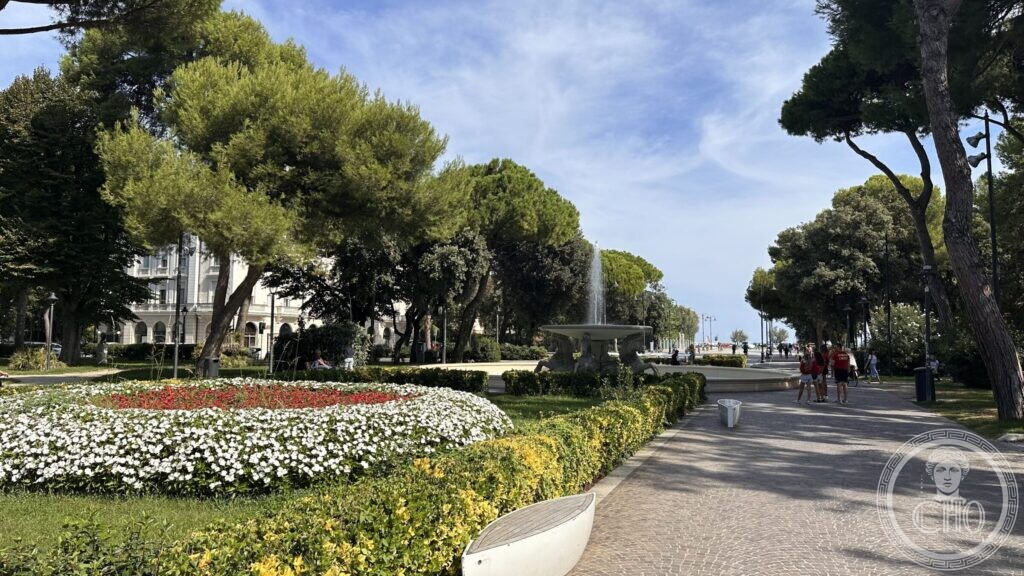
A shallow circular basin, low enough to sit on, holds still green water: this is the sea. Out of it rise four horses in dark stone, shoulder to shoulder and facing outwards, their forelegs folded under them and their hindquarters coiling away into the water in the manner of the sea-horses of classical fountains — the Italian name calls them simply cavalli, the tourist board’s English translation calls them sea-horses. Each pours a thin stream from its nostrils into the basin below. On their heads they carry a wide, plain bowl, and through the middle of it a single jet goes up far above the pines.
Set into the outer rim of the basin, at ground level and easy to walk past, is a white marble tablet cut in capitals: FONTANA REALIZZATA DALL’ARTISTA RIMINESE FILOGENIO FABBRI — 15 · I · 1880 — 17 · IX · 1940. It gives the sculptor his name, his city and the span of his life, and nothing else.
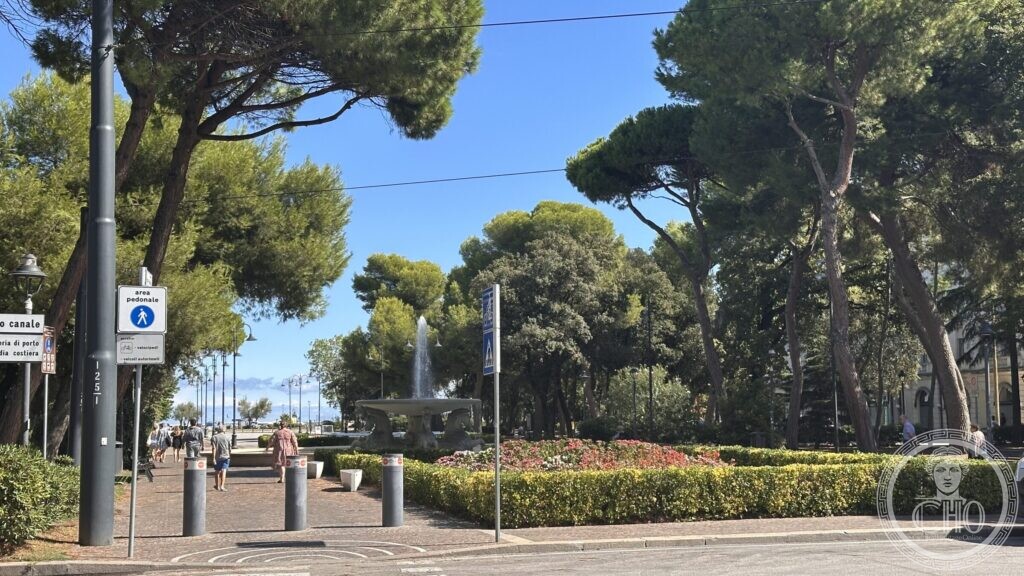
The setting matters as much as the fountain. Umbrella pines close over the water, hedges of clipped box and beds of red and white flowers surround it, and the axis of the park runs from here straight out to the sea. Look one way and the Grand Hotel shows through the trees; look the other and the promenade and the beach are a hundred metres off.
The fountain today

Practical information
- Open public park, free at any hour. The fountain plays through the season; it is turned off in winter.
- Parco Federico Fellini is pedestrian; the nearest parking is along viale Vespucci and around Piazzale Fellini.
- The sculptor’s plaque is at ground level on the outer rim of the basin, on the side facing the town. It is easy to miss.
Getting there
Walk down viale Principe Amedeo from the historic centre — about twenty minutes, or ten from the station — and the avenue ends at the park. Bus 11 runs the length of the seafront and stops at Piazzale Fellini.
Nearby
- Grand Hotel Rimini — the Liberty landmark at the other end of the park, with a 360° virtual tour
- Kursaal di Rimini — the lost bathing palace that stood on this seafront until 1948
- The villas of viale Principe Amedeo, on the walk back into town
- Piazzale Fellini and the seafront promenade
Sources
- Rimini Turismo (Comune di Rimini) — Fontana dei Quattro Cavalli, consulted 12 September 2026.
- Riviera di Rimini (Provincia di Rimini) — Fontana dei 4 cavalli, consulted 12 September 2026. The two accounts agree on the dates and differ only on where the fourth horse was kept.
- The marble plaque on the basin, read and photographed on site, 11 September 2026.
Find it on the map
See this place and what’s around it →Record researched and written by Luigi De Marchi for Cultural Heritage Online, 2026.
📷 Become a Cultural Heritage Online photographer
Share your photos of places: they stay published under your name as the author. The more they're seen, the more you get noticed — and soon a contest will reward the most appreciated photos.
Log in or sign up free to add a photo