
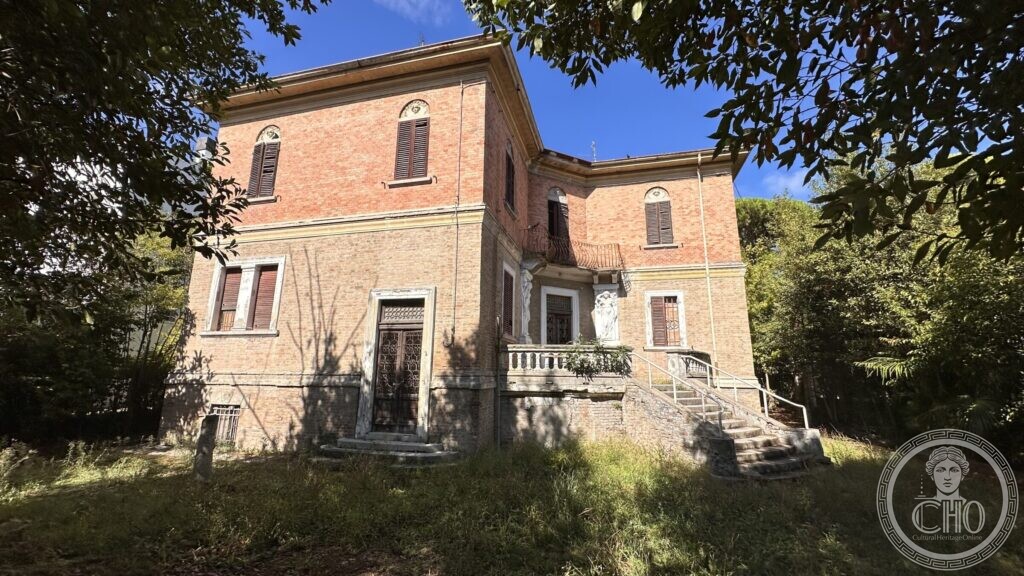
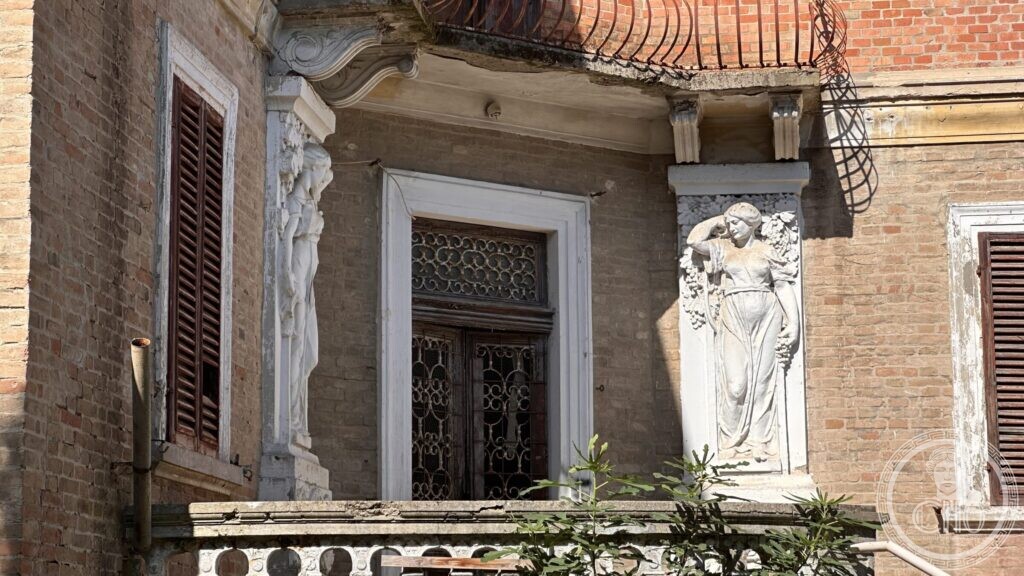
Caryatids on the loggia, a woman’s head in a wreath over every window, a door chained shut, and a garden that has become a wood. Nobody we have asked can tell us its name.
At a glance
Viale Principe Amedeo runs from Rimini’s station down to the sea, and its villas are the record of the city’s first tourist age: brick and render, iron gates, gardens behind low walls. Most are lived in. One, at the corner of viale Centauro, is not. It stands empty in a garden that has closed over it, with its ornament intact and its shutters shut — a complete piece of Rimini’s Liberty architecture that we have not been able to name. We are publishing it as we found it, and asking for help.
Key facts
- Where: viale Principe Amedeo at the corner of viale Centauro, San Giuliano Mare, Rimini
- Condition: abandoned; garden overgrown, doors chained, structure apparently sound
- Style: Liberty — Italian Art Nouveau — with carved figures, wreathed heads and wrought-iron grilles
- Name, architect, date: not established. See the note below.
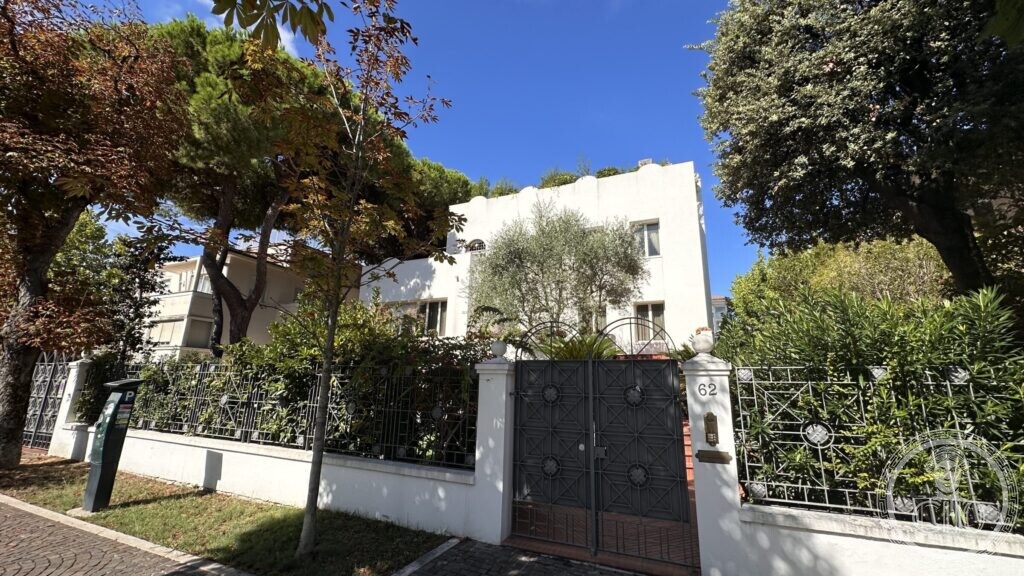
- Nearest landmark: the white modernist villa at number 62, immediately alongside
- Coordinates: 44.069340, 12.574320 — Google Maps
What we know, and what we do not
Rimini began taking in bathers in the middle of the nineteenth century, and by the turn of the twentieth the roads between the station and the sea were being built up with villas for families who spent the season here. Viale Principe Amedeo is the grandest of those roads: its surviving villas run from sober brick boxes of the 1880s to full Liberty fantasies, and a few — Villa Solinas, the villa the townspeople still call the Conte Baldini’s for the ilexes in its garden — carry names that the city remembers.
This one does not. We have searched the municipality’s pages on the city’s buildings, the regional and national heritage catalogues, and the published work of Rimini’s local history associations, and found no entry for it. What can be established is only what the place itself and its coordinates say: it stands at the corner of viale Principe Amedeo and viale Centauro, next to the white villa numbered 62, and it has been empty long enough for young trees to take the garden.
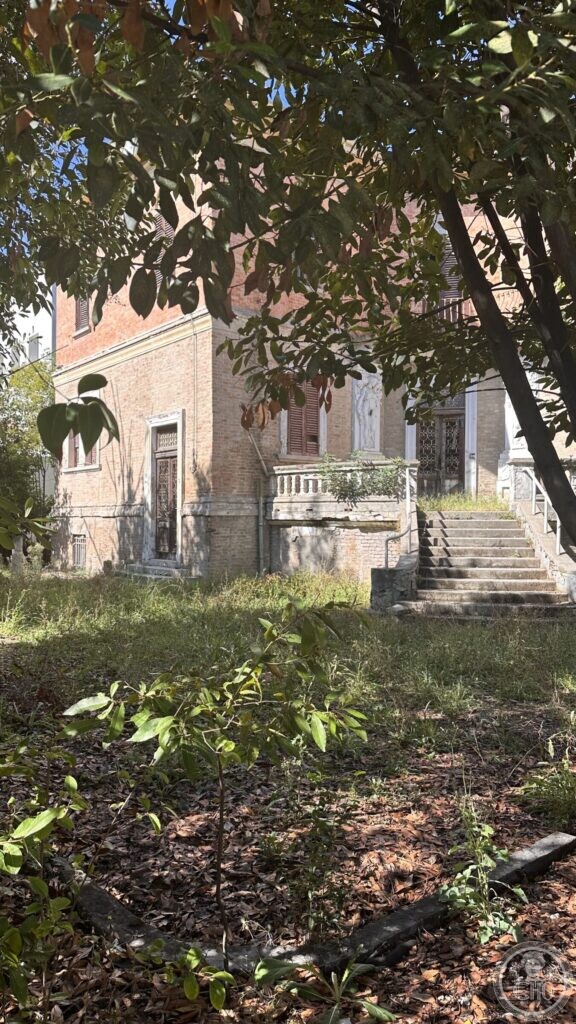
We are not going to invent a date for it. The carving — caryatids at the loggia, heads in wreaths in the window lunettes — belongs to the vocabulary of Italian Liberty in the years around 1900 to 1915, and the brickwork and the balustrades are of that world; but an attribution needs a document, not a resemblance. If you know this house — its name, who built it, who lived in it, whether it is protected — please write to us. We will correct this page and credit you.
What you see
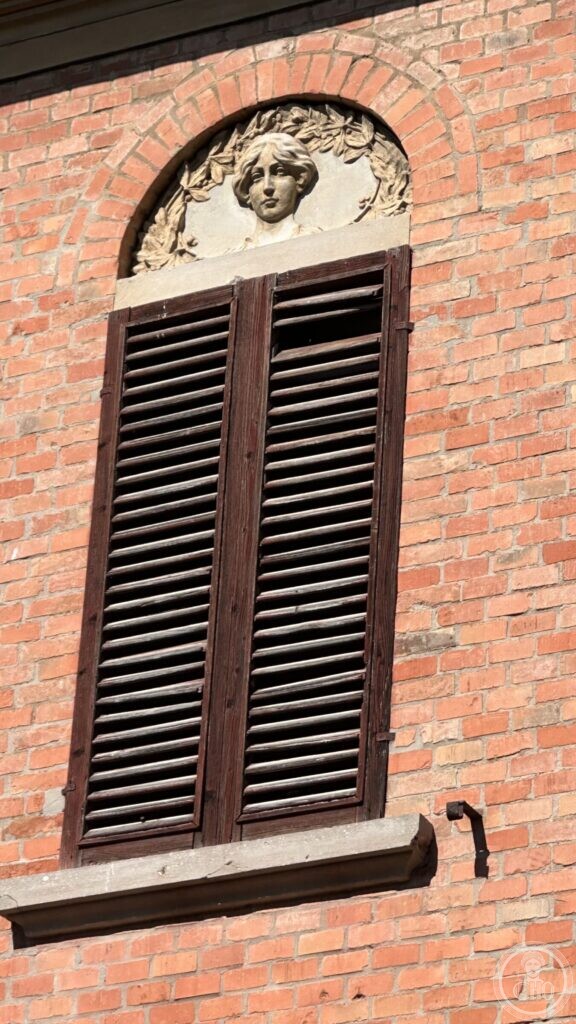
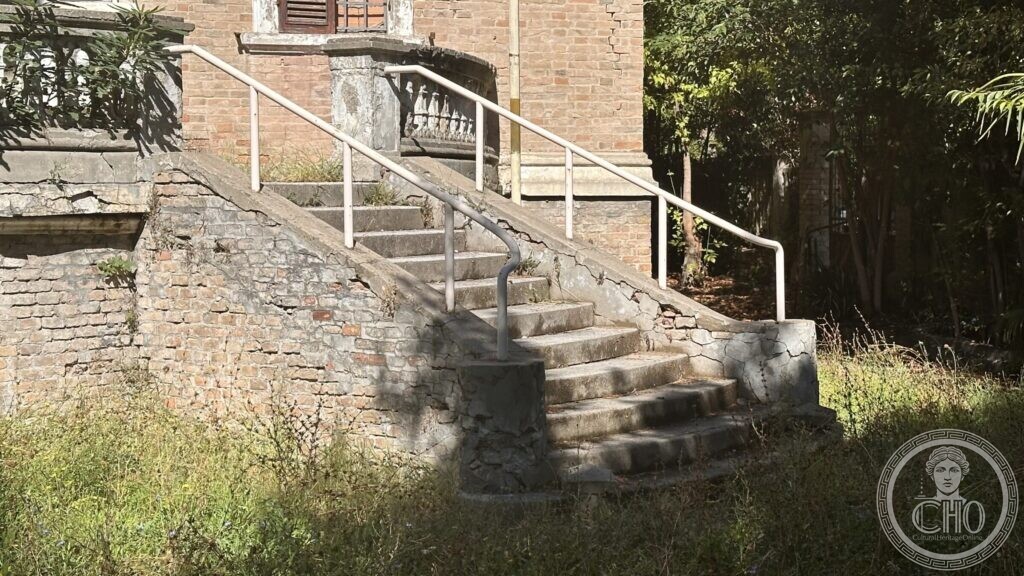
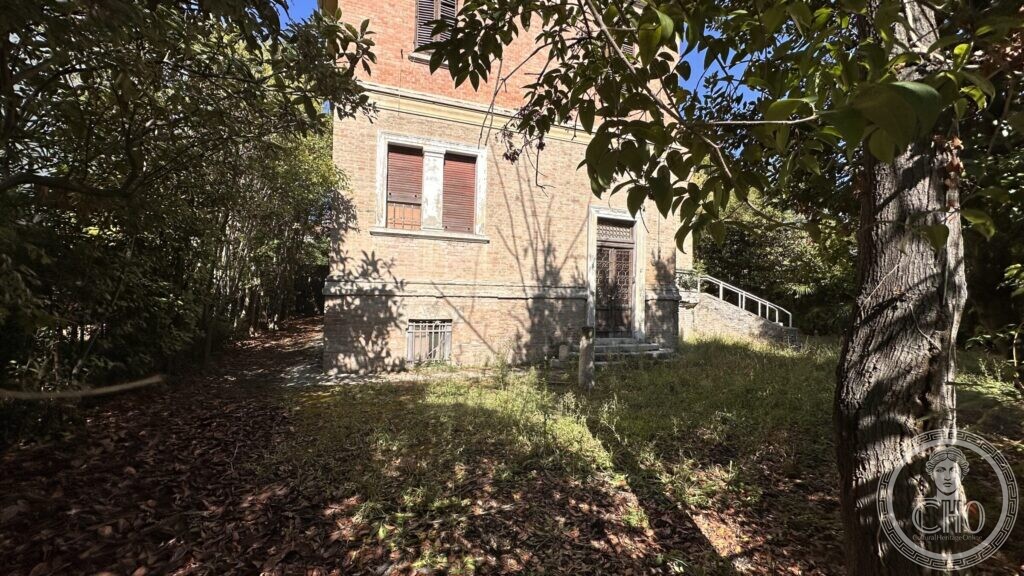
A square two-storey block in warm brick with a rendered band at first-floor level, a low hipped roof, and a raised ground floor reached by a flight of stone steps with a balustrade. The garden front carries a small loggia: a segmental hood on brackets over a French window, and on either side of it a carved female figure standing against the pier, one with grapes and vine leaves in her arms. Above every window of the upper floor, set in the brick arch, is a moulded lunette with a woman’s head at its centre in a wreath of leaves — the same head, repeated all round the house.
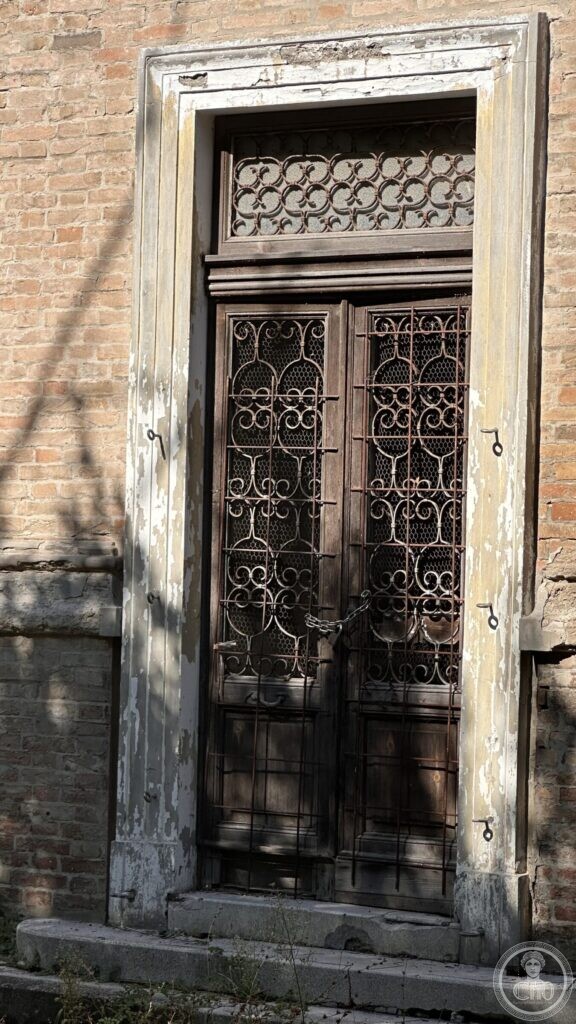
The doors are the best-preserved thing on it. Tall panelled leaves are filled with wrought iron in tight Art Nouveau scrollwork backed by mesh, with a matching overlight above; the paint has gone to bare grey wood and the chain across the handles is new. The steps at the side have lost their render in patches and grown weeds in the joints, and a modern steel handrail has been bolted to the old balustrade — someone has been in.
What makes the building hard to photograph is also what keeps it standing: the garden. Self-seeded trees have grown to roof height against the walls, so that the villa is only visible in pieces, through leaves, from the pavement of viale Centauro.
The villa as we found it, 11 September 2026

Practical information
- It is private property and it is closed. Everything on this page was photographed from the public pavement. Do not enter the garden or the building.
- The villa is on the corner of viale Principe Amedeo and viale Centauro, alongside the white villa at number 62. From the pavement of viale Centauro you can see the loggia and the window lunettes.
- Can you name it? If you know the house, its family, its architect or its protection status, write to us: we will correct the page and credit the information.
Getting there
Fifteen minutes on foot from Rimini station along viale Principe Amedeo, towards the sea; the corner with viale Centauro is about two thirds of the way down. The walk carries on to the Fontana dei Quattro Cavalli and the Grand Hotel.
Nearby
- The other villas of viale Principe Amedeo, including Villa Solinas and the villa with the motto Labore et Virtute
- Grand Hotel Rimini, at the sea end of the avenue, with a 360° virtual tour
- The Fontana dei Quattro Cavalli in Parco Federico Fellini
- Kursaal di Rimini — the lost bathing palace of the same seafront
Sources
- On-site observation and photography, 11 September 2026. The location was fixed from the GPS recorded in the photographs and confirmed against OpenStreetMap.
- No documentary source for this building was found in the municipal, regional or local-history material consulted on 12 September 2026. The page carries no date and no attribution for that reason.
Find it on the map
See this place and what’s around it →Record researched and written by Luigi De Marchi for Cultural Heritage Online, 2026.
📷 Become a Cultural Heritage Online photographer
Share your photos of places: they stay published under your name as the author. The more they're seen, the more you get noticed — and soon a contest will reward the most appreciated photos.
Log in or sign up free to add a photo