
Widows and orphans commissioned it, a Brescia sculptor won the competition, and the Church nearly refused to bless it — because the hero was naked.
At a glance
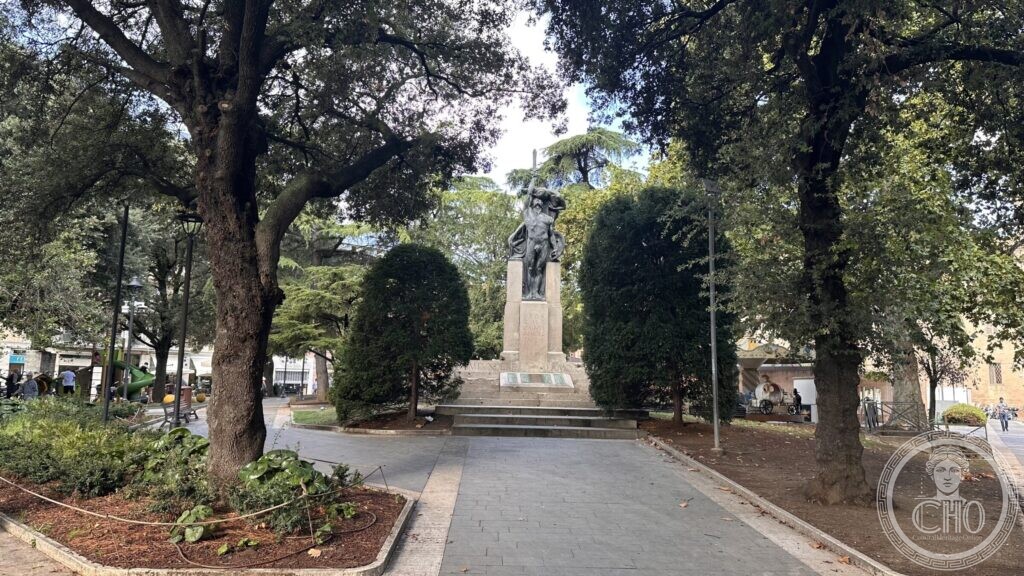
Rimini’s memorial to its dead of the First World War stands at the end of a gravel avenue in the gardens of Piazza Ferrari. Bernardino Boifava won the competition in 1923 with a bronze group of two figures: a naked warrior with a shield, and behind him a draped Victory raising a sword. King Victor Emmanuel III unveiled it on 11 September 1926. The monument was the centre of a four-year argument about money, taste and decency, and the record of that argument survives in the municipality’s own published history of the square.
Key facts
- Sculptor: Bernardino Boifava (Ghedi, 23 May 1888 – Forlì, 15 December 1953)
- Promoted by: the Comitato Riminese pro Monumento e Onoranze ai Caduti in Guerra, made up mostly of war widows and orphans
- Competition jury: the sculptor Ercole Drei, the architect Gaetano Nave and the engineer Sesto Baccarini
- Finalists: Uno Gera (Rome), Ruggero Dondé (Verona), Bernardino Boifava (Brescia) — Boifava declared the winner on 11 March 1923
- Foundation stone: 4 November 1922, Victory Day
- Unveiled: 11 September 1926, by King Victor Emmanuel III
- Materials: bronze on a base of red Baveno granite
- Signature: not on the bronze group, but on the lower edge of the bronze Savoy shield set between the granite steps
- Coordinates: 44.062072, 12.568110 — Google Maps
History
In 1922 a committee of Rimini citizens — the municipality’s history notes that it was made up in large part of widows and orphans — invited Italian artists to submit designs for “a figurative monument in bronze and stone to be raised in the middle of the Ferrari Gardens”. The brief asked for a work of considerable height, and, given the width of the square, a mass that was not slender. Its purpose was set out in one line: to glorify the memory of those who had fallen in the war.
The first stone was laid on 4 November 1922, Victory Day, together with the award of war crosses to the families of the dead. Inside it was placed a parchment: “On 4 November 1922 the citizens of Rimini solemnly laid this stone, that it might be the base of the monument in which the heroic sacrifice of the dead may beat with the memory of the living.” A procession of at least twelve thousand people reached Piazza Ferrari, where the eighty-voice choir of the Amintore Galli choral society was waiting to sing.
On 11 March 1923 the jury — the sculptor Ercole Drei, the architect Gaetano Nave and the engineer Sesto Baccarini — chose Bernardino Boifava’s design from three finalists. Boifava was a peasant’s son from Ghedi near Brescia who had learned his trade in a local workshop, then at the Moretto school of arts and crafts and the Academy of Fine Arts in Florence; called up at twenty-seven for the war, he had settled in Forlì, which he came to call his second home. In the years after the armistice he became one of the busiest makers of war memorials in Romagna.
Three more years passed before the monument stood. Costs were high, and the design ran into moral objections once it was shown to the public in a special issue of the review L’Ara in May 1924. A year later the Roman press took it up; the church authorities let it be known that, under ecclesiastical rules on images offending public decency, the blessing could not be given as things stood. What was actually changed was almost nothing: comparing the winning sketch with the finished bronze, the municipality’s history finds only one substantial difference, a broad leaf added over the hero’s groin. It is still there.
On 11 September 1926 King Victor Emmanuel III came to Rimini for the unveiling, and for the votive chapel to the fallen in the Tempio Malatestiano, painted by Francesco Brici. At four in the afternoon he left the town hall for Piazza Ferrari, where a company of the 27th Infantry Regiment was drawn up with its colours. The Bishop of Rimini blessed the monument; three bugle calls sounded; and the tricolour that wrapped the Hero slid down and spread over the granite base. Italo Balbo made the speech. The mayor then presented the sculptor to the king, who congratulated him and asked him how the work had been made.
Much later Federico Fellini put the monument into Amarcord, transfigured by memory. The gardens around it have changed twice since: the arrangement Boifava designed for — bronze against a background of trees — gave way in the 1980s to a paved square and the building that now covers the Roman house known as the Domus del Chirurgo.
What you see
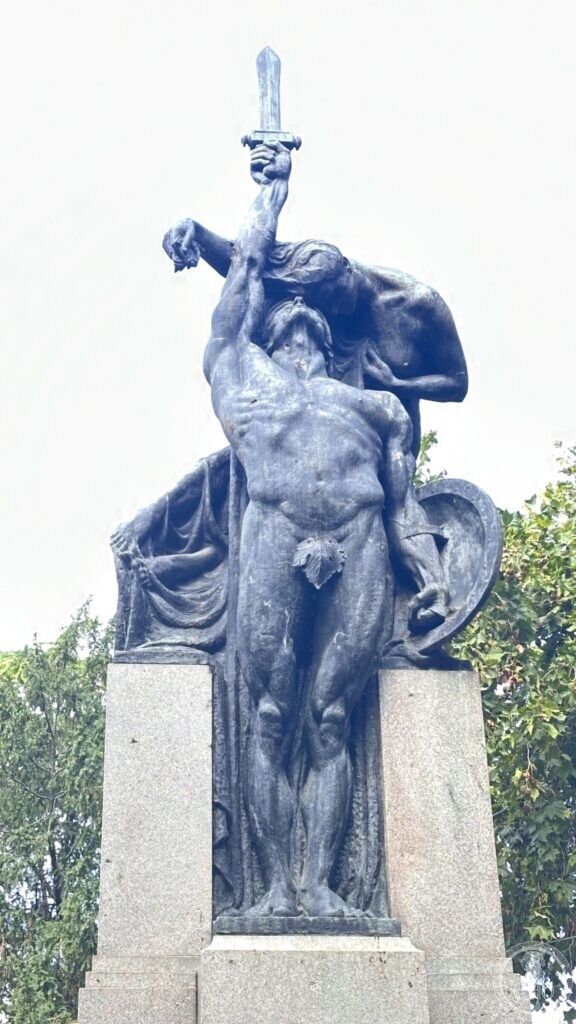
The monument closes a short gravel avenue between clipped hedges and ilexes, raised on a flight of steps in red Baveno granite. The bronze group is two figures in one movement: in front, a naked warrior, heavily muscled, holding a round shield at his side; behind and above him a draped female figure with wings, an arm thrown up, a straight sword raised in her fist. The composition is vertical and tightly closed, designed to be read from directly in front and from below.
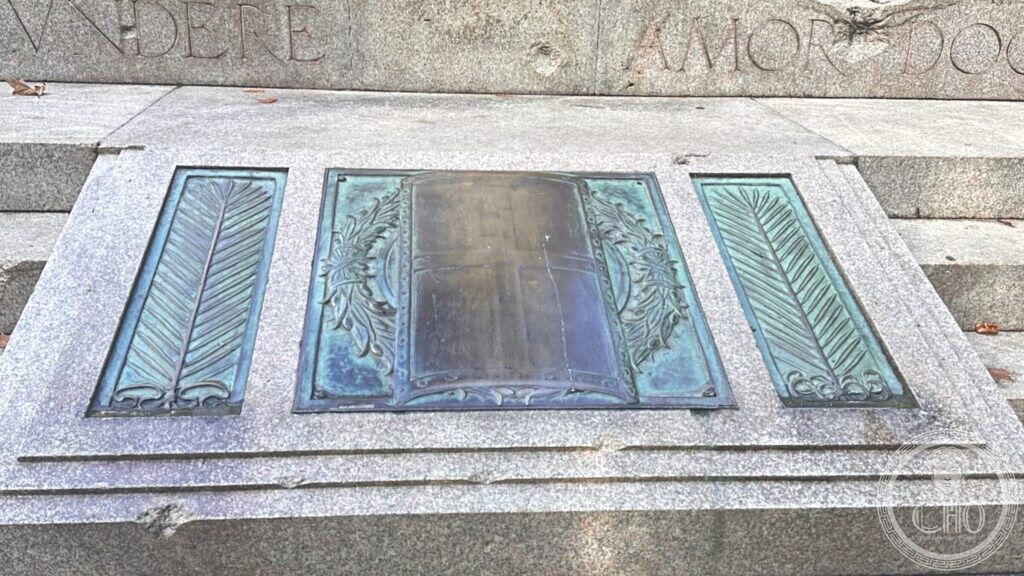
At the foot of the steps a bronze tablet is set into the granite, framed by two long panels of bronze palm fronds, with a Latin inscription cut into the stone above it — of which the photographs here preserve the words …VNDERE and AMOR DOC…. The sculptor’s own signature is not where you would look for it: the municipality’s restoration report records that it sits on the lower edge of the bronze Savoy shield wedged between the granite steps.
A few steps away, in the same gardens, stands the bust of Francisco Busignani, a gold medal for military valour killed in East Africa at twenty-three, made by the Rimini sculptor Elio Morri and unveiled in December 1939. After the war the lictorian fasces and the great marble letters of its dedication were erased and replaced with a plainer bronze inscription, and the bust was put back on its base on 28 October 1963. The two monuments have been cleaned and conserved together; the bronzes suffer from airborne dust, pigeon guano and acid rain, while the granite has needed little more than repointing.
The memorial today

Practical information
- The gardens are open public space, at the centre of Piazza Ferrari; the memorial is free to visit at any hour.
- The Domus del Chirurgo, the Roman surgeon’s house excavated in the same square, is part of the Museo della Città and has its own opening hours and ticket.
- Piazza Ferrari is also one of the main car parks for the historic centre, which is why the square is busier than the gardens suggest.
Getting there
Piazza Ferrari is a few minutes’ walk from Piazza Cavour and from the Tempio Malatestiano, and about ten minutes from Rimini station. It has a large public car park, signposted from the A14 Rimini Sud exit.
Nearby
- The Domus del Chirurgo, under the modern shelter in the same square
- The bust of Francisco Busignani by Elio Morri, in the same gardens
- The Tempio Malatestiano, where the votive chapel to the fallen was inaugurated on the same day as this monument
- Piazza Cavour and the Teatro Amintore Galli
Sources
- Comune di Rimini, Quaderno 6 — Piazza Ferrari. Un intervento tra storia e restauro (municipal publication), for the competition, the inauguration, the signature on the Savoy shield, the Busignani monument and the conservation report.
- Contemporary press quoted in that volume: «L’Ausa» and «Il Popolo di Romagna», Rimini, 11 September 1926.
- On-site observation and photography, 11 September 2026.
Find it on the map
See this place and what’s around it →Record researched and written by Luigi De Marchi for Cultural Heritage Online, 2026.
📷 Become a Cultural Heritage Online photographer
Share your photos of places: they stay published under your name as the author. The more they're seen, the more you get noticed — and soon a contest will reward the most appreciated photos.
Log in or sign up free to add a photo