
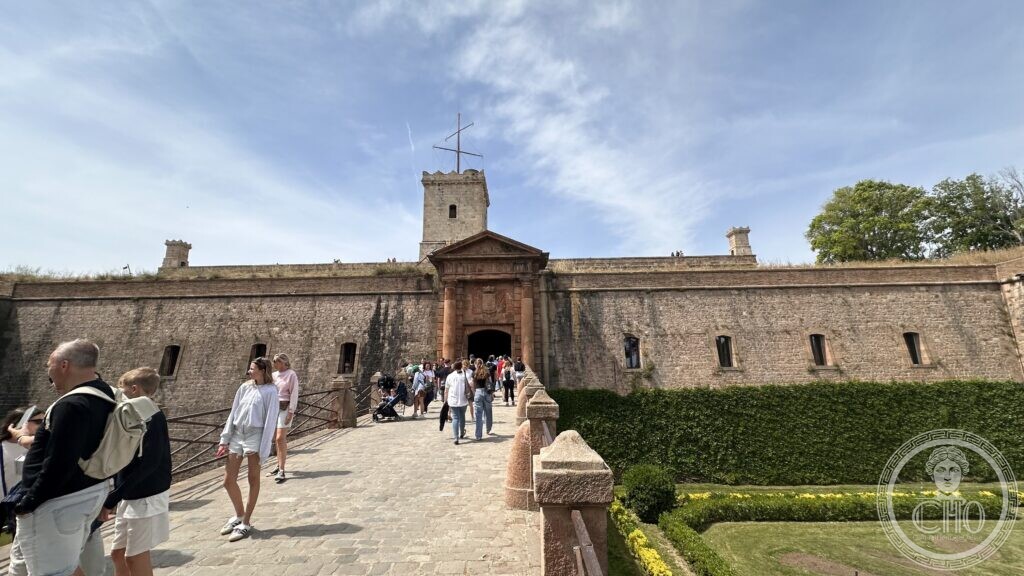
A star-shaped fortress on the hill above Barcelona’s port, built to defend the city and later used to punish it — a military prison whose walls saw the execution of a president of Catalonia, now handed over to the city as a place of memory.
At a glance
Castell de Montjuïc crowns the hill of the same name, its star-shaped bastions commanding the port and the whole sweep of Barcelona below. Raised in earth and stone in 1640 during the revolt against Philip IV, rebuilt in masonry as a full star fortress from 1694 and completed by the military engineer Juan Martín Cermeño in 1751, it spent much of its working life less as a defence against foreign attack than as a place to hold and punish Barcelona’s own citizens — a role that culminated, in October 1940, in the execution of Lluís Companys, president of the Generalitat of Catalonia. Transferred fully to the city in 2007, it is now a museum and civic space, with a Centre for Peace planned within its walls.
History
The first fort on Montjuïc went up in a matter of weeks in 1640, a simple earthwork faced in stone and mud, raised by Barcelona during the Reapers’ War against Philip IV. It proved itself almost immediately: on 26 January 1641 it withstood an assault by the Marqués de los Vélez. The provisional fort became a permanent castle from 1694, and in 1751 the military engineer Juan Martín Cermeño demolished what remained of the 1640 structure and completed the star-shaped fortress essentially as it stands today, adding cisterns, a dry moat and kitchens sized for a garrison of 3,000. Further building between 1779 and 1799 added more than 120 pieces of artillery.
From the 1890s the castle’s main function became internal rather than defensive: it held anarchists and labour organisers, prisoners of the Setmana Tràgica of 1909, and more than 3,000 workers detained during the 1919 La Canadenca strike. General Manuel Goded, a leader of the military uprising in Barcelona, was executed here by the Republican side on 12 August 1936, early in the Civil War; through the war and the Franco years that followed, the castle saw more than 4,000 Republican and Catalanist prisoners executed within or below its walls, among them, on 15 October 1940, Lluís Companys, the exiled president of the Generalitat handed over to Franco’s Spain by the Gestapo.
The Spanish state began ceding the castle to Barcelona in 1960, though Franco himself inaugurated a military museum inside it in June 1963. Full transfer to the city was agreed on 30 April 2007, the military museum closed, and the fortress has since been reimagined as public and cultural space, including plans for an international Centre for Peace.
What you see
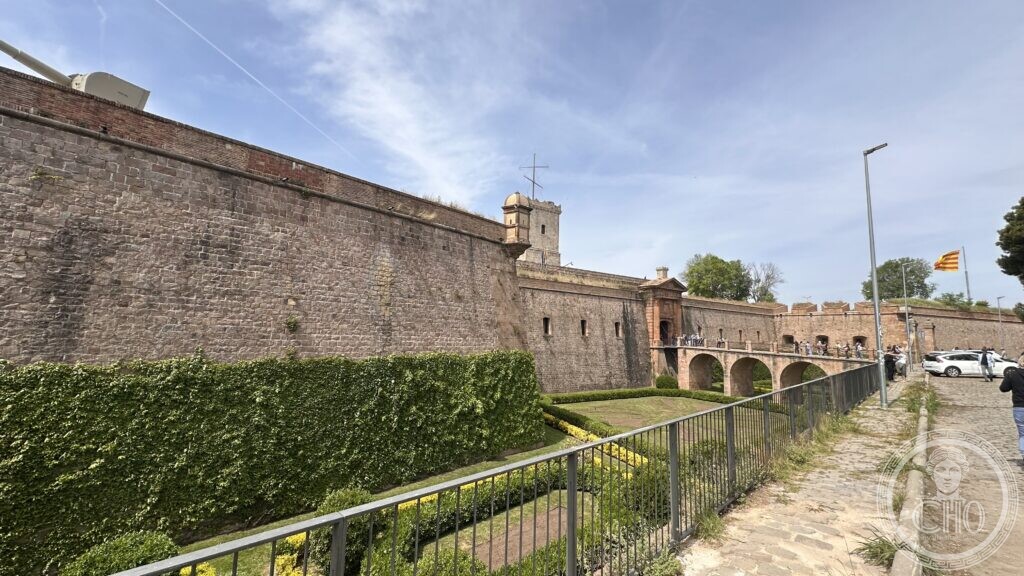
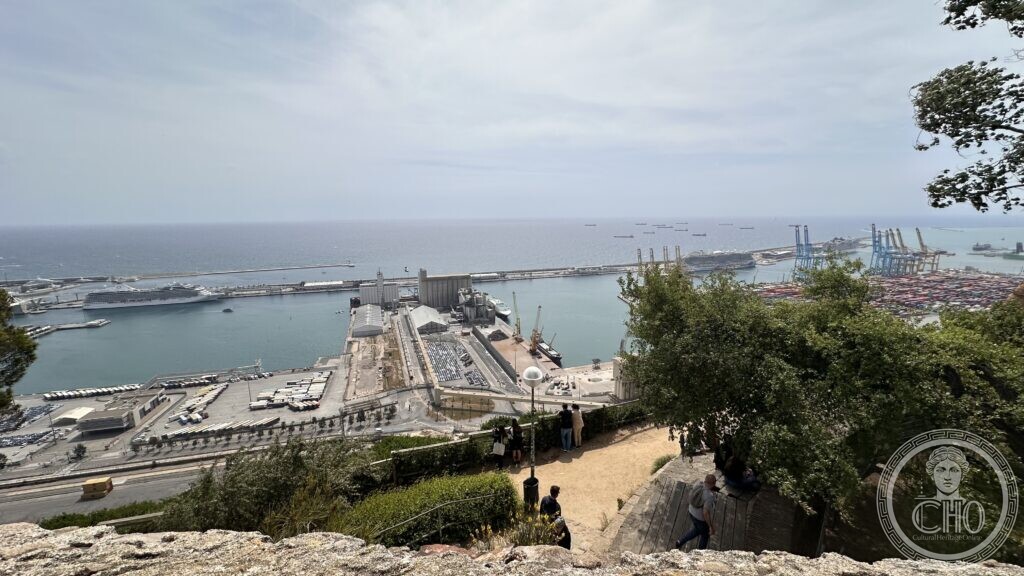
The approach crosses a stone bridge over a dry moat, now laid out as a garden of clipped hedges below the massive battered walls, to a gate set beneath the fortress’s tall central watchtower. From the ramparts, the star-shaped bastions — angled to give defenders clear lines of fire along every wall — open onto one of the widest views in Barcelona: the container cranes and breakwaters of the port immediately below, the Mediterranean beyond, and the city climbing away toward Tibidabo on the far side of the hill.
Key facts
- Location: Montjuïc hill, Sants-Montjuïc, Barcelona
- First fort: 1640, during the Reapers’ War against Philip IV
- Star fortress completed: 1751, by military engineer Juan Martín Cermeño
- Notable execution: Lluís Companys, president of the Generalitat of Catalonia, 15 October 1940
- Military museum: inaugurated 1963, closed after 2007
- Full transfer to Barcelona: 30 April 2007
- Coordinates: 41.3634° N, 2.1661° E
Getting there
Reachable by the Montjuïc cable car (Telèferic de Montjuïc) from Parc de Montjuïc, or by bus. Google Maps.
Photo gallery
Nearby
- Palau Nacional — MNAC — further down the hill of Montjuïc
- Plaça d’Espanya — at the foot of the hill
Sources
- Wikipedia (ES) — Castillo de Montjuïc — construction history, prison use, executions, transfer dates
Find it on the map
See this place and what’s around it →📷 Become a Cultural Heritage Online photographer
Share your photos of places: they stay published under your name as the author. The more they're seen, the more you get noticed — and soon a contest will reward the most appreciated photos.
Log in or sign up free to add a photo