

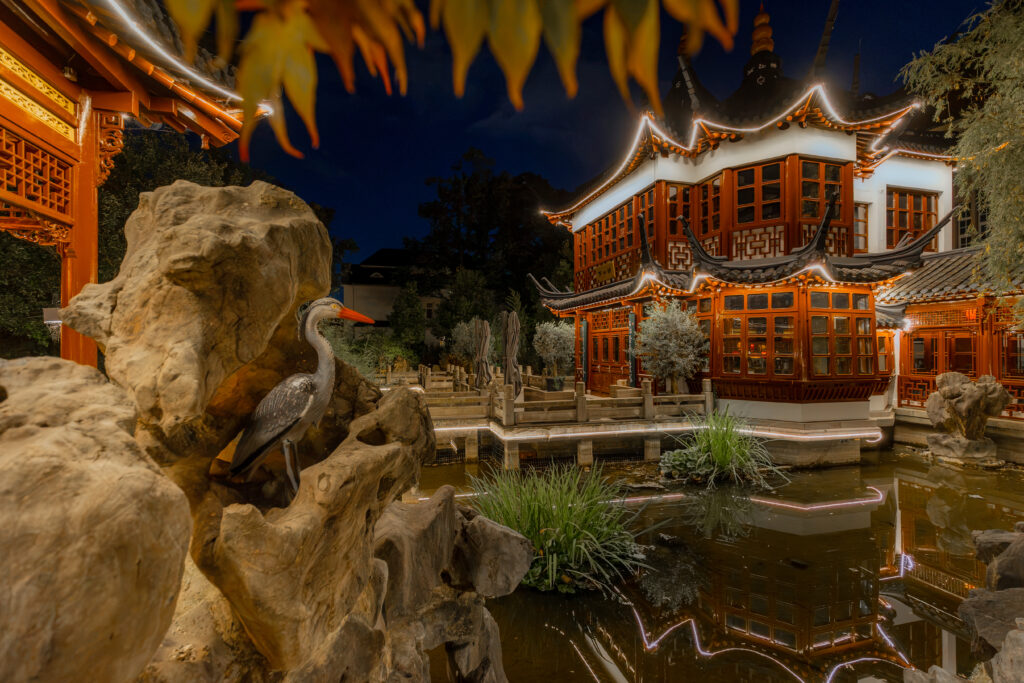
A garden between two cities: Shanghai’s historic Yu Yuan finds its echo on Feldbrunnenstraße, where architecture, water and stone have carried a forty-year partnership since 2008 — and, since September 2026, a new role as a place where Chinese intangible heritage is not just displayed but lived.
At a glance
Yu Garden Hamburg is a walled Chinese garden and teahouse ensemble of about 3,400 square metres in the Rotherbaum quarter, its architecture and layout drawn from Shanghai’s Yu Yuan and its teahouse modelled on the Ming-dynasty Huxinting, the “Mid-Lake Pavilion” that still stands there today. Built as architectural expression of the sister-city partnership between Hamburg and Shanghai, signed in 1986, the garden pairs two distant places through a shared architectural language rather than a shared address. Since September 2026 it has also housed the China Intangible Cultural Heritage Overseas Experience Center, opened for the partnership’s fortieth anniversary.
History
Hamburg and Shanghai became sister cities in 1986. Two decades on, that partnership found architectural form: ground was broken on Feldbrunnenstraße in November 2007, and Hamburg’s First Mayor Ole von Beust opened the finished garden on 25 September 2008 together with a delegation from Shanghai. From 2013 the complex housed the Confucius Institute at the University of Hamburg. Weather damage later closed the garden for renovation; it reopened on 17 January 2020 at a ceremony attended by Hamburg’s First Mayor Peter Tschentscher and the Chinese Consul General, under a new operating team.
On 3 September 2026, the garden gained a further role: the China Intangible Cultural Heritage Overseas Experience Center was unveiled on site, under the motto “Weite Horizonte – Lebendiges Erbe” (“Broad Horizons – Living Heritage”). The opening brought together Chinese Consul General Lin Dong, Hu Junjie, Vice President of YUYUAN Inc., Chen Qiuyi, president of the Hamburger China-Gesellschaft, and Corinna Nienstedt of the Hamburg Senate Chancellery. The centre’s premise is that intangible heritage — a craft, a ceremony, a taste, knowledge passed from one generation to the next — is best understood not from a distance but through direct encounter, which is what the garden’s tea culture and craft programming now aims to offer.
What you see
The teahouse pavilion stands over a koi pond crossed by a zigzag bridge that slows the crossing on purpose, so the view changes with every few steps rather than arriving all at once. Its red-lacquered timber frame and upturned tiled eaves are lit at night along every roofline; weathered Taihu limestone, prized in Chinese garden design for its water-worn, perforated shapes, rises directly from the water’s edge among bamboo and pruned trees. The effect, by design, is a landscape meant to be discovered gradually rather than surveyed at a glance.
Practical information
- Restaurant and tea pavilion open Tuesday–Sunday, 12:00–23:00 (closed Monday); phone +49 40 3750 2020.
- Event spaces of 15–200 m² are available for hire within the garden.
- Programming for the China Intangible Cultural Heritage Overseas Experience Center — workshops, demonstrations, seminars — is announced through Yu Garden Hamburg’s own channels.
Getting there
The garden sits on Feldbrunnenstraße in Rotherbaum, within walking distance of Hamburg Hauptbahnhof and the Dammtor and Stephansplatz stations. Google Maps.
Photo gallery
Nearby
- Hamburg — the city overview
Sources
- Wikipedia (DE) — Yu Garden — address, size, construction dates, 1986 partnership, 2020 reopening and management
- Hamburg Kulturbehörde — press release, reopening 2020 — address, new operating team, opening date
- Klönschnack — Hamburg and Shanghai strengthen cultural exchange at Yu Garden — 3 September 2026 opening of the China Intangible Cultural Heritage Overseas Experience Center, names and motto
- Yu Garden Hamburg (official site) — current opening hours and contact
Find it on the map
See this place and what’s around it →Record researched and written by Carla Szathvary for Cultural Heritage Online, 2026.
📷 Become a Cultural Heritage Online photographer
Share your photos of places: they stay published under your name as the author. The more they're seen, the more you get noticed — and soon a contest will reward the most appreciated photos.
Log in or sign up free to add a photo