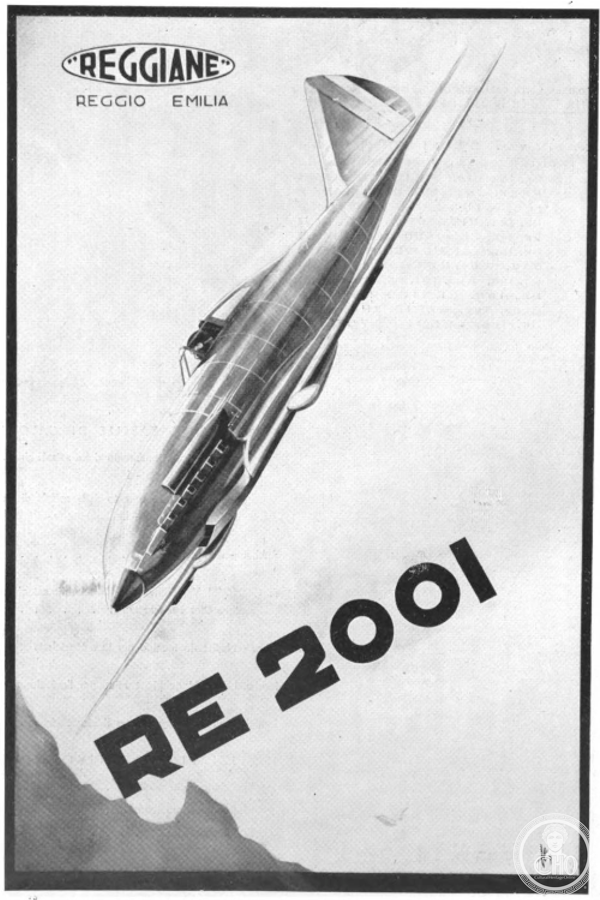
The aeroplane is climbing away from the reader, and you can see straight through it. The guns are there, the frames, the tank, the pilot’s seat, all drawn as though the skin had been peeled off and left as a film of glass. It is an odd way to sell an aircraft, and it tells you who the advertisement was for.
The sheet is plain. Top left, in a period lozenge, the maker: «REGGIANE», and beneath it REGGIO EMILIA. The rest of the page is given to a single monochrome drawing, a fighter seen from below and behind as it banks up and to the right, with the ground blocked in as a dark wedge in the corner. Along the lower right, laid in perspective so that it recedes with the aircraft, the type: RE 2001. Down in the corner of the frame there is a small ink monogram, two strokes crossing, which reads as an A and a K joined.
What the drawing shows
The transparency is not decoration; it is the whole content. An advertisement in an aviation magazine could not show a fighter doing anything — the performance figures were secret and a photograph of an aeroplane in the air says nothing that another aeroplane does not also say. So the draughtsman drew the machine instead of the flight: the ribs of the wing, the ammunition boxes, the fuel tank behind the cockpit, the tailwheel retracted into its well. The reader of an aeronautical magazine in the early 1940s was, more often than not, a man who wanted to see the mechanism. He was given it.
Reggio Emilia, from railway wagons to fighters
The Officine Meccaniche Reggiane began in August 1901 as the Officina Meccanica e Fonderia Ing. Romano Righi e C., founded at Reggio Emilia by the Modena engineer Romano Righi with his father Policarpo and with Giuseppe Menada. Menada ran the local railway company and made sure the new works had orders: it started by building and repairing goods wagons. It became the Società Anonima Officine Meccaniche Reggiane in 1904 and Reggiane Officine Meccaniche Italiane S.A. in 1912, expanded into artillery shells during the First World War, and in 1918 came into contact with Caproni — the group that would take control of it in the 1930s and turn a wagon works into an aircraft factory.
The Re.2001 was the second of its fighters. In the summer of 1939 the Italian Air Ministry obtained German Daimler-Benz DB 601 engines for evaluation — inverted-V twelve-cylinder units, liquid-cooled, of about 1,175 CV — at the moment when the prototype of the Reggiane Re.2000 «Falco», a radial-engined fighter, was being tested. Roberto Longhi, who had designed the Re.2000, was asked to fit the German engine into it. The changes were not radical: the forward fuselage was made slimmer and longer, and the aircraft that came out of it was the Re.2001, unofficially the «Falco II». Two hundred and thirty-seven were built. The Regia Aeronautica used them in the Mediterranean, above all over Malta, as interceptors, fighter-bombers and night fighters, and the airframe became the basis of the later Re.2005 and Re.2006.
The slim, pointed nose in the drawing is the mark of that engine. It is the one thing on the sheet that dates it: an aircraft with a DB 601 in it could not have been advertised before 1940.
The monogram, and a name we could not confirm
The collector who owns the sheet gives it to Aurelio Craffonara, «signing AK», and dates it to 1941. We have not been able to confirm either half of that. The Dizionario Biografico degli Italiani records Craffonara as born at Gallarate on 15 September 1875 and dead at Genoa on 5 February 1945 — not on the 20th, as the note that came with the scan has it — a watercolourist and illustrator who worked on posters, postcards and children’s books, and who signed his journalism with the pen-name Pallestrina Goito. No AK monogram is recorded for him there, and no catalogue of this particular sheet has been found. What is certain is only what is on the paper: a small joined monogram in the corner, in a hand we cannot put a name to. The sheet is therefore published here without an author.
About this image. The work is still protected by copyright: under Italian law (L. 633/1941) rights run for 70 years from the death of the author. Since the author has not been identified, that term cannot be considered expired, and the image is treated as fully protected. It is reproduced here for documentation, study and critical purposes only, under Art. 70 of L. 633/1941 and the fair-use provision of 17 U.S.C. §107. The scan was made by the collector from his own copy of the sheet, part of the period material he keeps in a private archive: owning the physical sheet is not the same as holding the rights to the work. The image is not offered for sale, no reproduction rights are granted, and any request concerning the work should be addressed to the rights holders. Cultural Heritage Online publishes this material to document it, with no celebratory intent; see our terms and the DMCA contact published there.
Sources
- S1 — Govi, Sergio. I reggiani dalla A alla Z: Descrizione tecnica e storia dei caccia Reggiane. Giorgio Apostolo Editore, 1985. ISBN 978-88-87261-10-3.
- S2 — Curami, Andrea, e Gianni Rocca. Savoia Marchetti: Ali d'Italia. La Bancarella Aeronautica, 2000. ISBN 978-88-88402-05-5.
Spotted an error? Write to editorial@culturalheritageonline.com and we correct it the same day.