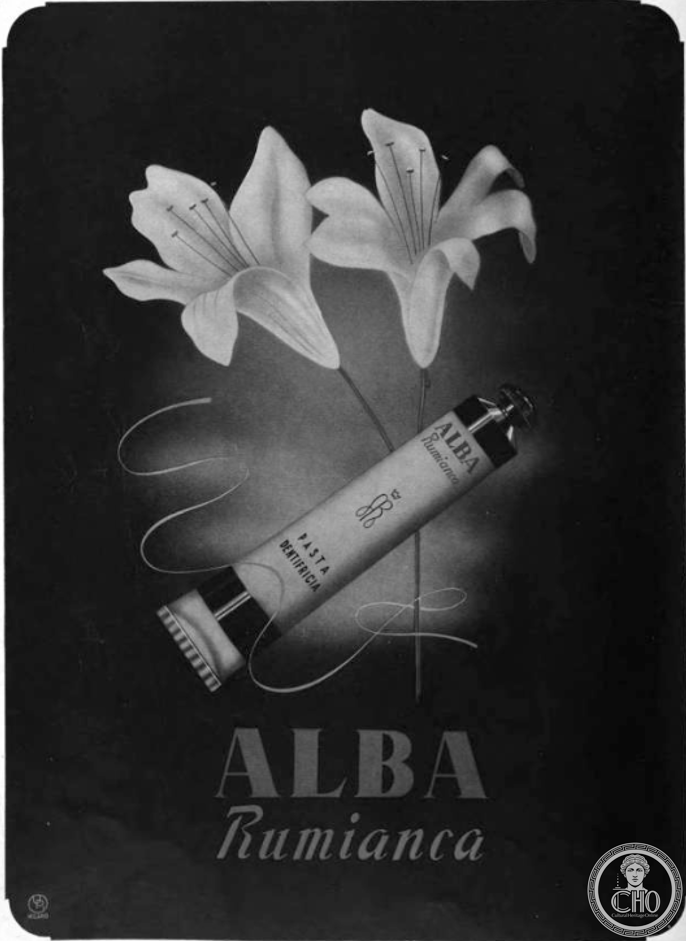
Almost the whole sheet is black. Out of it come two white lilies, open, lit from the left, and lying across their stems a tube of toothpaste with its cap towards the light. Underneath, in an outline capital and a hand-drawn italic: ALBA, Rumianca. Nothing else — no claim, no slogan, no price.
It is a photographic composition rather than a drawing, in the manner of the better Italian advertising of the war years: a dark ground, a single raking light, two or three objects and no text to speak of. The tube carries its own small print — ALBA, Rumianca, a monogram, and PASTA DENTIFRICIA down the side. A thin white line loops behind the objects like a ribbon of light. Bottom left, very small, a circular studio device with a monogram inside it and a word under it that ends in —ANO.
The lily and the chlorine
The name is a promise about whiteness and morning, and the lilies say the same thing twice. What is worth knowing is the company behind them. Rumianca was born at Genoa in 1915 as the Chimico Mineraria Rumianca, taking its name from the works it opened that same year in the village of Rumianca, in the upper Ossola — today part of Pieve Vergonte. In 1922 the head office moved to Turin; only in 1941 did the firm settle on the name Rumianca S.p.A.
Its business was heavy secondary chemistry: caustic soda, ammonia, carbon disulphide, carbon tetrachloride, sulphuric acid, chlorosulphonic and formic acid, oleum, chloral, resins, chlorine, and later DDT. Alongside those it made products for agriculture and for the house, and that is the shelf this tube belongs to. The distance between the two lists is the interesting part of the sheet: a firm whose plant existed to turn Alpine hydroelectric power into chlorine also needed a name that could be spoken in a bathroom, and paid a photographer to build one out of two lilies.
Rumianca went on. In 1967 most of its capital passed to SIR, and the group became SIR-Rumianca; after the chemical crisis of 1981 Eni took over what was left, and by way of Anic and EniChimica the plants ended in EniChem Synthesis. The toothpaste did not survive the journey.
What is not settled
The note that came with the scan gives the studio as Arostudio Boroni of Milan and the publication as Lo Stile, number 37 of January 1944. The device in the lower left corner is real — a small circle with a monogram and a place-name that could be Milano — but at the resolution available it cannot be read with confidence, and we have found no record of a studio of that name. The sheet is published here without an attribution and without a date. What it does carry, plainly, is the brand, the product and the company; that is enough for it to be worth keeping.
About this image. The work is still protected by copyright: under Italian law (L. 633/1941) rights run for 70 years from the death of the author. Since the author has not been identified, that term cannot be considered expired, and the image is treated as fully protected. It is reproduced here for documentation, study and critical purposes only, under Art. 70 of L. 633/1941 and the fair-use provision of 17 U.S.C. §107. The scan was made by the collector from his own copy of the sheet, part of the period material he keeps in a private archive: owning the physical sheet is not the same as holding the rights to the work. The image is not offered for sale, no reproduction rights are granted, and any request concerning the work should be addressed to the rights holders. Cultural Heritage Online publishes this material to document it, with no celebratory intent; see our terms and the DMCA contact published there.
Sources
- Rumianca — foundation at Genoa in 1915, the works at Rumianca (Pieve Vergonte), the move to Turin in 1922, the name Rumianca S.p.A. from 1941, the product range including goods for domestic use, and the later passage to SIR and Eni
- The sheet itself, for the brand, the wording on the tube and the studio device in the lower left corner.