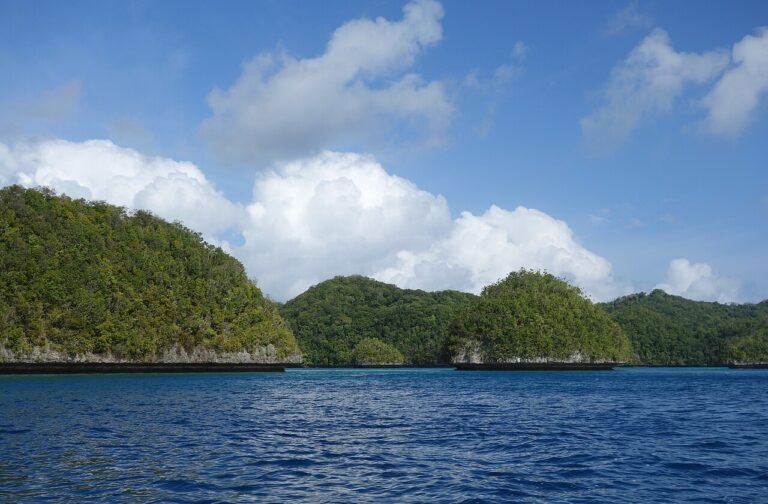
Nan Madol: Ceremonial Centre of Eastern Micronesia, inscribed in 2016 and immediately placed on the World Heritage in Danger list, is the most remarkable archaeological site in Oceania — 92 artificial islets of interlocking basalt prisms and coral fill built in a tidal flat southeast of Pohnpei island, the ceremonial capital of the Saudeleur dynasty (c. 1100–1628 CE) and the only ancient city in the world built on a coral reef.
Nan Madol: The Venice of the Pacific Pohnpei island, Federated States of Micronesia, western Pacific Ocean
Nan Madol: Ceremonial Centre of Eastern Micronesia (inscribed in 2016 under criteria (i), (iii), and (vi), and simultaneously placed on the World Heritage in Danger list) is the largest archaeological site in Micronesia and one of the most significant in the Pacific Islands — a complex of 92 artificial islets (total area approximately 1.8 km²) built in the tidal flat (mangrove swamp) southeast of the main island of Pohnpei, connected by a network of tidal canals (hence the nickname “Venice of the Pacific”), constructed from approximately 950,000 tonnes of interlocking basalt logs (prismatic basalt, the naturally occurring hexagonal basalt columns like those of the Giant’s Causeway or Fingal’s Cave) and coral fill. The site was the ceremonial capital of the Saudeleur dynasty — the rulers who unified and controlled Pohnpei from approximately 1100 to 1628 CE, until their overthrow by the legendary hero Isokelekel and his 333 warriors from the Kosraean island. The Saudeleur rulers built Nan Madol as a royal compound separate from the main island — isolating the ruling lineage from the commoner population in a pattern reminiscent of the Forbidden City of Beijing or the Kremlin of Moscow, but constructed of stacked basalt prisms in a coral reef environment unique in world architecture. The most significant structure is Nandauwas (the royal mortuary compound) — a basalt-walled enclosure 20 metres tall with walls 1.5 metres thick, containing the burial tombs of the Saudeleur rulers.
The Engineering of Nan Madol Nan Madol archaeological site, southeastern Pohnpei
The construction of Nan Madol over a 350-year period (950–1300 CE approximately) required the transport of approximately 950,000 tonnes of basalt prisms from quarry sites on the opposite (northwestern) coast of Pohnpei — a distance of approximately 20 km by sea, around the island, navigated in double-hulled canoes. The basalt prisms (which can weigh up to 5 tonnes each, though most are 5–50 kg) were quarried at Sokehs Rock, a spectacular volcanic basalt plug on the northwest coast of Pohnpei, and at several other basalt outcrops on the island; they were transported by lashing them to floating log rafts towed by canoe across the open lagoon of Pohnpei (a crossing that required navigating through the reef passage and around the island). The transport mechanism has fascinated archaeologists and engineers since Nan Madol’s first documentation by European visitors in the 1820s; Pohnpeian oral tradition attributes the construction to the twin sorcerers Olsihpa and Olsohpa, who used magic to fly the stones into place. The largest structure, Nandauwas, required approximately 150,000–200,000 tonnes of basalt for its walls alone. The islets were created by filling the coral reef with basalt stones and coral rubble to create platforms above the high tide line, then building the residential and ceremonial structures on these platforms.
Practical information
Pohnpei (formerly Ponape) is served by United Airlines from Guam (2.5 hours, 2–3 times weekly) and Honolulu (7+ hours with stop, less frequent). The Federated States of Micronesia (FSM) are in Compact of Free Association with the United States; US citizens do not need a visa, and most other nationals can enter without a visa for 30 days. Nan Madol is accessible from Kolonia (the capital of Pohnpei) by motorboat (45 minutes across the lagoon) or by road to the mangrove landing (15 minutes by car + 20 minutes by boat). Entry to the site requires a permit from the Pohnpei Historic Preservation Office (approximately USD 10–15). The site is best visited with a local guide (who can interpret the oral traditions and navigate the canal system). The vegetation overgrowth is significant — many of the secondary islets are heavily covered in mangrove — and the site is partially inundated at high tide. The best time to visit is during the dry season (April–June and October–November); Pohnpei is one of the wettest places on Earth (average annual rainfall: 7,600 mm), so even the dry season is rainy by mainland standards.
Frequently Asked Questions
Is Nan Madol a UNESCO World Heritage Site?
Yes. Nan Madol: Ceremonial Centre of Eastern Micronesia was inscribed in 2016 under criteria (i), (iii), and (vi), and was simultaneously placed on the World Heritage in Danger list due to its threatened condition — vegetation overgrowth destroying the basalt walls, lack of conservation management, and sea-level rise threatening the low-lying coral-fill islets. The FSM has committed to a conservation plan; Nan Madol is the only UNESCO World Heritage Site in Micronesia and one of two in the entire Pacific Islands subregion (the other is East Rennell, Solomon Islands, natural).
What was the Saudeleur dynasty?
The Saudeleur dynasty (from “Sau Deleur,” meaning “lords of Deleur,” with “Deleur” being the ancient name for Pohnpei) were the rulers who unified Pohnpei under a single authority from approximately 1100 to 1628 CE — a period of approximately 500 years during which 16 successive Saudeleur rulers controlled the island from their isolated ceremonial capital at Nan Madol. The Saudeleurs are remembered in Pohnpeian oral tradition as increasingly tyrannical rulers who demanded tribute, corvée labour, and ritual homage from the commoner population; they are said to have required that each household bring a live turtle to Nan Madol as tribute annually. The dynasty ended with the invasion of Isokelekel (a legendary figure from Kosrae or, in some traditions, from a supernatural realm), who defeated the last Saudeleur, Saudeleur Saueunlap, and established the Nahnmwarki system (a more distributed chieftainship that still governs Pohnpei today). The end of the Saudeleur dynasty corresponds approximately to the abandonment of Nan Madol as an active political centre, though some ceremonial use continued into the early historic period.
How is Nan Madol similar to and different from other ancient urban centres?
Nan Madol resembles other ancient capital cities in its separation of a ruling elite from the general population (a pattern seen in the Forbidden City of Beijing, the Vatican in Rome, the Kremlin in Moscow, and the ceremonial precincts of Mesoamerican cities like Teotihuacan). Its uniqueness derives from its construction medium and environment: built entirely of basalt prisms and coral fill in a tidal mangrove flat on a Pacific coral reef, with no foundation other than the reef itself, using no mortar (the basalt prisms are simply stacked in a log-cabin interlocking pattern), and accessible only by water. There is no comparable site anywhere in Oceania or in the world: no other ancient civilization built its capital city on an artificial platform in a coral reef environment. The closest analogy (artificial island construction for urban purposes) is found in the Aztec capital Tenochtitlan, built on Lake Texcoco in Mexico — but Tenochtitlan was built on a lake, not on a reef, and used different construction methods.
Sources
- S1 — Hanlon, David. Upon a Stone Altar: A History of the Island of Pohnpei to 1890. University of Hawaii Press, 1988. ISBN 978-0-8248-1124-2.
- S2 — Rainbird, Paul. The Archaeology of Micronesia. Cambridge University Press, 2004. ISBN 978-0-521-65630-6.
Spotted an error? Write to editorial@culturalheritageonline.com and we correct it the same day.