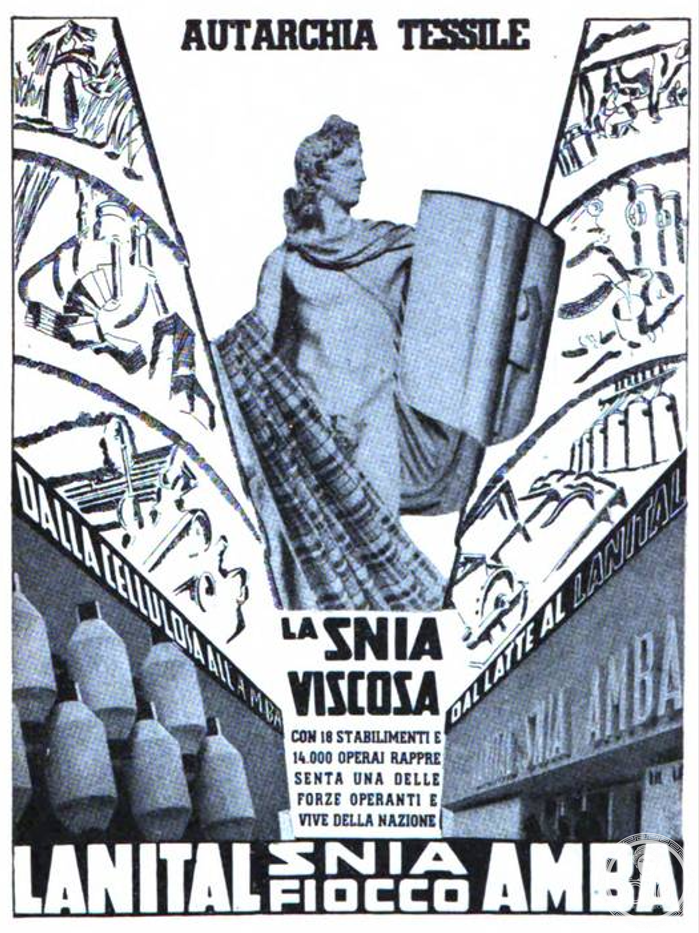
A Roman statue with a shield stands where a fashion model ought to be, and over its marble shoulder hangs a length of checked cloth — real cloth, photographed. The cloth is the miracle on offer: it began, one of the page’s diagonal bands explains, as milk.
The slogan across the top is «AUTARCHIA TESSILE». Two bands run down the page like the sides of a V: one reads «dal latte al Lanital» — from milk to Lanital — the other traces the parallel route from cellulose to fibre. Between them, drawn side panels show the stages of the work — cows, vats, spinning — while a photographed rank of spinning cones fills the lower left and a factory front with the company’s sign the lower right. The central caption states the scale: «LA SNIA VISCOSA, with 18 factories and 14,000 workers, represents one of the working and living forces of the nation». And along the foot, in the largest type on the page, the products: LANITAL — SNIA FIOCCO — AMBA.
Wool out of milk
Lanital was the most theatrical of all the autarkic fibres. In 1935 the Italian chemist Antonio Ferretti found a way to spin a wool-like fibre from casein, the protein of milk; SNIA Viscosa industrialised the process, and from 1937 until the end of the war the fibre was sold as Lanital, to enormous official fanfare — in the sanctions years after the Ethiopian war the regime made it a symbol of self-sufficiency, celebrated even in a popular song of 1937, «Il miracolo della lana». The fibre behaved much like wool — warm, soft, moth-resistant — though it wore out faster, and after the war SNIA tried to relaunch it under other names. The company itself, listed on the Milan exchange from 1922, was the giant of Italian artificial fibres; the sheet’s own figures — eighteen plants, fourteen thousand workers — are its argument for belonging among the «working and living forces of the nation».
Marks and date
The sheet carries no printed date; Lanital’s commercial life places it between 1937 and the war years. We found no legible signature on the scan, and the sheet is published without an attribution. The statue-and-product formula — antiquity vouching for chemistry — is the same one the campaign used for Bemberg’s cupro silk, and the two sheets read as siblings.
About this image. The work is still protected by copyright: under Italian law (L. 633/1941) rights run for 70 years from the death of the author. Since the author has not been identified, that term cannot be considered expired, and the image is treated as fully protected. It is reproduced here for documentation, study and critical purposes only, under Art. 70 of L. 633/1941 and the fair-use provision of 17 U.S.C. §107. The scan was made by the collector from his own copy of the sheet, part of the period material he keeps in a private archive: owning the physical sheet is not the same as holding the rights to the work. The image is not offered for sale, no reproduction rights are granted, and any request concerning the work should be addressed to the rights holders. Cultural Heritage Online publishes this material to document it, with no celebratory intent; see our terms and the DMCA contact published there.
Sources
- S1 — Marchi, Cesare. La Snia Viscosa e il miracolo del rayon. Mondadori, 1978. ISBN 978-88-04-15210-1.
- S2 — Bairati, Piero. Sul filo di lana: Cinque generazioni di imprenditori e la grande industria. Il Mulino, 1986. ISBN 978-88-15-01157-2.
Spotted an error? Write to editorial@culturalheritageonline.com and we correct it the same day.