

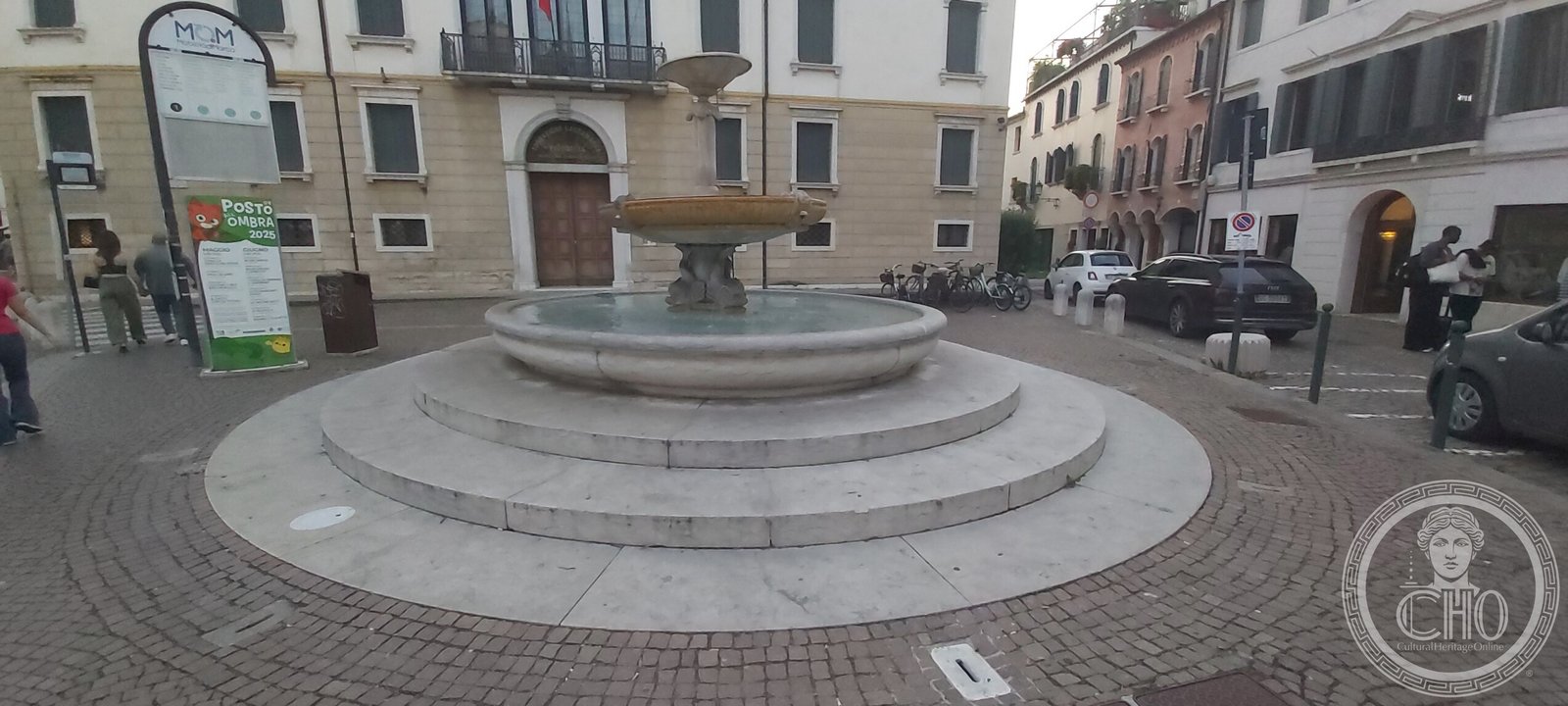
The name was dropped after the war. The reason for the name was not: the top basin still rests on four fasces, bound and crowned with laurel, in the middle of an ordinary square where people park their bicycles.
At a glance
Three oval marble basins rise from a podium of steps in Piazza San Leonardo, opposite the gate of Ca’ Spineda. The fountain was designed in 1929 by Luigi Candiani, built in about two months and paid for with 36,000 lire. It was called the Fontana del Littorio, and the name was justified by the small column under the highest basin: a bundle of four slender fasces, capped by a capital of laurel festoons.
Key facts
- Architect: Luigi Candiani (Mareno di Piave 1888 – Treviso 1993)
- Built: 1929, in roughly two months
- Cost: 36,000 lire — 23,200 for materials, 13,000 for labour and plant
- Materials: olive marble from Valdagno and rosa corallo marble, on a reinforced-concrete base, with porphyry paving and a trachyte step
- Form: three oval basins; the middle one on four dolphins, its axes 2.95 m and 1.95 m; four stylised lion heads; a pine cone on the upper basin
- Water: eight jets from the mouths of the dolphins, four from the lion heads, one from the top
- Original name: Fontana del Littorio
- Address: Piazza San Leonardo, Treviso
History
The fountain replaced an older one on the square, probably of the type still standing in Piazza Pola. Candiani was in his early forties and had not yet opened the Treviso studio that would make him the most prolific architect in the province; he would also design the facade of the church of San Leonardo, which closes this same square, and in the following year the Palazzo del Littorio in Piazza San Vito.
Treviso argued about it, in print. Local newspapers ran satirical verse and cartoons on the new fountain, and at least one poet came to its defence in dialect, calling it assae bela — quite beautiful — against critics who complained about its perspective. It is worth recording that a piece of regime street furniture could be publicly mocked in 1929 for being badly proportioned.
After 1945 the name went. The fasces did not, and this is the ordinary fate of such things: an inscription is easy to erase, a load-bearing member is not.
What you see
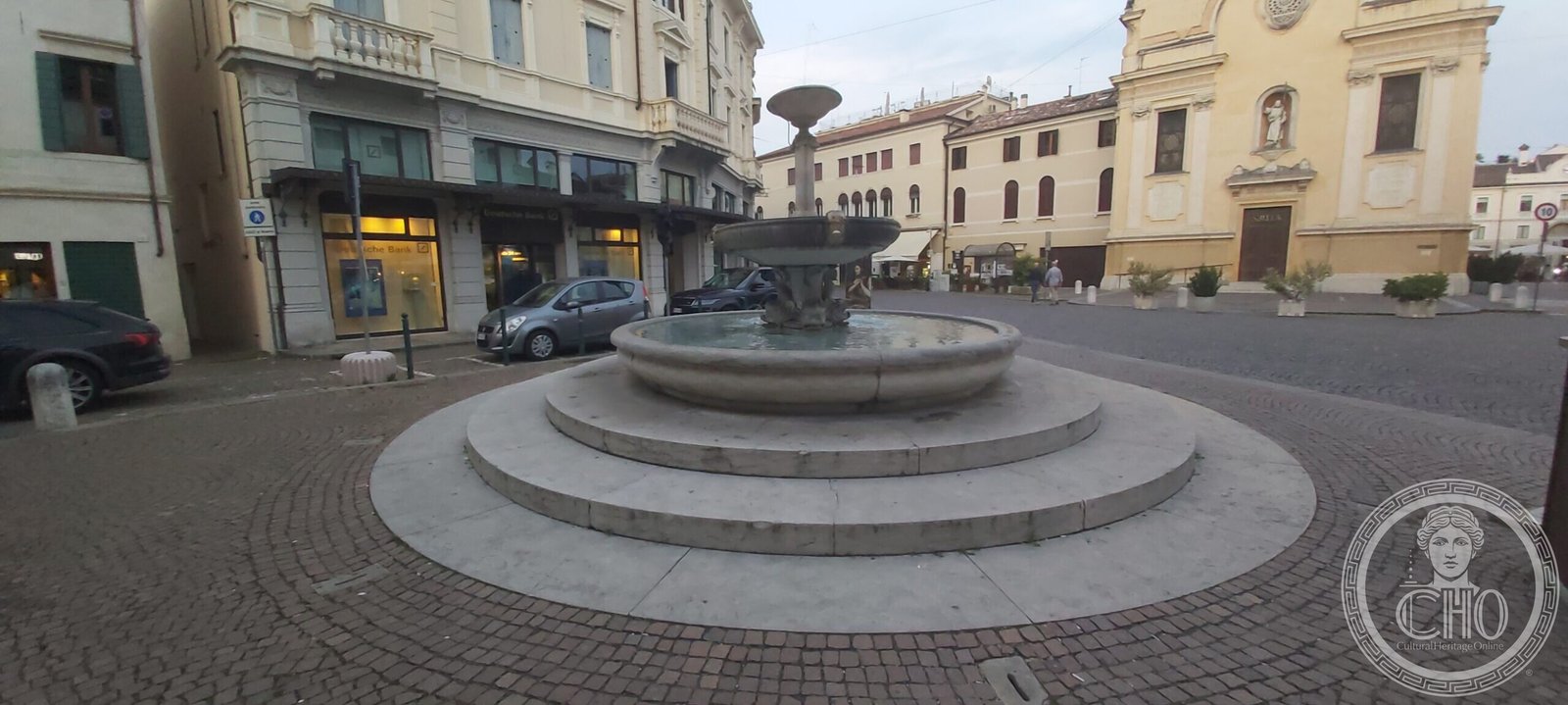
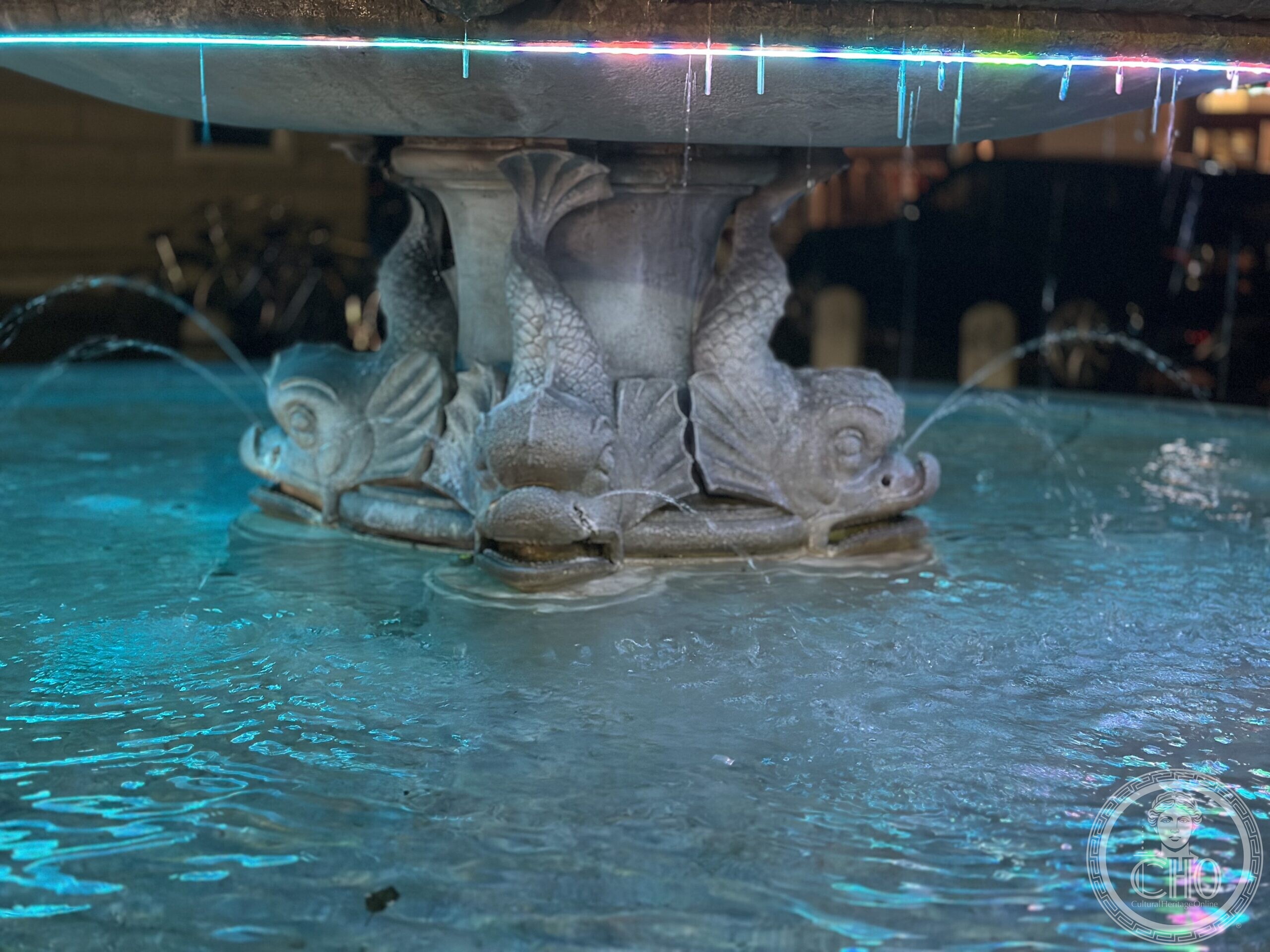
A circular podium of shallow steps, wide enough to sit on, with the lower basin set on it — six pieces of olive marble worked with polished cordelle. Four dolphins in the same marble carry the middle basin, which is of rosa corallo and has a stylised lion head at each end of its two axes. Above it the little column of four fasces, the laurel capital, the top basin, and on it a marble pine cone. When the jets are running the water falls in three stages, from the cone to the upper bowl, from the lion heads and dolphin mouths to the middle, from the middle to the pool.
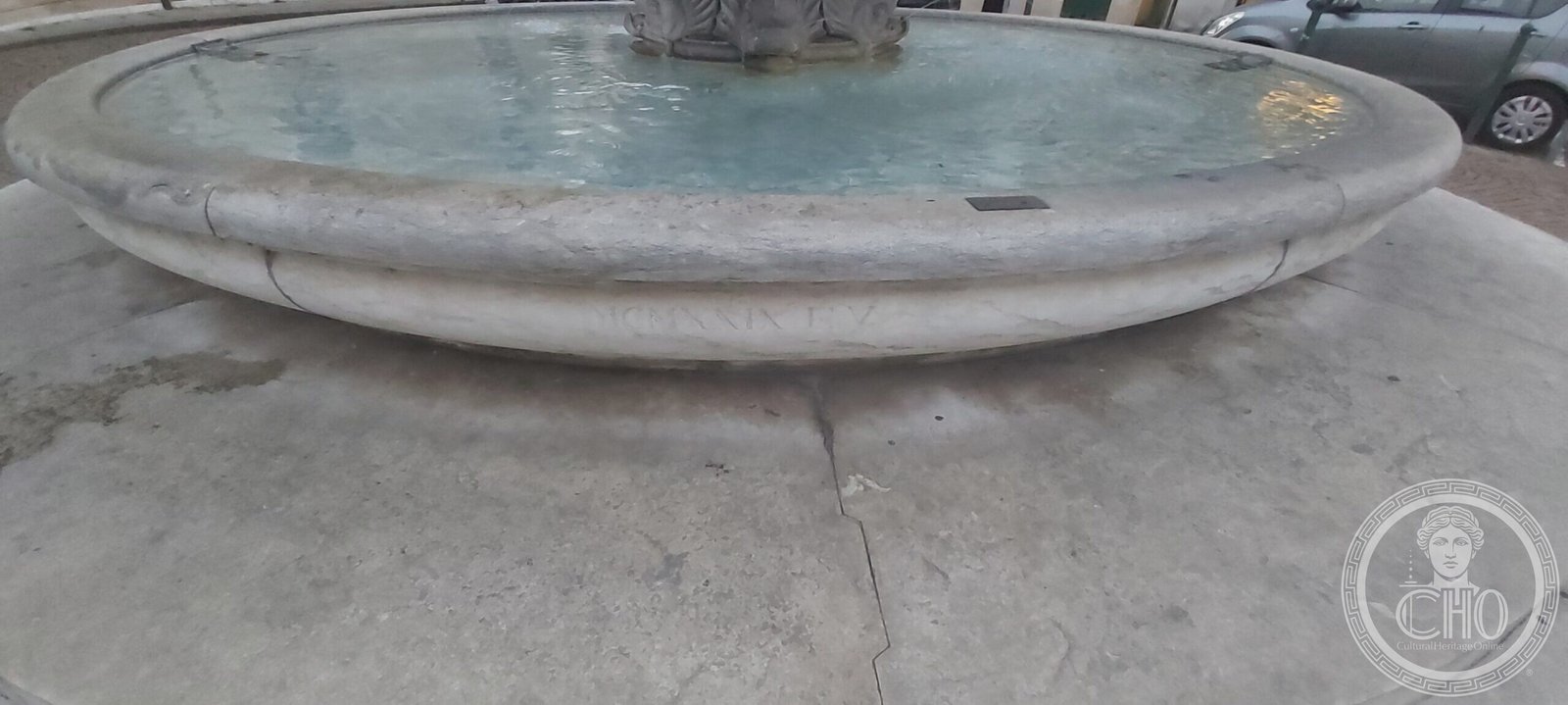
The date is on the stone. Cut into the moulding of the lower basin, in widely spaced Roman capitals, runs MCMXXIX · E·V — 1929, era volgare: the ordinary calendar. The regime counted its own years too, from October 1922, and stamped that count on a great deal of what it built; here it is the common era that is cut into the marble, and the fascist year is nowhere on the fountain. The fasces above say one thing, the dating below says another, and both were carved at the same moment.
Reading the fountain
Fascist emblems that survive in Italian public space are usually there because removing them would mean rebuilding something. That is the case here, and we publish the fountain as what it is: a well-made piece of 1929 municipal design whose structure incorporates the symbol of the party that paid for the square. No celebration is intended, and none is needed — the object explains itself better than a caption could.
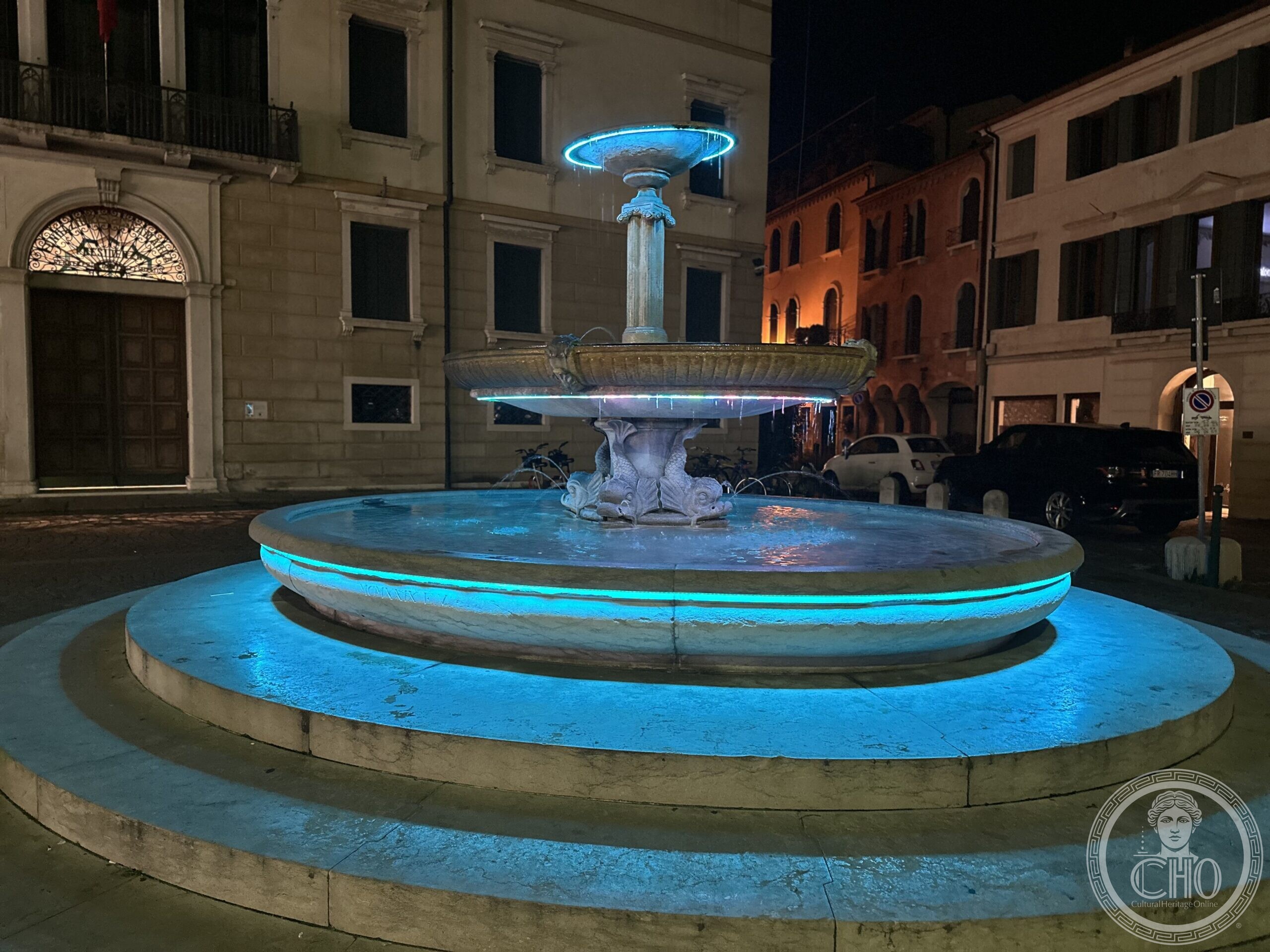
The fountain at night
Photographs by Luigi De Marchi.
Practical information
- Public square, always accessible, no charge.
- The lion heads and the fasces are best seen from the steps, close to.
- Allow 10 minutes; Piazza San Vito and Piazza dei Signori are a two-minute walk west.
Getting there
Piazza San Leonardo is in the walled centre of Treviso, opposite Ca’ Spineda. GPS: 45.66607, 12.24843 — open in Google Maps.
Nearby
- Palazzo del Littorio — Treviso — Candiani’s building of the following year, in Piazza San Vito.
- Fontana di Piazza San Vito — the other fountain of these years, and the one that is often confused with this.
- Edificio ex GIL — Treviso
Sources
- Wikipedia (Italian) — Fontana di piazza San Leonardo: Candiani’s authorship and the 1929 date; roughly two months of work; the cost of 36,000 lire broken into 23,200 for materials and 13,000 for labour and plant; olive marble from Valdagno and rosa corallo; the three oval basins, the four dolphins, the four stylised lion heads, the axes of 2.95 m and 1.95 m, the pine cone; the eight dolphin jets, four lion jets and one from the top; the column of four fasces with laurel capital; the original name; the position opposite Ca’ Spineda; the fountain it replaced; the satirical verse and cartoons in the local press and the dialect poem calling it assae bela.
- Wikipedia (Italian) — Luigi Candiani (architetto): his dates and his Treviso works, including the facade of San Leonardo and the fountain of that square.
- The inscription MCMXXIX · E·V was read from the contributor’s photograph of the basin rim; the description of the basins was made from his photographs.
Find it on the map
See this place and what’s around it →Record researched and written by Stefano Vigolo for Cultural Heritage Online, 2026.
📷 Become a Cultural Heritage Online photographer
Share your photos of places: they stay published under your name as the author. The more they're seen, the more you get noticed — and soon a contest will reward the most appreciated photos.
Log in or sign up free to add a photoRequest to use these images
Each photograph is by the person named on it. Cultural Heritage Online is the seller: it runs the payment, handles tax and delivers the file, and the photographer receives 70% of the price net of tax. Buying gives you the right to use the image in your own project — a website, an article, a presentation — with the file and a written licence. Read the Terms of Sale.
What you receive. The file as it is held in our archive: the photographer's own original, without the Cultural Heritage Online watermark, unretouched and not enlarged. This is a working archive built over many years by many people, so the files differ — some were taken recently, others years ago with the equipment of their time. Older pictures are usually smaller: a camera from fifteen or twenty years ago simply recorded fewer pixels than a phone does today, so the resolution is lower and the print comes out smaller. We say so rather than hide it. The size, weight, format and year of each one are printed below it, and the print size is given at 300 dpi. Nothing is upscaled to make a number look better. Where the picture on this page has been cropped for the layout, the file you receive is the full frame, which may be wider or taller than what you see here.
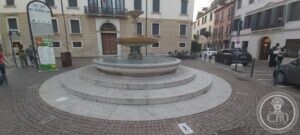
Fountain of Piazza San Leonardo, Treviso
Photo: Stefano Vigolo
€3.00
2546 × 1145 px · JPG · 901.1 KB
prints 22 × 10 cm at 300 dpi · taken 2025