

The shopkeepers of the square paid for it themselves and gave it to the city. It was a thank-you with a condition attached: they had been allowed to keep their market where it was.
At a glance
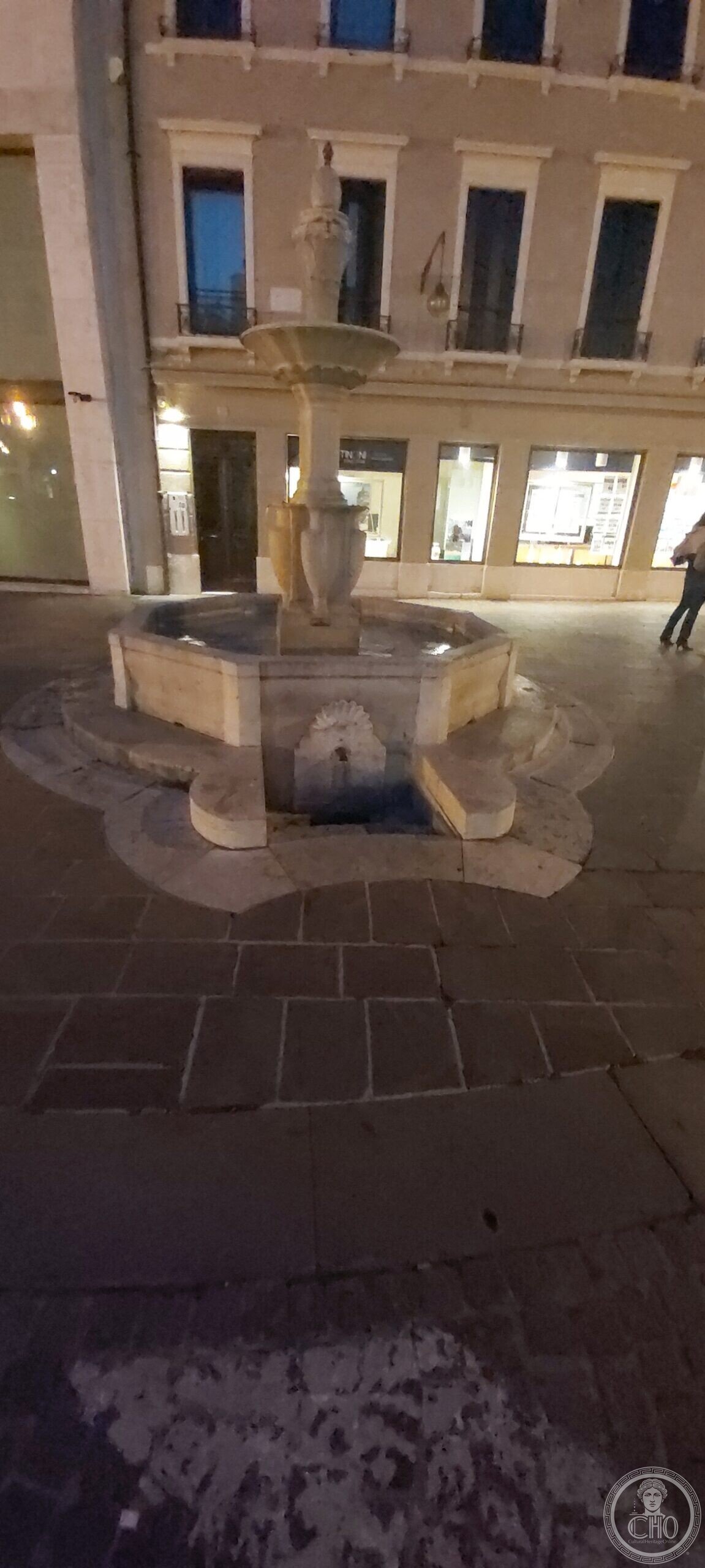
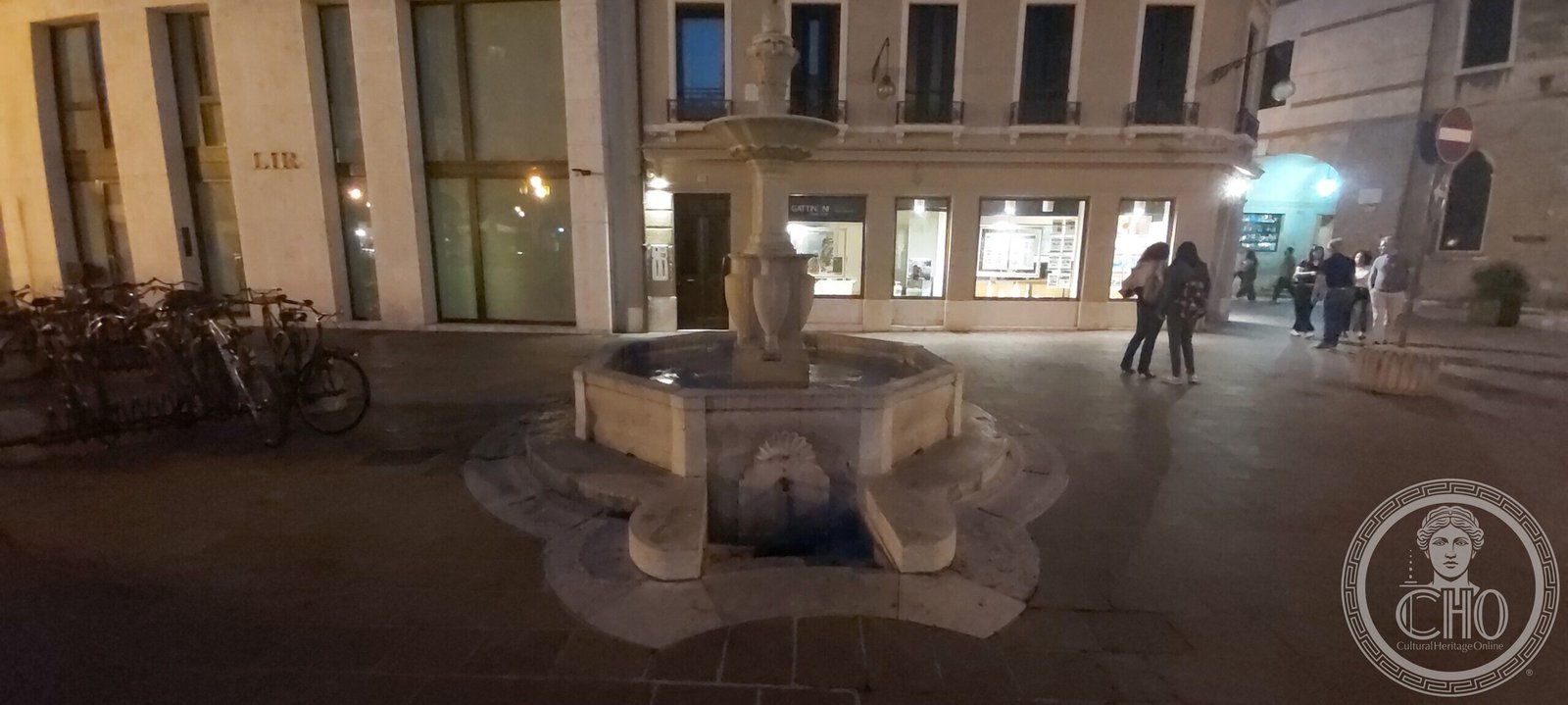
In the middle of Piazza San Vito, a step from Piazza dei Signori, stands a low fountain of Verona marble: an octagonal basin on a circular stepped base, a fluted column rising from the centre, a shallow bowl at the top. It was built in 1930, in the same works that gave the square its new paving and its Palazzo del Littorio, and it was unveiled with them on 28 October that year. It replaced an older fountain on the same spot.
Key facts
- Built: 1930, replacing an earlier fountain
- Unveiled: 28 October 1930, with the repaved square and the new party headquarters
- Materials: Verona marble on a circular stone base, with Grisignana stone
- Form: octagonal basin, fluted column, upper bowl
- Paid for by: the merchants of the square, who offered it to the municipality
- Designer: not named in the sources we have found — see the note below
- Address: Piazza San Vito, Treviso
History
Around 1930 Piazza San Vito — until then Piazza delle Prigioni — was rebuilt from the ground up. The paving and the fountain together took sixty-eight working days. Everything was unveiled on 28 October 1930, the eighth anniversary of the March on Rome, along with the other “public works completed in the seventh year in our Municipality”, as the official language of the day put it.
The fountain, though, did not come out of the public purse. It was wanted by the traders who worked the square and offered by them to the municipality, in acknowledgement that the market had been kept there rather than moved. That is an unusually candid piece of civic accounting, and it explains the position: dead centre, where the stalls stood around it.
A contemporary chronicle described the design as inspired by the Italian seventeenth century. It is a fair description of the intention rather than of the result: the fountain is quieter and flatter than any true Baroque model, and reads as a municipal object of its own decade.
What you see
A circular platform of two low steps, cut into a scalloped outline so that the paving flows around it. On the platform sits the basin: eight straight sides, a plain moulded rim, the water held shallow. From the middle rises a baluster and then a fluted column, read at the time as a bundle of stems from which an aquatic flower opens to form the cup. On the front face of the basin a carved mask spouts into a low trough at pavement level — the working part, at the height where a bucket or a dog could reach it.
It is deliberately unmonumental. Nothing about it is triumphal, nothing carries an emblem, and it survives untouched for exactly that reason: there was nothing on it to chisel off after 1945.
Who designed it
We cannot say. The renovation of the square between 1923 and 1930 involved the architect Luigi Candiani and the municipal technical office, and Candiani certainly designed the Palazzo del Littorio on the north side; our contributor attributes the fountain to the municipal technical office. But no source we have consulted names a designer for the fountain itself, and the entry that documents it most fully does not give one. Candiani’s fountain in Treviso is a different one, two minutes away in Piazza San Leonardo. Until a document says otherwise, this one stays unattributed.
Practical information
- Public square, always accessible, no charge.
- Five minutes will do it; the Palazzo del Littorio stands on the same square.
Getting there
Piazza San Vito is in the walled centre of Treviso, immediately east of Piazza dei Signori. GPS: 45.66656, 12.24573 — open in Google Maps.
Nearby
- Palazzo del Littorio — Treviso — on the north side of this square, unveiled the same day.
- Fontana di Piazza San Leonardo — the other fountain of these years, two minutes away, and the one that was called del Littorio.
- Civic Museums of Treviso — Santa Caterina
Sources
- Wikipedia (Italian) — Fontana di piazza San Vito: the 1930 date and inauguration of 28 October; Verona marble and Grisignana stone; octagonal basin on a circular base; the fluted column read as a bundle of stems opening into a water flower; sixty-eight working days for paving and fountain; the fountain offered by the square’s merchants in acknowledgement that the market was kept there; the contemporary chronicle’s reference to the Italian seventeenth century. The entry names no designer.
- Wikipedia (Italian) — Luigi Candiani (architetto): his Treviso works, which include the fountain of Piazza San Leonardo but not this one.
- The description of the basin, the platform and the spouting mask was made from the contributor’s photographs.
Find it on the map
See this place and what’s around it →Record researched and written by Stefano Vigolo for Cultural Heritage Online, 2026.
📷 Become a Cultural Heritage Online photographer
Share your photos of places: they stay published under your name as the author. The more they're seen, the more you get noticed — and soon a contest will reward the most appreciated photos.
Log in or sign up free to add a photoRequest to use these images
Each photograph is by the person named on it. Cultural Heritage Online is the seller: it runs the payment, handles tax and delivers the file, and the photographer receives 70% of the price net of tax. Buying gives you the right to use the image in your own project — a website, an article, a presentation — with the file and a written licence. Read the Terms of Sale.
What you receive. The file as it is held in our archive: the photographer's own original, without the Cultural Heritage Online watermark, unretouched and not enlarged. This is a working archive built over many years by many people, so the files differ — some were taken recently, others years ago with the equipment of their time. Older pictures are usually smaller: a camera from fifteen or twenty years ago simply recorded fewer pixels than a phone does today, so the resolution is lower and the print comes out smaller. We say so rather than hide it. The size, weight, format and year of each one are printed below it, and the print size is given at 300 dpi. Nothing is upscaled to make a number look better. Where the picture on this page has been cropped for the layout, the file you receive is the full frame, which may be wider or taller than what you see here.
Fountain of Piazza San Vito, Treviso, at night
Photo: Stefano Vigolo
€3.00
2613 × 1175 px · JPG · 478.5 KB
prints 22 × 10 cm at 300 dpi · taken 2025
Is this page about you?
This page is read by travellers and heritage enthusiasts who find it on Google. Tell us how you are connected to this place and we will take it from there.