

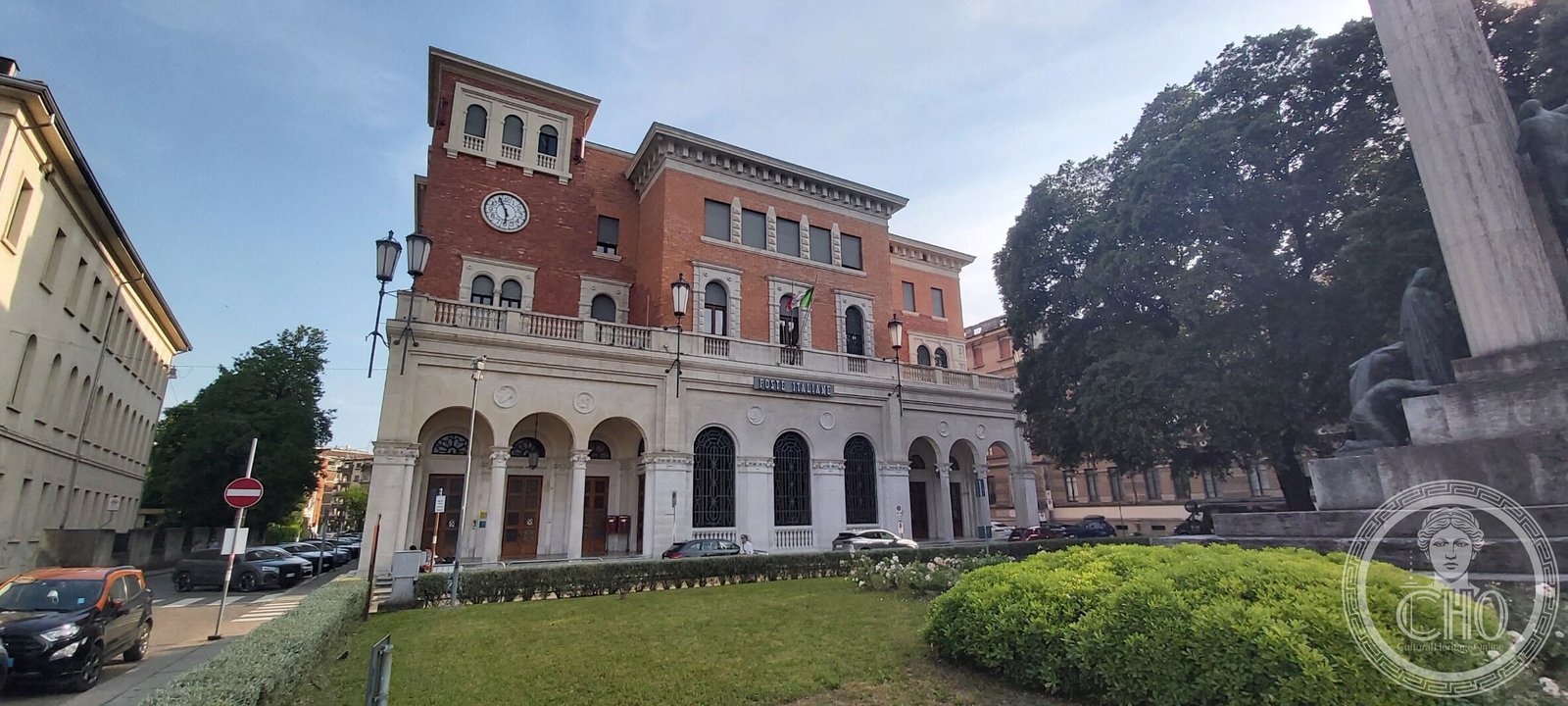
On 7 April 1944 the bombers took most of this part of Treviso apart. The post office was badly hurt and stayed standing, which is why the square around it is a 1930s square with a hole in it.
At a glance
A long brick block with a white stone arcade at street level, a clock in a raised tower over the entrance, and POSTE TELEGRAFI cut into the frieze. It was built between 1928 and 1931 to a design by Roberto Narducci, the architect who gave the Italian postal administration much of its inter-war face, and it was opened by King Vittorio Emanuele III on 4 November 1931 — the anniversary of the Victory — in the same ceremony that unveiled the war memorial across the square.
Key facts
- Architect: Roberto Narducci (Rome, 14 August 1887 – Rome, 10 February 1979)
- Built: 1928–1931
- Inaugurated: 4 November 1931, by Vittorio Emanuele III, together with the war memorial
- Style: late historicist — brick and stone, arcade, clock tower
- War: one of the few buildings here left standing after the bombing of 7 April 1944, though seriously damaged
- Restored: facades and stonework, 2022
- Address: Piazza della Vittoria, Treviso — still a working post office
History
Narducci built nine postal buildings and about forty railway stations between 1924 and 1953. The postal palaces of these years are late historicist work — he moved towards modernism later — and they were placed deliberately: the point was to give the post office a central position in a provincial capital, on the best square the city had, at the scale of a public institution rather than of an office.
The square was made for the occasion. It had been Piazza Bressa and Piazza della Cavallerizza; it was renamed Piazza della Vittoria and finished as a single composition, the post office on one side and the memorial to the dead of the Great War on the other, both unveiled on the same November afternoon with the King present.
Thirteen years later, on 7 April 1944, Treviso was bombed. The post office was one of the few buildings in this area to remain standing. Its facades were restored through 2022, recovering the original colours of the stone and render.
What you see
The ground floor is an open loggia: round arches on paired stone columns, running the length of the front, with the postal counters behind. Above, the wall turns to brick, laid warm and plain, with stone framing the upper windows. Over the entrance the mass rises into a short tower carrying a clock face and, above that, a belvedere of small arched openings. The composition is symmetrical but not stiff; the tower does the work that a portico or a pediment would have done a century earlier.
Read it beside the Palazzo del Littorio in Piazza San Vito, three minutes away, and the two make the same argument in different words: both are modern institutions of the same decade dressed in older clothes, one Venetian Gothic, one a Roman-Renaissance manner. Treviso in these years did not build in the language of the new. It built in the language of the city it already was.
Practical information
- Still an operating post office; the arcade and the square are public.
- Interiors are accessible during counter hours, as a customer would see them.
- Allow 10 minutes outside; the war memorial stands in the same square.
Getting there
Piazza della Vittoria is in the southern part of the walled centre, about ten minutes on foot from Treviso Centrale station. GPS: 45.66287, 12.24255 — open in Google Maps.
Nearby
- “Gloria”, the war memorial of Treviso — unveiled with this building on 4 November 1931.
- Istituto Tecnico Riccati — on the west side of the same square, eight years older.
- Palazzo del Littorio — Treviso
Sources
- Treccani, Dizionario Biografico degli Italiani — Narducci, Roberto: born Rome 14 August 1887, died Rome 10 February 1979; the Treviso post office dated 1928–31 in the list of his postal buildings; the late-historicist character of his work of these years.
- Poste Italiane (tgposte.poste.it) and the Treviso press — the inauguration of 4 November 1931 by Vittorio Emanuele III together with the war memorial; construction begun in 1929; the square renamed Piazza della Vittoria; the building among the few left standing after the bombing of 7 April 1944; the restoration completed in 2022.
- The description of the elevations was made from the contributor’s photograph.
Find it on the map
See this place and what’s around it →Record researched and written by Stefano Vigolo for Cultural Heritage Online, 2026.
📷 Become a Cultural Heritage Online photographer
Share your photos of places: they stay published under your name as the author. The more they're seen, the more you get noticed — and soon a contest will reward the most appreciated photos.
Log in or sign up free to add a photoRequest to use these images
Each photograph is by the person named on it. Cultural Heritage Online is the seller: it runs the payment, handles tax and delivers the file, and the photographer receives 70% of the price net of tax. Buying gives you the right to use the image in your own project — a website, an article, a presentation — with the file and a written licence. Read the Terms of Sale.
What you receive. The file as it is held in our archive: the photographer's own original, without the Cultural Heritage Online watermark, unretouched and not enlarged. This is a working archive built over many years by many people, so the files differ — some were taken recently, others years ago with the equipment of their time. Older pictures are usually smaller: a camera from fifteen or twenty years ago simply recorded fewer pixels than a phone does today, so the resolution is lower and the print comes out smaller. We say so rather than hide it. The size, weight, format and year of each one are printed below it, and the print size is given at 300 dpi. Nothing is upscaled to make a number look better. Where the picture on this page has been cropped for the layout, the file you receive is the full frame, which may be wider or taller than what you see here.
Palazzo delle Poste e Telegrafi, Piazza della Vittoria, Treviso
Photo: Stefano Vigolo
€3.00
2365 × 1064 px · JPG · 1,021.0 KB
prints 20 × 9 cm at 300 dpi · taken 2025
Is this page about you?
This page is read by travellers and heritage enthusiasts who find it on Google. Tell us how you are connected to this place and we will take it from there.