
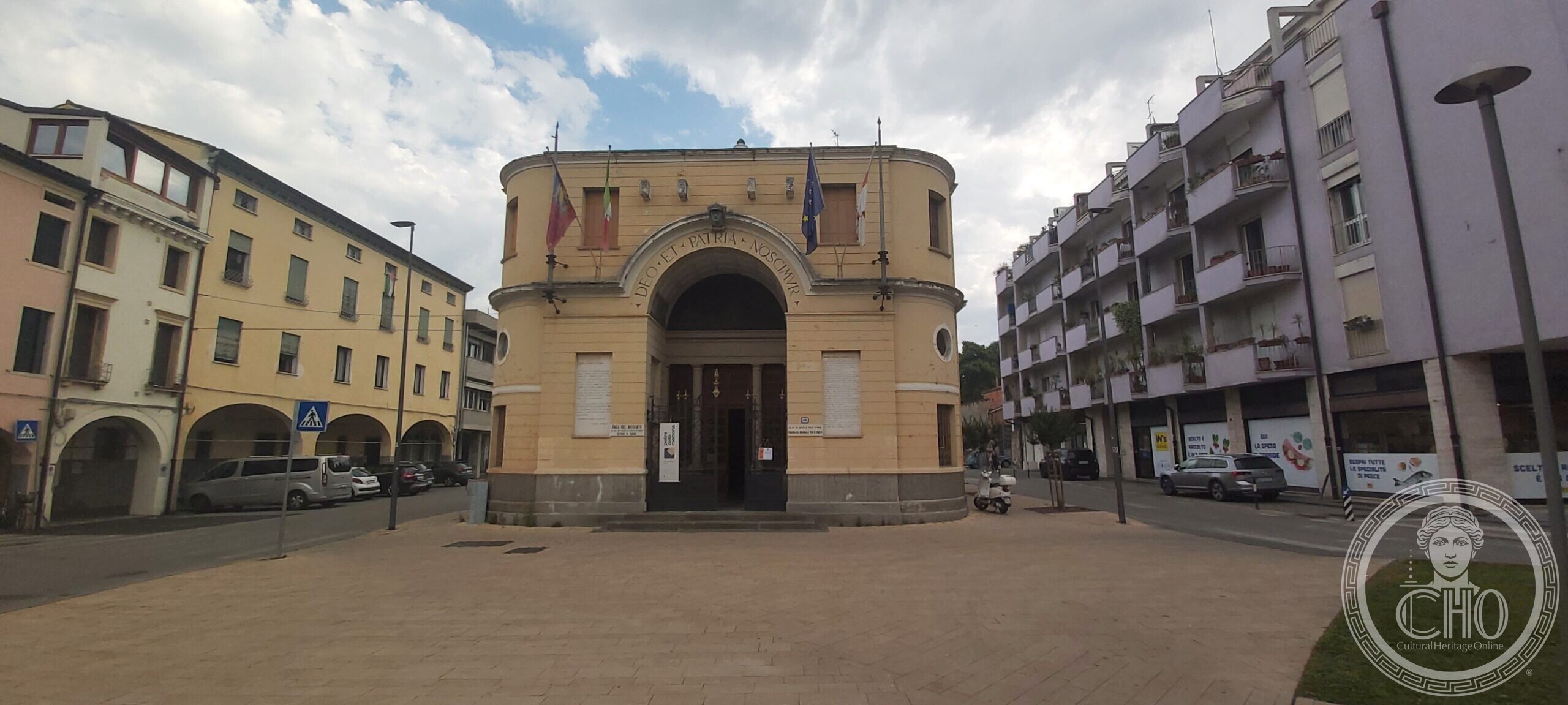
One of the first veterans’ houses built in Italy, raised by the men the First World War sent home maimed. Above its door a bronze lunette by Luigi Soressi shows eagles that are wounded and still flying — the plainest statement of purpose any building of its kind ever made.
At a glance
The Casa del Mutilato stands alone on Piazzale Mazzini, a curved pale-yellow block on the northern edge of Padua’s historic centre. It was built in 1926–1927 to a design by Renato Fabbrichesi, an engineering professor at the University of Padua, as the seat of the local branch of the A.N.M.I.G. — the national association of war-disabled and invalids, founded in 1917 by the wounded themselves. It was among the first such houses completed in Italy, and it is still the association’s regional headquarters, which means the building has served the same purpose for a century.
Key facts
- Engineer: Renato Fabbrichesi, professor at the University of Padua
- Cornerstone: 4 November 1926, blessed by the bishop of Padua, Elia Dalla Costa
- Inaugurated: 6 November 1927, one year and two days later
- Sculpture: bronze lunette over the entrance by Luigi Soressi, sculptor from Piacenza working in Padua
- Motto: Deo et patria noscimur, chosen by Carlo Delcroix, the association’s national president
- Later: raised by an extra storey in 1956 as the association grew
- Address: Piazzale Mazzini 40, Padua
History
The A.N.M.I.G. was founded in 1917, while the war was still being fought, to give practical and financial help to men returning without limbs or sight, and to their families. It was an association of the disabled themselves, not a charity organised on their behalf, and in the decade after the war its local sections built themselves houses across Italy — part clubroom, part welfare office, part memorial. Padua’s was among the first to be finished.
The dates were chosen with care. The cornerstone was laid on 4 November 1926, the anniversary of the armistice of Villa Giusti that ended Italy’s war; the bishop of Padua, Elia Dalla Costa — later archbishop of Florence — blessed it. The building was inaugurated on 6 November 1927 before a large crowd. Renato Fabbrichesi gave it a neo-Renaissance dress rather than the stripped classicism that would dominate the following decade: the design was praised at the time for being elegant and plain, and its plan is unusual — a curved front block, and behind it an octagonal assembly hall under a dome.
The association outgrew it. In 1956 the building was raised by a further storey, which is why the upper windows sit slightly awkwardly above the original cornice line. A century on, the association still has its regional presidency here.
What you see
The building is freestanding, and Fabbrichesi rounded its corners so that it would read as an object in the square rather than a fragment of a street. The front curves gently forward; the entrance is a tall arch set in a plain wall, framed by two flat pilasters and flanked by two stone tablets carrying, on one side, a speech by Victor Emmanuel III and, on the other, the Victory Bulletin of General Armando Diaz. Around the arch, in widely spaced Roman capitals, runs the motto DEO · ET · PATRIA · NOSCIMUR — “by God and country we are known” — formulated by Carlo Delcroix, the blinded and handless writer who led the association nationally.
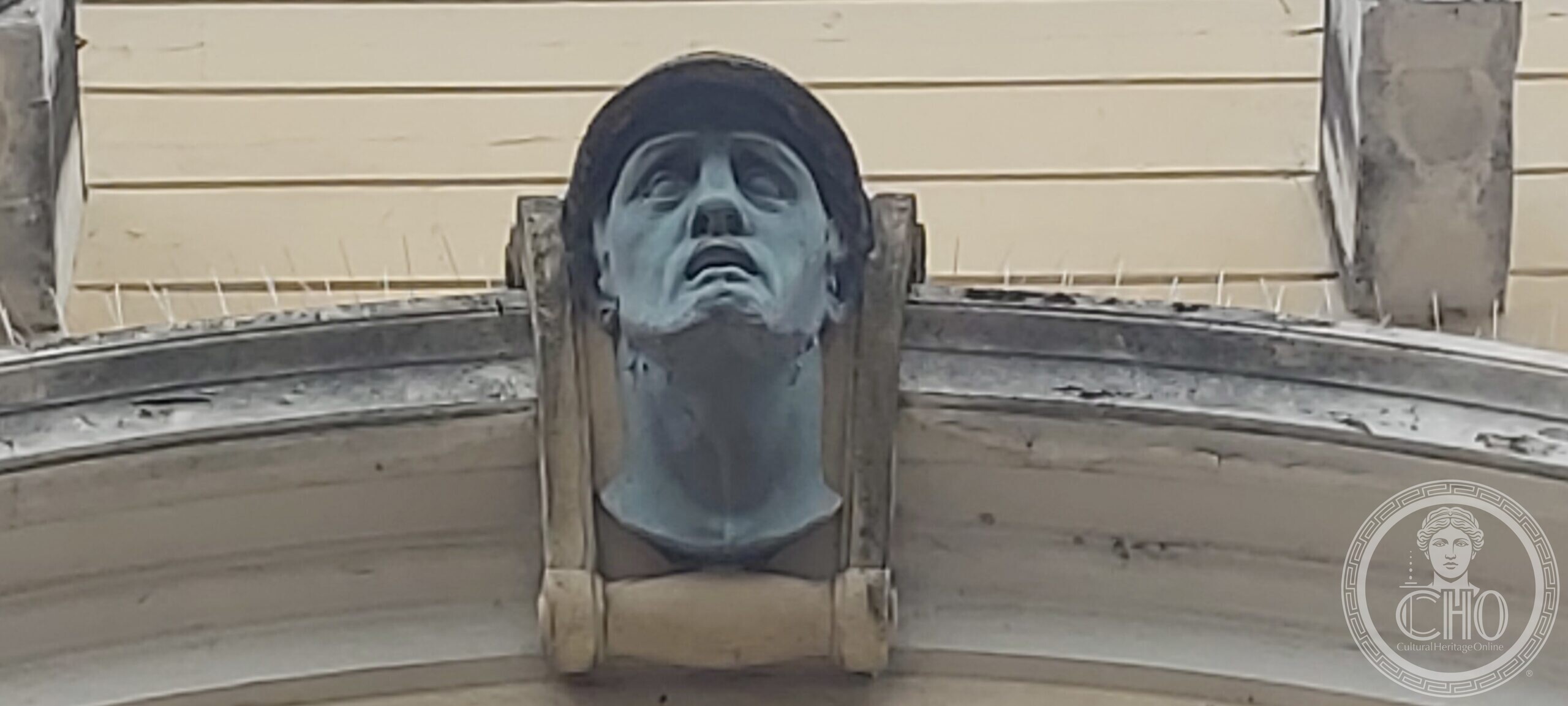
At the crown of the arch, where a keystone would be, there is a bronze mask: the head of a soldier in a helmet, face turned up, mouth open. It is not a heroic face. It is a man gasping, and it is placed exactly where a passer-by walks under it without looking up.
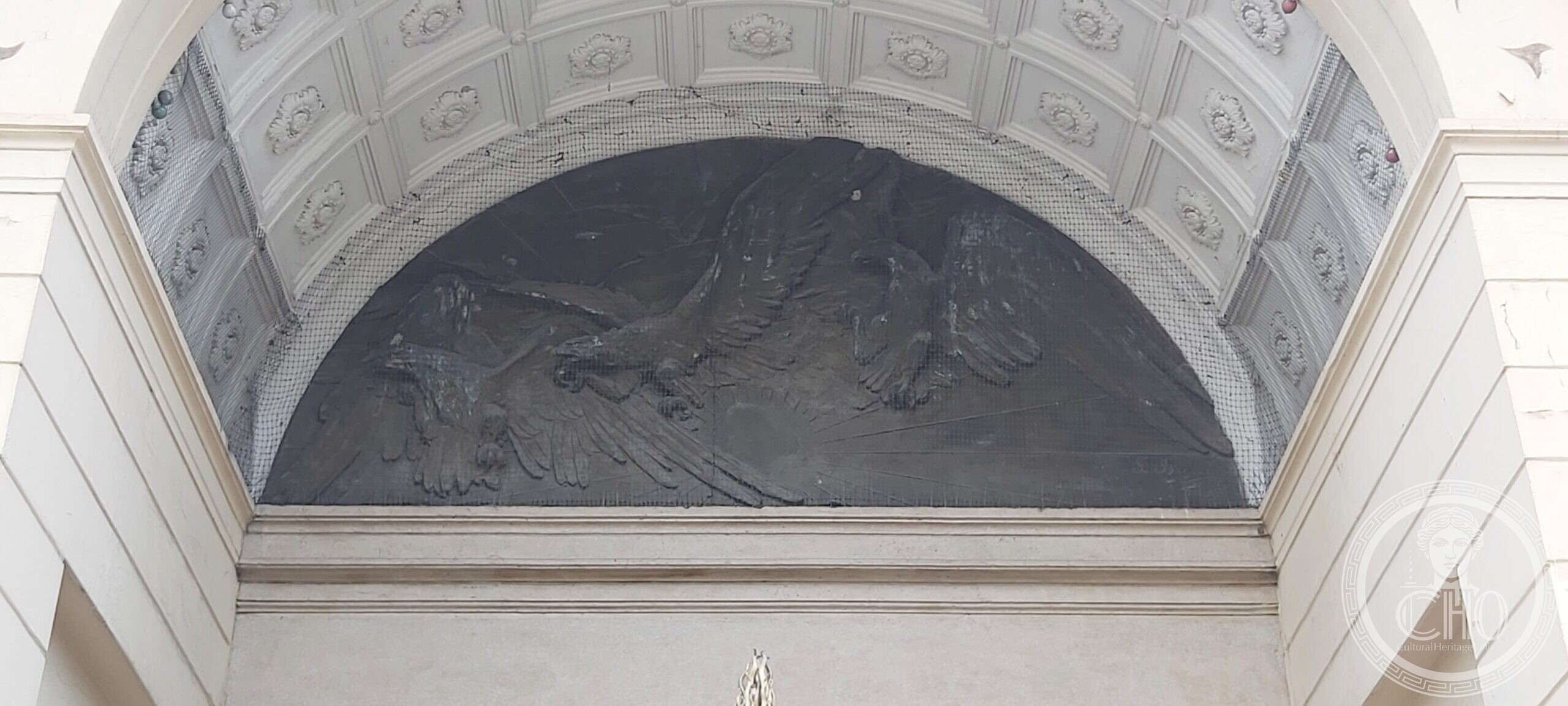
Step under the arch and the atrium opens above into a high lunette filled, edge to edge, by a bronze relief. Behind protective netting, three great eagles beat across the field, wings overlapping, dropping toward a burst of rays in the lower right corner. Read quickly they look like imperial eagles, the standard rhetoric of the period. Read slowly they are not: these birds are wounded, and the subject of the relief is that they are flying anyway. That is the association’s own metaphor for its members, and it is the reason the sculpture is here rather than a trophy of arms.
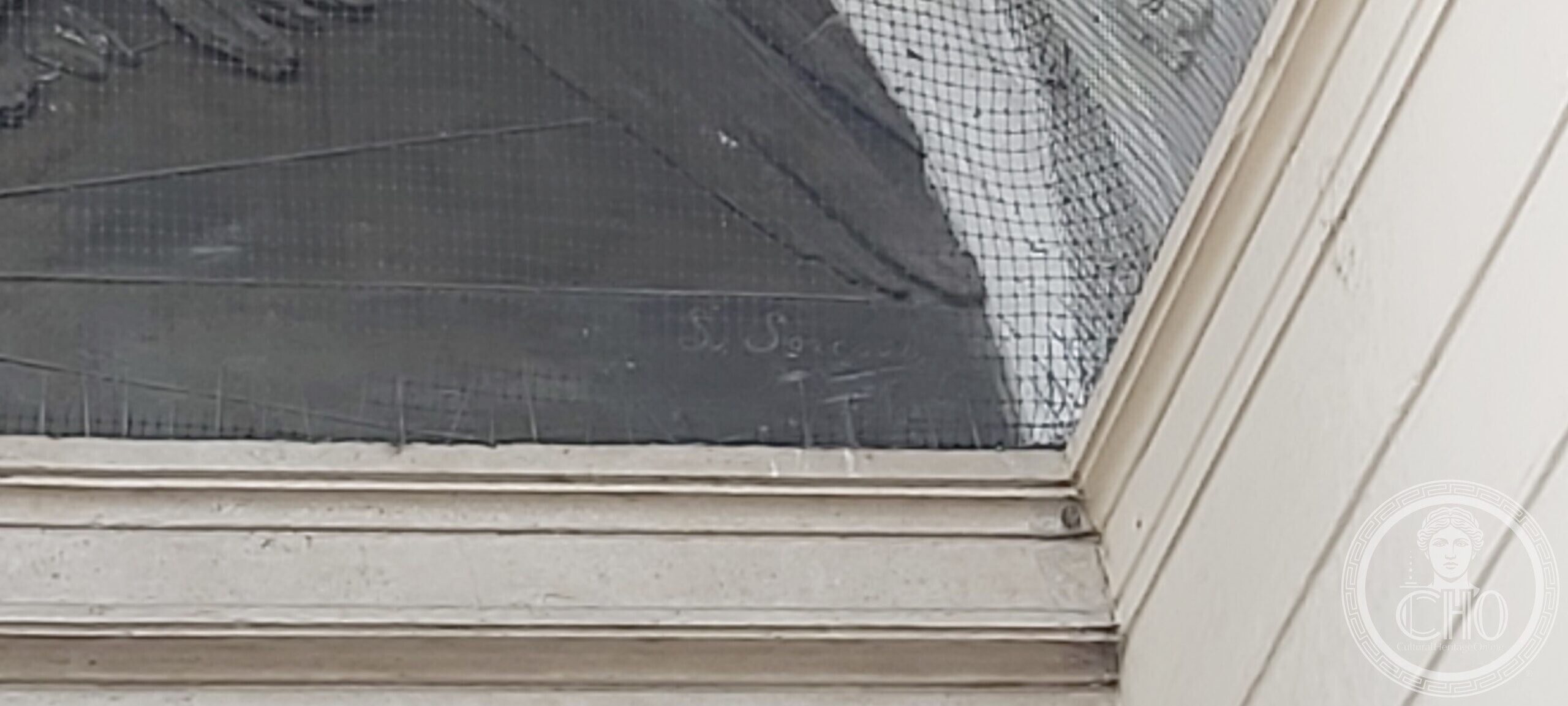
The sculptor signed it. Low on the right edge of the bronze, in a thin incised hand almost invisible from the ground, is the name of Luigi Soressi — a sculptor from Piacenza who worked in Padua, and who in 1924 also made the bust of Giuseppe Tartini in the Chiostro del Generale at the Basilica of Saint Anthony.
Reading the building
Case del Mutilato were built in Italy in the years when the Fascist regime was consolidating, and the regime made loud use of the war-disabled as living proof of the nation’s sacrifice. The motto over this door, and the royal speech carved beside it, belong to that world. The building itself, however, was raised by and for men who came home broken, and it has housed their association without interruption ever since. We publish it as what it is: a document of both things at once.
Practical information
- The exterior, the inscriptions and the bronze mask are visible from the square at any time.
- The bronze lunette is inside the entrance atrium and can be seen from the doorway; the interior is an association headquarters, not a museum, and opens for its own events.
- Allow 15 minutes here, and combine it with the Rotonda tower two minutes away.
Getting there
Piazzale Mazzini is on the northern edge of the historic centre, about fifteen minutes on foot from Padova railway station and ten from the Scrovegni Chapel. GPS: 45.41513, 11.87406 — open in Google Maps.
Nearby
- Torre della Rotonda — Padua’s water tower over a war grave — visible from this square, and part of the same story: the tower stands over ninety-three civilians killed in the air raid of 1916.
- Casa del Mutilato — Verona and Bologna — two of the later houses, in the stripped style of the 1930s.
- Palazzo Liviano — Gio Ponti, Padua
Sources
- Padova e la Grande Guerra — La Casa del Mutilato: Fabbrichesi’s authorship, the 1926 cornerstone and 1927 inauguration, the plan, the Delcroix motto, the two facade plaques, Soressi’s wounded eagles and the 1956 raising.
- Veneto Grande Guerra — Casa del Mutilato di Guerra, Padua: among the first built in Italy; construction 1926–1927 to Fabbrichesi’s design.
- A.N.M.I.G. / Comune di Padova — centenary material on the association founded in 1917 and its Padua seat at Piazzale Mazzini 40.
- On Luigi Soressi in Padua: his works for the Veneranda Arca del Santo (bust of Tartini, 1924) and this bronze lunette.
- The keystone mask, the motto and the signature were read from the contributor’s photographs.
Gallery
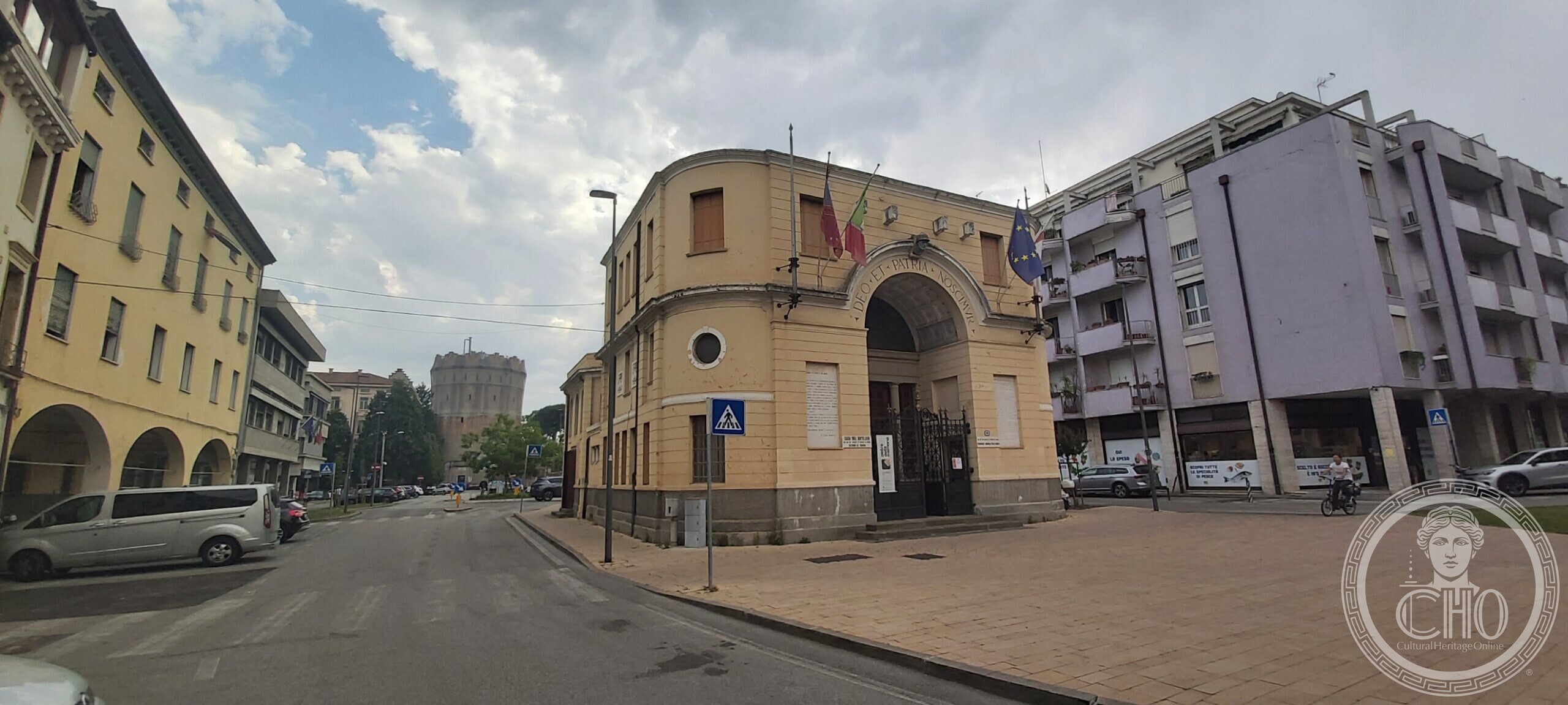
More views — photographs by Stefano Vigolo, 2026.
Find it on the map
See this place and what’s around it →Record researched and written by Stefano Vigolo for Cultural Heritage Online, 2026.
📷 Become a Cultural Heritage Online photographer
Share your photos of places: they stay published under your name as the author. The more they're seen, the more you get noticed — and soon a contest will reward the most appreciated photos.
Log in or sign up free to add a photoRequest to use these images
Each photograph is by the person named on it. Cultural Heritage Online is the seller: it runs the payment, handles tax and delivers the file, and the photographer receives 70% of the price net of tax. Buying gives you the right to use the image in your own project — a website, an article, a presentation — with the file and a written licence. Read the Terms of Sale.
What you receive. The file as it is held in our archive: the photographer's own original, without the Cultural Heritage Online watermark, unretouched and not enlarged. This is a working archive built over many years by many people, so the files differ — some were taken recently, others years ago with the equipment of their time. Older pictures are usually smaller: a camera from fifteen or twenty years ago simply recorded fewer pixels than a phone does today, so the resolution is lower and the print comes out smaller. We say so rather than hide it. The size, weight, format and year of each one are printed below it, and the print size is given at 300 dpi. Nothing is upscaled to make a number look better. Where the picture on this page has been cropped for the layout, the file you receive is the full frame, which may be wider or taller than what you see here.
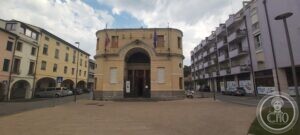
padova-casa-del-mutilato-front
Photo: Stefano Vigolo
€3.00
2609 × 1173 px · JPG · 511.1 KB
prints 22 × 10 cm at 300 dpi · taken 2026
Is this page about you?
This page is read by travellers and heritage enthusiasts who find it on Google. Tell us how you are connected to this place and we will take it from there.