
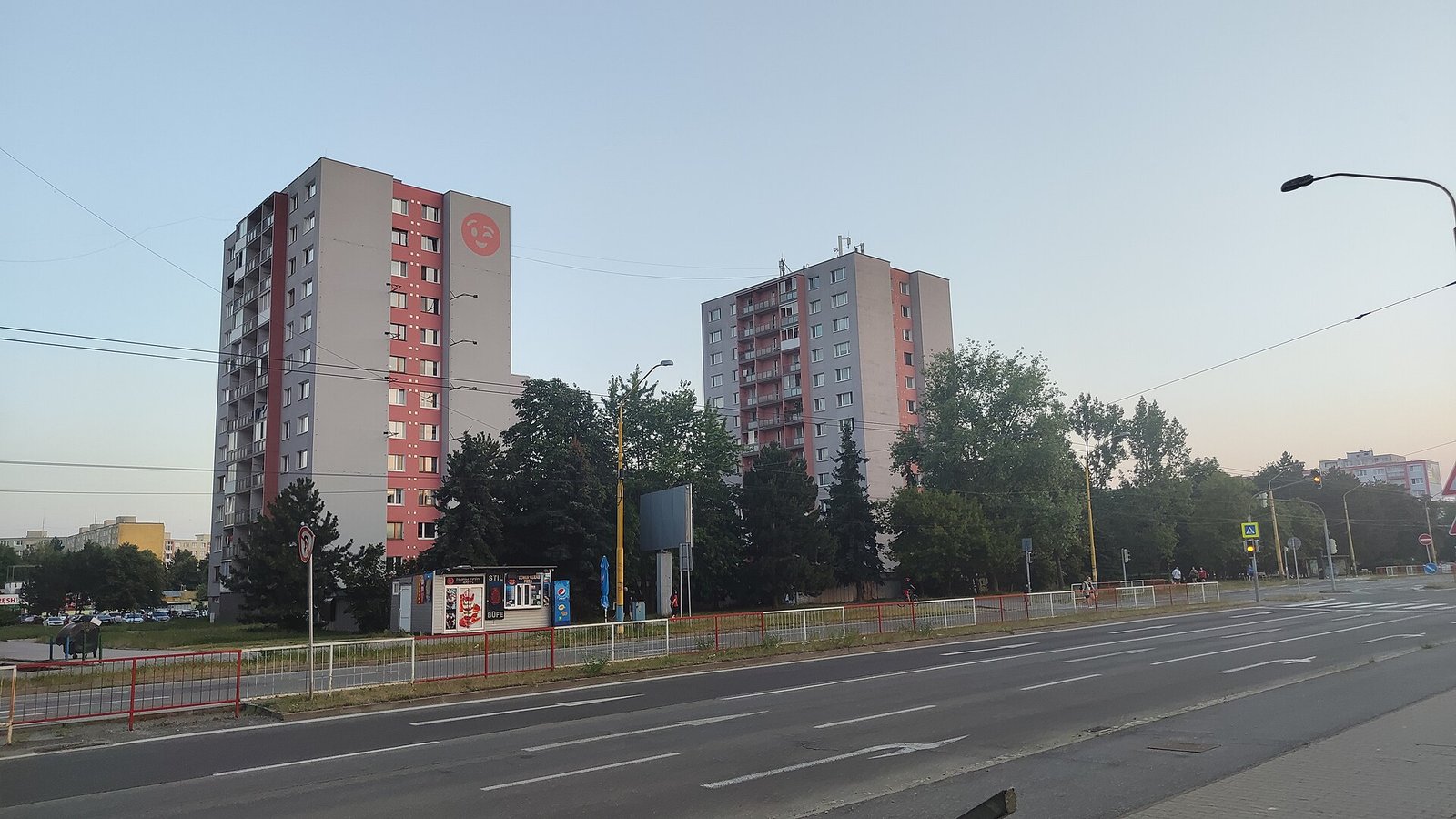
A new town for twenty-five thousand steelworkers and their families, laid out on the western slope above Košice — planned for sixty thousand people, and the only estate in the city finished with everything a city needs.
At a glance
Officially it is Nové Mesto, the New Town. Nobody in Košice calls it that. From the western slope of the basin the ground steps down towards the old city, and the name that stuck was Terasa — the Terrace. Building began on 22 February 1962 and ran to 1971, ordered into existence by the government’s decision to build the East Slovak Ironworks and by the need to house their twenty-five thousand employees. It was planned for sixty thousand inhabitants and holds about forty thousand today, which makes it the third-largest housing estate in Slovakia after Petržalka and Ružinov in Bratislava. Unlike its neighbours it was completed with its full programme of services, and it has since grown into a second centre of the city.
Key facts
- Built: from 22 February 1962 to 1971
- Official name: Nové Mesto (New Town); universally known as Terasa
- Reason: housing for the 25,000 employees of the East Slovak Ironworks (Východoslovenské železiarne) and their families
- Planned for: 60,000 inhabitants; about 40,000 today
- Rank: third-largest housing estate in Slovakia, after Petržalka and Ružinov
- Spine: Trieda SNP, carrying a high-capacity tramway and a fast line direct to the ironworks
- Borough: Košice-Západ, the most populous borough of Košice and the fifth most populous municipal district in Slovakia
- Landmark: the former Communist Party regional headquarters, 1979–1985, today the city magistrate
History
Mass housing in Košice did not begin here. Between the wars, when the city was the last civilised outpost of the new Czechoslovakia looking east, functionalist tenement blocks went up on the northern edge of the centre for the Slovak and Czech officials arriving with the new administration — the district still known as Malá Praha, Little Prague, and the bank clerks’ Masaryk colony. After 1945 the first true estates followed, Košice I and Košice II in 1954–1956, three to five storeys, in a restrained socialist realism that never took deep root in this city.
Terasa was of a different order. In the 1960s the government decided to build the East Slovak Ironworks, and twenty-five thousand workers had to live somewhere. The answer was a satellite town on the western slope of the basin, looking back at the old centre. Construction started on 22 February 1962 — part of the site had been a military training ground — and continued until 1971.
What distinguishes it from the estates that followed is that it was actually finished. Health centres, shops, schools and post offices were built as planned, and so were facilities of a higher order: a hospital, a cinema, university faculties. Institutions serving the whole city moved out here too, among them the police passport office and, between 1979 and 1985, the regional headquarters of the Communist Party — the building that houses the city magistrate today. The University Hospital of Louis Pasteur grew on the same ground between 1967 and 1991.
Later estates pushed the city further out, and Terasa, once the edge, became interior. It now works as a secondary centre of Košice rather than a dormitory, which is a rarer outcome for a project of this kind than it sounds.
What you see
Trieda SNP runs through the middle and organises everything. It was built wide, to carry a high-capacity tramway north and south of the centre and a fast line running directly to the ironworks — transport planned into the estate from the start rather than added afterwards. On either side stand the prefabricated blocks, including examples of the K 61 panel type in its end-of-terrace variant, set in open ground with parks: Zuzkin park, Katkin park and Aničkin park, one to each of the first three Luník sectors.
The details are worth slowing down for. Some blocks are laid out so that ground-floor flats open straight onto grass. Sculpture by well-known Slovak artists was commissioned for the public spaces, in the manner of the period. And two buildings on the estate take the form of inverted pyramids, widening as they rise — the kind of gesture the 1960s allowed itself once the housing quota had been met.
Practical information
- Where: the Košice-Západ borough, west of the old town, up the slope
- Access: free — this is a residential district, walked from the street
- Getting around: trams 5, 6 and 9 and the R-lines run along Trieda SNP; trolleybuses 71 and 72
- Guided visits: MiC Košice — Potulky mestom runs a walk through the district that enters three interiors, including one of the two inverted-pyramid buildings
- Time needed: a couple of hours on foot
Getting there
Terasa is fifteen minutes from the old town by tram along Trieda SNP, or half an hour on foot up the slope. Košice airport lies south of the city; direct trains connect Bratislava, Prague and Budapest with the main station on the eastern edge of the centre, from which the trams run west.
Nearby
- Košice old town, with the State Theatre and the Cathedral of St Elizabeth
- Jakab’s Palace, at the southern edge of the old town
- The Dominican church on Dominikánske námestie, the oldest building in the city
Sources
- Košické sídliská — Slovak Wikipedia (planning, dates, population, transport)
- Košice – mestská časť Západ — Slovak Wikipedia (borough, parks, public buildings)
- MiC Košice — Potulky mestom, programme notes for the Terasa walk (interiors, sculpture, inverted pyramids)
- Hero image — Wikimedia Commons (V0lkanic, CC BY 4.0)
Find it on the map
See this place and what’s around it →Events here — now on & upcoming
- The Hidden Corners of Terasa01 Oct 2026 — 05 Oct 2026See the event →
📷 Become a Cultural Heritage Online photographer
Share your photos of places: they stay published under your name as the author. The more they're seen, the more you get noticed — and soon a contest will reward the most appreciated photos.
Log in or sign up free to add a photo