

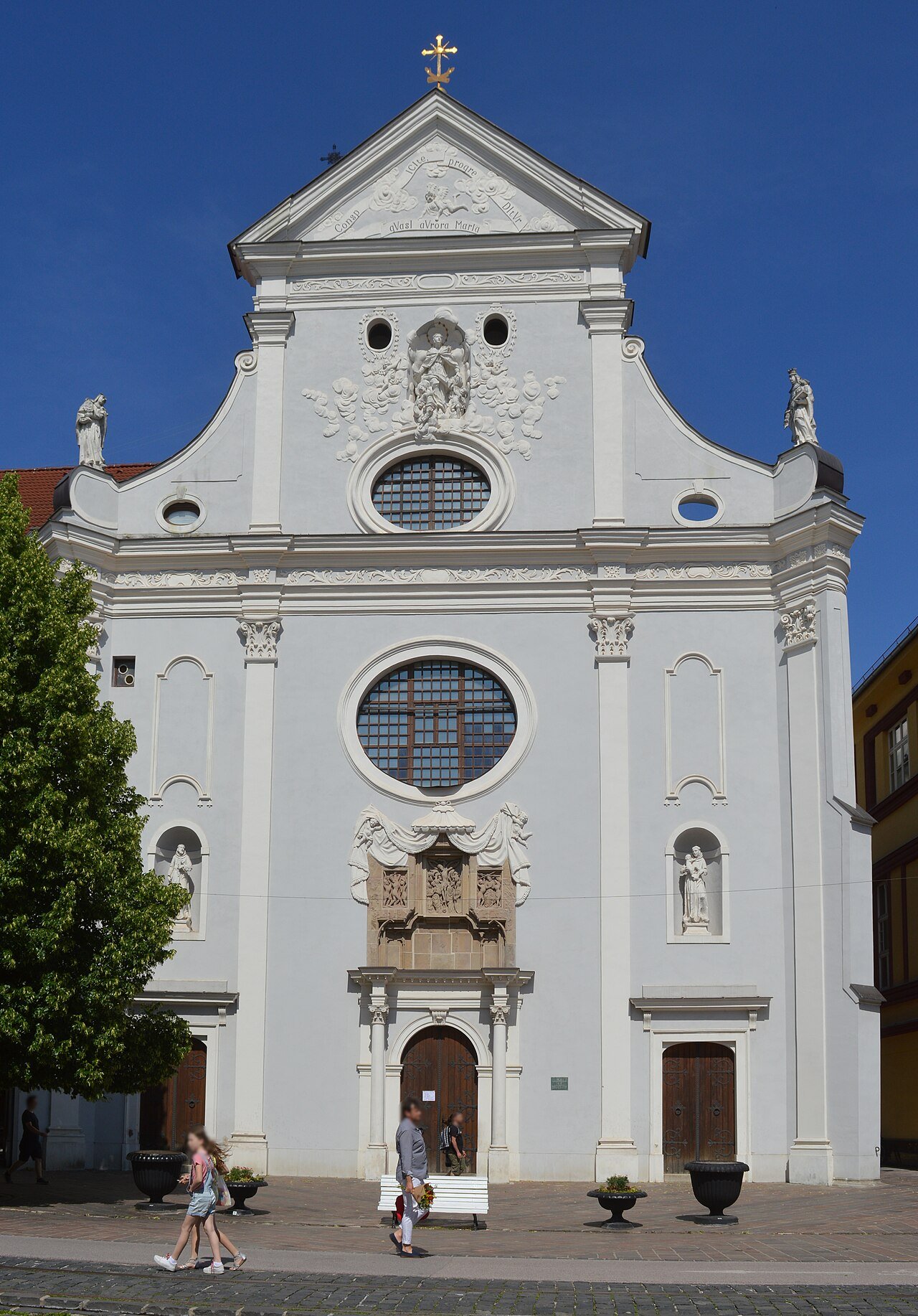
The longest church in Slovakia has been a Franciscan house, an arms depot, a cathedral in exile, a food store for Napoleon’s wars and a seminary church — and it changed its patron saint along the way.
At a glance
Three names attach to the same building on Hlavná: the Franciscan church, the Seminary church, and officially the Seminary Church of St Anthony of Padua. It was begun by the Perényi family after the city fire of 1333, dedicated then to St Nicholas, and finished in 1405. It is the longest church in Slovakia. What followed is one of the most interrupted building histories in Central Europe: burnt in 1556, abandoned by the friars in 1600, used as a weapons store until 1668, rebuilt in Baroque between 1718 and 1724, burnt again in 1779, confiscated from its order, and finally given to the new Košice seminary in 1804. Twice — during the Ottoman occupation of Eger, and again in the nineteenth century — it served as a cathedral.
Key facts
- Begun: after the city fire of 1333, by the Perényi family
- Completed: 1405, originally dedicated to St Nicholas
- Status: the longest church in Slovakia
- Baroque rebuilding: 1718–1724, builder Tomáš Tornyossy, sculptor Šimon Griming
- Main altar: rococo, 1760, with a painting by Michael Angelo Unterberger
- Served as cathedral: 1597–1671 for the Eger diocese; again in the 19th century while St Elizabeth’s was restored
- Became the seminary church: 1804, when the Košice bishopric was founded
- Plan: single nave with seven side chapels, Gothic polygonal presbytery, six-storey tower on the north wall of the sanctuary
- Location: Hlavná 81, Staré Mesto, Košice
History
Fire opened the story. After Košice burned in 1333 the Perényi family paid for a new Franciscan church, dedicated to St Nicholas and completed in 1405. It burned again in the great city fire of 1556, and this time recovery took much longer: the Franciscans left Košice in 1600, and the damaged building was turned into an arms depot. Services continued only in the closed sanctuary and the sacristy.
That sanctuary then acquired an unlikely rank. Between 1597 and 1671, while the Ottomans held Eger, it served as the cathedral of the Eger diocese. Through the Hungarian anti-Habsburg risings it was the only church in Košice left to Catholics.
Around 1634 Count Štefan Nyári, the city’s senior military officer, began working for the Franciscans’ return. They came back in 1651, but were allowed only a single chapel, which they dedicated to St Anthony of Padua. They regained the whole church in 1668, when Leopold I ordered the weapons store closed. Repairs to the derelict building could not start until the risings ended, in 1718.
The rebuilding of 1718–1724 gave the church the face it has now. The builder Tomáš Tornyossy and the sculptor Šimon Griming worked the nave and both façades into Baroque; the Gothic was left standing only in the original presbytery, and the reliefs of the medieval portal survived. A new main altar arrived in 1760. In 1779 the church burned once more, and during the four-year repair Joseph II dissolved the mendicant orders and confiscated it from the Franciscans. When the Košice bishopric was created in 1804 a priests’ seminary was established next door, and the church became the seminary church — the name it still carries. During the Napoleonic wars it held food stores; in the nineteenth century, while the Cathedral of St Elizabeth was under restoration, it stood in as cathedral again.
What you see
The plan is medieval and the surface is Baroque. A single long nave runs east to a polygonal Gothic presbytery — the one part the eighteenth century left alone — and off it open seven side chapels, four on the south side and three on the north. A six-storey tower on a square plan is built against the north wall of the sanctuary. The length of the nave is what gives the church its record: no church in Slovakia is longer.
The interior belongs to the 1700s. The Viennese painter Wretlund frescoed the main nave with the Coronation of the Virgin, the Baptism of Christ and the four Church Fathers, framed by painted architecture that continues the real vault upward. The rococo main altar of 1760 carries a painting by the Austrian Michael Angelo Unterberger — the Virgin and Child with St Anthony of Padua — flanked by figures of Saints Peter and Paul; above the sanctuary vault, St Thomas Aquinas holds the Blessed Sacrament. The seven side altars are all eighteenth-century, among them a baldachin-type altar of the Virgin and an altar of St Francis of Assisi.
Under the floor is a second church. The crypt beneath the sanctuary holds the Eger bishop Benedikt Kisdy, who died in 1660; other vaults hold the marble sarcophagus of J. Renaud and his son, guarded by four angels with military trophies, and the tombs of General J. G. Sterdhal (1740) and several eighteenth-century citizens. Members of the order were buried here too.
Practical information
- Where: Hlavná 81, on the main street of Košice
- Church: in use for worship; visitors are welcome outside services
- Crypts and choir: not normally open — reachable on guided visits
- Guided visits: MiC Košice — Potulky mestom runs a walk that opens two of the underground crypts and the choir, including a large crypt found in the 1990s
- Time needed: 20 minutes for the church; about an hour with a guided visit below ground
Getting there
The church stands on Hlavná, the long pedestrian spine of Košice, a short walk north of the Cathedral of St Elizabeth and the State Theatre. Košice airport has connections through Vienna, Prague and Warsaw; direct trains run from Bratislava, Prague and Budapest. Trams and trolleybuses reach the edge of the old town, and the centre is walked end to end in twenty minutes.
Nearby
- Cathedral of St Elizabeth (Dóm svätej Alžbety), five minutes south along Hlavná
- State Theatre Košice, on the main square
- Jakab’s Palace, at the southern edge of the old town
- The Dominican church on Dominikánske námestie, the oldest building in the city
Sources
- Kostol svätého Antona Paduánskeho (Košice) — Slovak Wikipedia
- Wikidata Q38655213 (location, completion 1405)
- MiC Košice — Potulky mestom, programme notes for the Seminary (Franciscan) church walk
- Hero image — Wikimedia Commons (André Savetier, CC BY-SA 4.0)
Find it on the map
See this place and what’s around it →Events here — now on & upcoming
- Beneath and Above the Seminary Church03 Dec 2026 — 07 Dec 2026See the event →
📷 Become a Cultural Heritage Online photographer
Share your photos of places: they stay published under your name as the author. The more they're seen, the more you get noticed — and soon a contest will reward the most appreciated photos.
Log in or sign up free to add a photo