

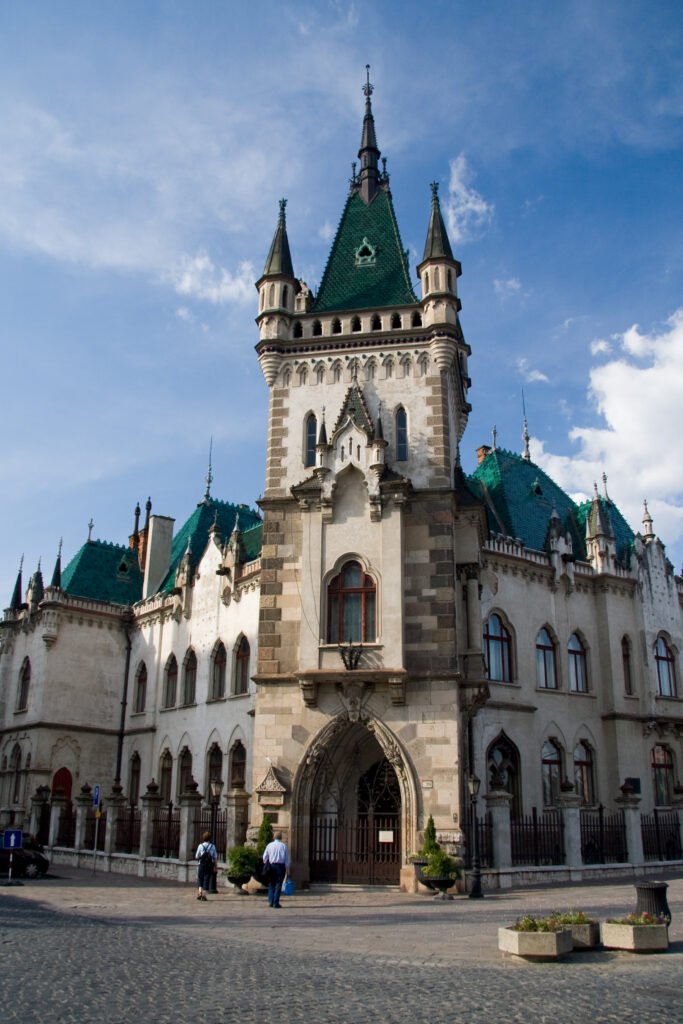
Peter Jakab built himself a neo-Gothic house from the cathedral’s own offcuts — spires and tracery on the edge of the old town, and, for a while after the war, home to a president.
At a glance
Peter Jakab was a builder, and in 1899 he made himself a house that advertised the trade: a neo-Gothic palace of spires, gables and pointed windows at the edge of Košice’s old town. Its stone had a history before it arrived — much of it came from the long restoration of the nearby Cathedral of St Elizabeth, reset here as a private residence. After the Second World War the palace briefly housed a head of state. Today it stands on the line of the old mill canal as one of the city’s most photographed corners.
Key facts
- Completed: 1899
- Builder: Peter Jakab (built for his own family)
- Style: Neo-Gothic
- Stone: partly reused from the Cathedral of St Elizabeth
- Location: corner of Mlynská and Štefánikova, Košice Old Town
- Notable: post-war residence of Czechoslovak president Edvard Beneš
- Later: British Council (1992–2000); now an events venue
History
Peter Jakab was among the builders working on the long restoration of Košice’s Cathedral of St Elizabeth in the closing decades of the nineteenth century. Stone that was cut away or replaced there did not go to waste: in 1899 he used it to raise a house for his own family, so the palace carries fragments of the cathedral inside its walls.
The result is unashamedly neo-Gothic — pointed arches, a corner tower and the vertical pull of a church brought down to the scale of a villa. Jakab set it beside the Mlynský náhon, the mill canal that once ran through this part of the old town, where its silhouette met the water.
The building’s later life outgrew a private house. After the city was liberated at the end of the Second World War, the palace served for a time as the residence of Edvard Beneš, president of the restored Czechoslovak republic. From 1992 to 2000 it housed the British Council, and it now hosts cultural and social events. Guided walks that open the interior are among the few ways to see the rooms behind the tracery.
What you see
The palace reads as a small cathedral turned residence. A corner tower anchors the composition; from it run stepped gables, finials and windows drawn to a point — the whole grammar of Gothic worked at domestic scale. Look closely at the masonry and the borrowed stones reveal themselves: pieces once carved for the Cathedral of St Elizabeth, given a second life a few streets away.
The setting completes the picture. Jakab placed the house on a corner beside the old mill canal, so it turns two faces to the street and was designed to be seen against the water that then ran beside it. Even now, with the canal gone, it keeps the slightly theatrical stance of a building meant to be admired.
Practical information
- Exterior: free to see at any time, from the street corner
- Interior: open on guided visits and during events
- Guided visits: run by local operators, including MiC Košice’s themed city walks
- Time needed: about 30–60 minutes with a guided visit
Getting there
Jakab’s Palace stands at the southern edge of the old town, on the corner of Mlynská and Štefánikova, a few minutes on foot from the Cathedral of St Elizabeth and the State Theatre. Košice has an international airport, and direct trains link the city with Bratislava and Budapest. The old town is pedestrian and easily walked end to end.
Nearby
- Cathedral of St Elizabeth (Dóm svätej Alžbety) — the source of the palace’s stone
- State Theatre Košice, on the main square
- Hlavná Street and the old-town promenade with its singing fountain
Sources
- Jakabov palác — Slovak Wikipedia
- Hero image — Wikimedia Commons (Maroš Mráz, CC BY-SA 3.0)
- MiC Košice — Potulky mestom (themed guided city walks)
Find it on the map
See this place and what’s around it →Events here — now on & upcoming
- Jakab's Palace: Inside and Out02 Jan 2027 — 07 Jan 2027See the event →
📷 Become a Cultural Heritage Online photographer
Share your photos of places: they stay published under your name as the author. The more they're seen, the more you get noticed — and soon a contest will reward the most appreciated photos.
Log in or sign up free to add a photoIs this page about you?
This page is read by travellers and heritage enthusiasts who find it on Google. Tell us how you are connected to this place and we will take it from there.