
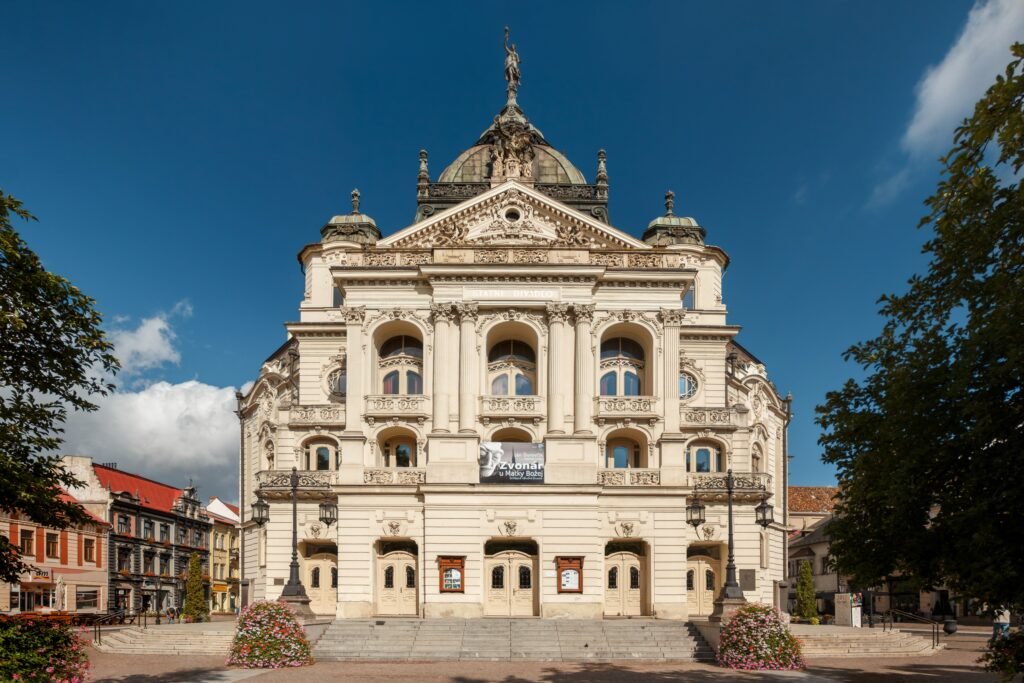
Adolf Lang’s Neo-Baroque theatre closes the main square of Košice — a lyre-shaped auditorium under a ceiling painted with scenes from Shakespeare.
At a glance
On the main square of Košice, the State Theatre stands free on its own island of paving, made to be read from every side. Adolf Lang completed it in 1899, at the height of the theatre-building decades that gave the cities of Austria-Hungary their gilded auditoriums. It is Neo-Baroque outside and in, built to impress from the promenade and again the moment the doors open. More than a century on it remains the working stage of drama, opera and ballet in eastern Slovakia, and the anchor of the square around it.
Key facts
- Completed: 1899
- Architect: Adolf Lang
- Style: Neo-Baroque
- Location: Hlavné námestie (Main Square), Košice Old Town
- Auditorium: lyre-shaped, richly modelled in plaster
- Ceiling: frescoed with scenes from Shakespeare
- Today: working state theatre — drama, opera and ballet
History
Adolf Lang’s theatre was completed in 1899, when Košice — then Kassa, a city of Austria-Hungary — joined the wave of monarchy towns raising monumental civic theatres in the closing decades of the nineteenth century. Lang worked in the Neo-Baroque then expected of such buildings: symmetry, columns and a crowning silhouette meant to read as an event on the street rather than a wall along it.
As borders moved across the twentieth century the house kept its purpose while the city changed hands and names. It has stayed what it was built to be: the principal stage of the region. Today the State Theatre Košice (Štátne divadlo Košice) runs its three companies — drama, opera and ballet — from the same building.
The frescoed ceiling is the detail visitors carry away. Its scenes are drawn from Shakespeare — Othello, Romeo and Juliet, King Lear and A Midsummer Night’s Dream — so that the plays performed below have always had an audience painted above them.
What you see
Lang set the theatre as a free-standing pavilion on Hlavné námestie, which is why it can be walked around and read from any angle. The Neo-Baroque front is layered — columns, cornices, a gable at the crown — and the interior carries the same weight in plaster, with garlands, masks and mouldings worked across the foyer and hall.
The auditorium is shaped like a lyre, a curve that pulls every tier toward the stage. Above it the painted ceiling turns the room into a gallery: the Shakespeare scenes overhead give even the plainest seat something to hold before the curtain moves.
Practical information
- Season: year-round programme of drama, opera and ballet
- Interior: seen on performance nights or on a guided visit
- Guided visits: run by local operators, including MiC Košice’s themed city walks
- Time needed: about 60–90 minutes for a guided visit
- Tickets and programme: on the theatre’s official site
Getting there
The theatre stands on Hlavné námestie in the centre of the Old Town, a few minutes on foot from the Cathedral of St Elizabeth. Košice has an international airport, and direct trains link the city with Bratislava and Budapest. The old town is pedestrian and walkable end to end, so the theatre is an easy stop on any route through the centre.
Nearby
- Cathedral of St Elizabeth (Dóm svätej Alžbety) — Slovakia’s largest church, on the same Main Street
- Hlavná Street and its singing fountain, running the length of the old town
- Jakab’s Palace (Jakabov palác), a neo-Gothic landmark by the river
Sources
- State Theatre Košice — English Wikipedia
- Hero image — Wikimedia Commons (Lynx1211, CC BY-SA 4.0)
- Štátne divadlo Košice — official theatre
- MiC Košice — Potulky mestom (themed guided city walks)
Find it on the map
See this place and what’s around it →Historical events at this place (1)
📷 Become a Cultural Heritage Online photographer
Share your photos of places: they stay published under your name as the author. The more they're seen, the more you get noticed — and soon a contest will reward the most appreciated photos.
Log in or sign up free to add a photoIs this page about you?
This page is read by travellers and heritage enthusiasts who find it on Google. Tell us how you are connected to this place and we will take it from there.