
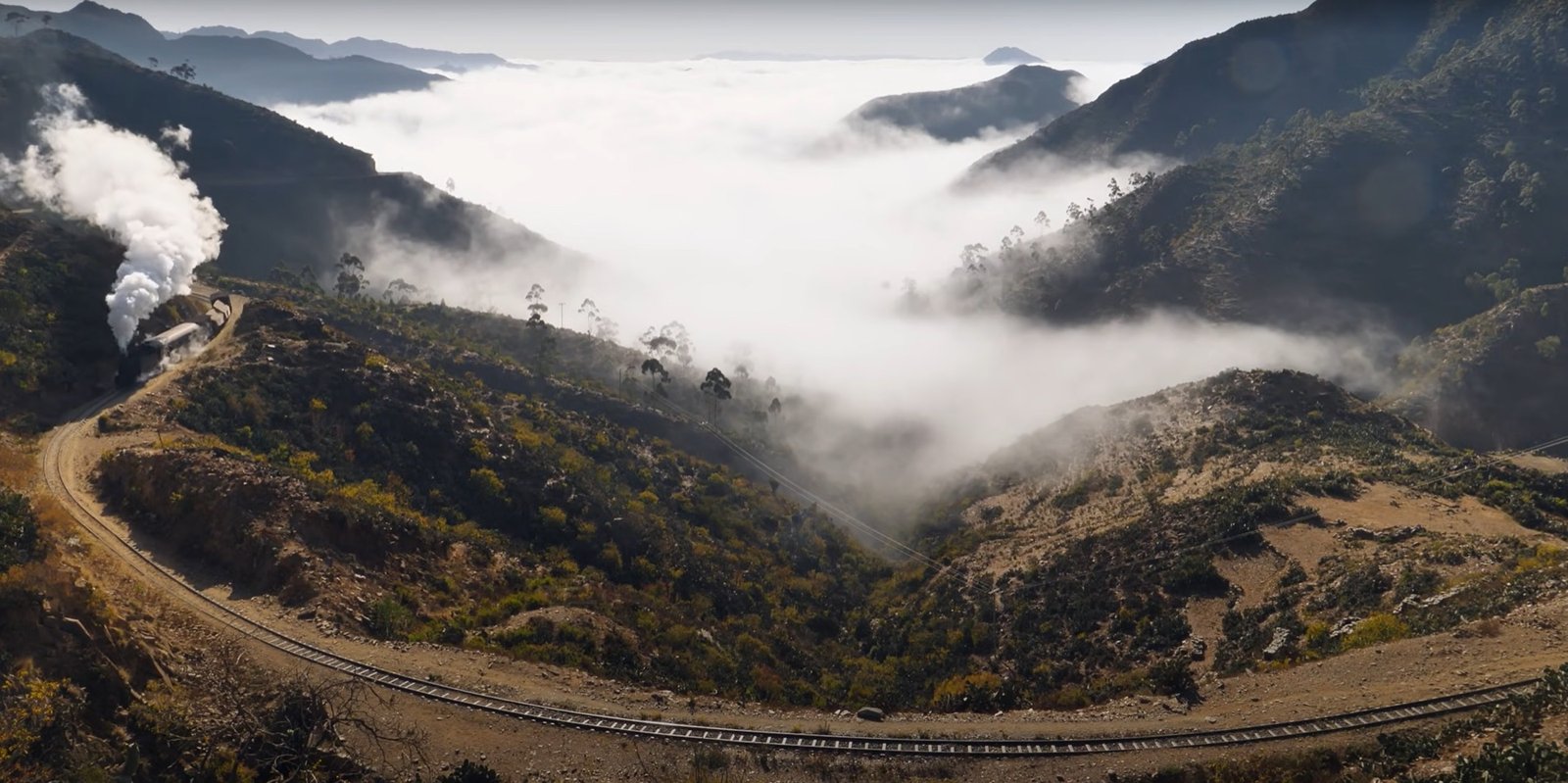
Eritrea (1887–1932): the 950 mm narrow-gauge railway that climbs 2,394 metres from Massawa on the Red Sea to Asmara, built under Italian colonial rule and rebuilt, after the war, by Eritreans themselves.
At a glance
The Eritrean Railway runs 118 kilometres from Massawa, on the Red Sea, to Asmara, more than two thousand metres above it. Its 950-millimetre track was cut into the wall of the highlands under Italian colonial rule, in a sequence of tunnels, viaducts and hairpin curves. The line fell silent during the long war of the late twentieth century. Then, without foreign help, retired Eritrean railwaymen brought it back. Today steam still works the mountain, and the railway survives as one of the most complete pieces of early colonial infrastructure anywhere in Africa.
Key facts
- Gauge: 950 mm, an Italian narrow gauge
- Route: Massawa (Red Sea) to Asmara, 118 km now in service
- Built: from 1887; reached Asmara in 1911; extended to Bishia (280 km) by 1932
- Summit: 2,394 m, just east of Asmara
- Engineering: 39 tunnels and 65 bridges, including a fourteen-arch viaduct over the Obel river
- Ruling gradient: above 3% for long stretches
- Rolling stock: Ansaldo and Breda Mallet steam locomotives; Fiat ‘Littorina’ railcars of the 1930s
- Rebuilt: 1994–2003, by Eritrean crews using salvaged track and machines
History
Italy took Massawa in 1885 and began laying track two years later, starting with a short Decauville line inland from the port. The gauge chosen was 950 millimetres, one of several then common on light railways in Italy, narrow enough to turn the curves the mountains demanded. Progress was slow. The line reached the escarpment, climbed it, and only in 1911 arrived at Asmara. Work went on into the 1930s, when the track was pushed west across the plateau to Keren, Agordat and finally Bishia, some 280 kilometres from the sea.
The railway was built to serve the colony — to move troops and goods, and later the materials of Italy’s 1935–36 war against Ethiopia — and it was built with Eritrean labour. It should be read as colonial infrastructure, an instrument of the occupying power as much as a work of engineering. What makes its later history unusual is who chose to save it.
The climb
From Massawa the line runs flat across the coastal plain, then meets the wall of the highlands and starts to climb. To gain more than two thousand metres in barely a hundred kilometres, its engineers threaded the track through 39 tunnels and carried it over 65 bridges, the grandest a fourteen-arch stone viaduct across the Obel river. The gradient holds above three per cent for long reaches, and the curves are so tight that a train can watch its own locomotive across the gorge. Near the top, east of Asmara, the rails touch 2,394 metres before dropping into the city.
The machines match the ground. Squat Mallet steam locomotives, articulated to bend around the curves, were built by Ansaldo and Breda in Italy; beside them ran the Fiat ‘Littorina’ railcars of the 1930s, streamlined in the Art Deco manner of their decade. Several survive. On charter days they still work the grade, steam standing straight up in the thin highland air.
Destroyed, then rebuilt
After the Second World War the outer sections were abandoned. In the 1970s the war between Ethiopia and the Eritrean independence movement finished the job: track was torn up, bridges dropped, the line erased. When Eritrea won independence there was no railway left to inherit, only its scattered bones.
What happened next is the reason the line is remembered at all. From 1994 the new state set out to rebuild it with no outside contractor and almost no new material. Retired railwaymen, some in their seventies and eighties, were called back to relay the track their fathers had laid, salvaging rail, sleepers and locomotives from the wreckage. In February 2003 a train ran from Massawa to Asmara again. That reconstruction is now as much the story of the railway as the original works.
Riding it today
- The line runs for charters and special workings, not a daily timetable; there is no regular scheduled passenger service.
- Steam excursions are arranged through Eritrean tour operators and railway enthusiast groups — book well ahead.
- Asmara station and the railway workshops can often be visited; the scenic highlight is the mountain section between Asmara and Nefasit.
- Travel outside Asmara requires a permit in Eritrea; arrange it through your operator.
Getting there
Asmara, the upper terminus, is Eritrea’s capital and has the country’s main airport. The station stands on the southern edge of the centre, a short walk from the Fiat Tagliero building and the modernist core that carries Asmara’s UNESCO listing. Massawa, the lower terminus, lies about 115 kilometres away on the coast.
Nearby
Sources
- Wikipedia, Eritrean Railway — gauge, dates, route, tunnels and bridges, summit altitude, reconstruction.
- Railway Gazette International and the sinfin.net world railways survey — rolling stock (Ansaldo and Breda Mallets, Breda Class 202, Fiat railcars) and the 2003 completion by recalled railwaymen.
- Cultural Heritage Online, Italian Eritrea: Asmara, the Modernist Capital, and the Road to the Sea — colonial context.
Find it on the map
See this place and what’s around it →Record researched and written by Luigi De Marchi for Cultural Heritage Online, 2026.

📷 Become a Cultural Heritage Online photographer
Share your photos of places: they stay published under your name as the author. The more they're seen, the more you get noticed — and soon a contest will reward the most appreciated photos.
Log in or sign up free to add a photo