
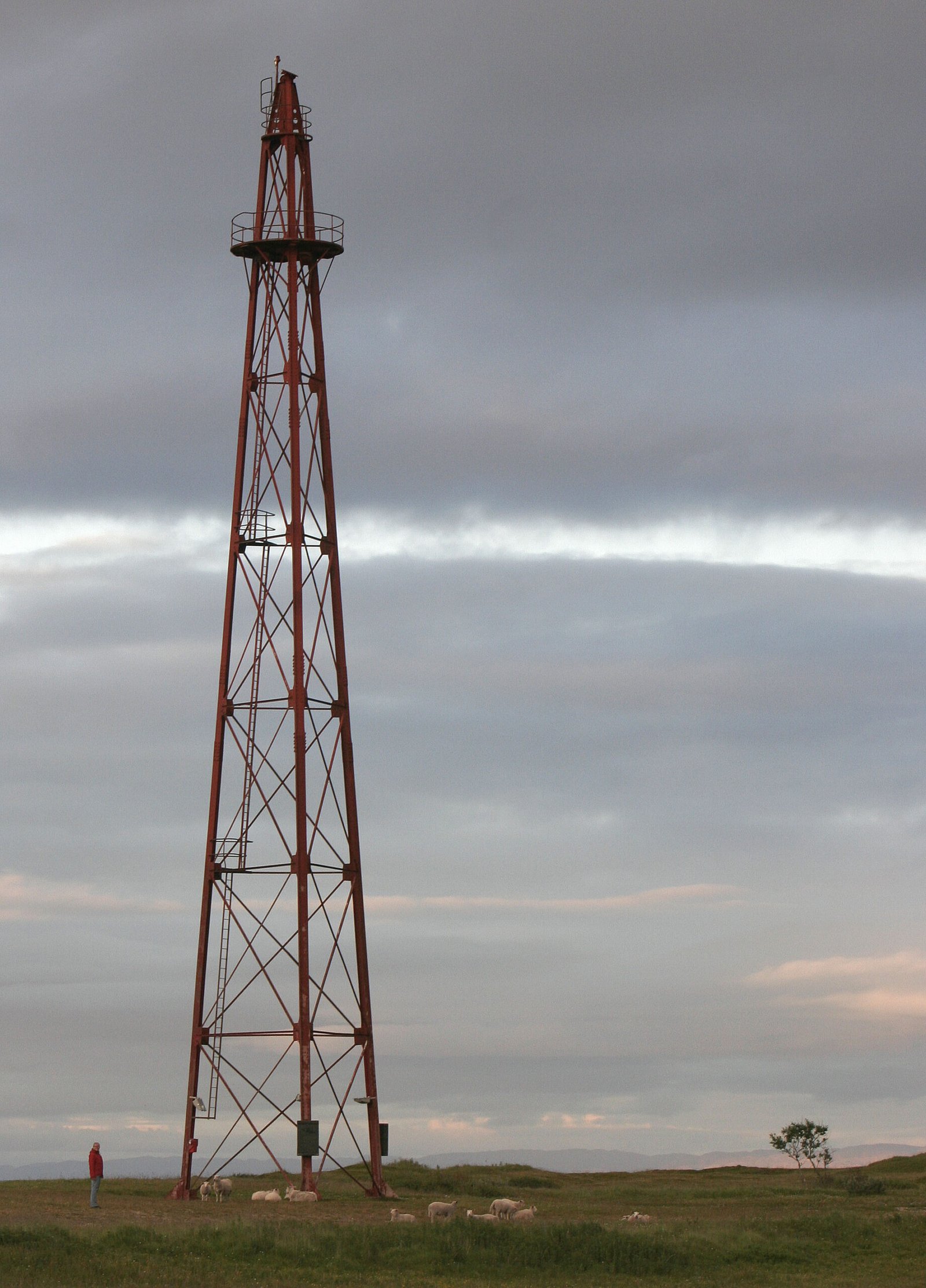
On a flat island in Norway’s far north-east stands a red steel mast that two Italian-built airships used on their way to the North Pole: the Norge in 1926, the Italia in 1928. It is one of the polar age’s rare surviving artefacts.
At a glance
The mooring mast on Vadsøya island was the last mainland stop of the two great airship expeditions of the 1920s. The Norge — designed and piloted by Umberto Nobile, with Roald Amundsen as expedition leader and Lincoln Ellsworth as sponsor — left Vadsø on 5 May 1926 for Ny-Ålesund and, from there, made the first verified journey of any kind to the North Pole. Two years later Nobile’s Italia moored at the same mast in the first days of May 1928, en route to the flight that ended in the crash on the pack ice and the drama of the Red Tent. The mast still stands, with a memorial plaque recording the Italia’s call, and has become the emblem of the town.
Key facts
- Used by: the airship Norge (departed Vadsø 5 May 1926, 09:40) and the airship Italia (arrived 4 May 1928)
- The Norge flight: Rome–Pulham–Oslo–Gatchina–Vadsø–Ny-Ålesund–North Pole (12 May 1926, 01:25 GMT)–Teller, Alaska — the first verified trip of any kind to the Pole
- The airships: N-class semi-rigid craft designed by Umberto Nobile — the Norge 106 m long, 19,000 m³ of hydrogen, three Maybach engines
- The Italia sequel: Pole reached 24 May 1928; crash on the return 25 May; eight survivors of the Red Tent rescued by the icebreaker Krassin in July
- Today: the mast still stands on Vadsøya, with an information board and a memorial plaque to the Italia’s mooring
History
The context, stated plainly: the polar flights were international ventures — Norwegian, Italian and American — and they were also claimed loudly by the Italian regime of the day as national triumphs. The rivalry between Amundsen and Nobile over credit for the Norge flight, and the propaganda uses of both expeditions, are part of the record; so are the seventeen lives lost in the Italia disaster and its rescue, Amundsen’s among them. The mast is documented here as the shared heritage of that story.
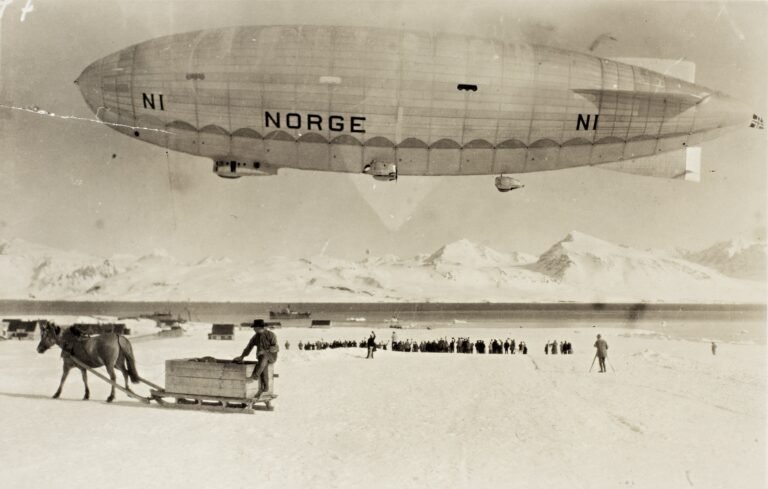
Vadsø entered the route planning for a simple reason: it is about as far north-east as mainland Norway goes, the natural last anchorage before the open crossing to Svalbard. The Norge, having flown from Ciampino across Europe via Pulham, Oslo and Gatchina, rode at the Vadsøya mast before the final legs; the Italia repeated the pattern two years later, arriving from Stolp on the Baltic on 4 May 1928. Photographs from both visits show the airships hanging over the little island like weather balloons of impossible size, the whole town gathered beneath.
The two expeditions ended in opposite registers — the Norge in a record that stands (the first verified attainment of the North Pole, by any means), the Italia in the century’s most famous polar disaster, with the Red Tent on the drifting ice, the Krassin steaming to the rescue, and Amundsen vanishing in the search. The mast outlived them both. It was left standing when airships left history, and the town kept it.
What you see
The mast is a tapering lattice of riveted steel, painted oxide red, rising alone from the flat grass of Vadsøya with a climbing ladder up its spine and a small crow’s-nest platform near the top, where the mooring gear engaged the airship’s nose. Sheep graze around its legs in summer; there is no fence, no ticket, no queue — just the tower, the wind, and the Varanger fjord flat to the horizon.
An information board tells the double story, and a plaque commemorates the mooring of the Italia. As an object it is pure working engineering of the 1920s, and that is its power: nothing else on the site needs explaining.
Practical information
- The mast stands on Vadsøya, the island facing Vadsø town, reached by the road bridge; it is open ground, freely accessible at all times.
- Vadsøya also holds traces of the old town and wartime history; allow an hour for the island loop.
- Weather on the Varanger coast changes fast — dress for wind in any season.
Getting there
Vadsø lies on the Varanger fjord in Finnmark, Norway’s far north-east, with flights and the Hurtigruten coastal service connecting it to the rest of the country. GPS (Vadsøya): 70.06913, 29.73719 · Open in Google Maps.
Related places and reading
- Airship mooring mast, Ny-Ålesund (Svalbard) — the next and final stop of both expeditions
- North by Airship: the Norge, the Italia and the Route to the Pole — the full story
- The Airship Route to the Pole — the two-stop historical route
Sources
- English Wikipedia, “Norge (airship)” (route and dates, Vadsø departure 5 May 1926, first verified trip to the Pole, specifications, “the airship mooring mast still stands today”).
- English Wikipedia, “Italia (airship)” (Vadsø call of 4 May 1928, Pole 24 May, crash 25 May, Red Tent, Krassin rescue, Amundsen’s death).
- On-site memorial plaque to the Italia mooring (photographed on Wikimedia Commons).
- OpenStreetMap Nominatim (Vadsøya coordinates).
Find it on the map
See this place and what’s around it →Record researched and written by Luigi De Marchi for Cultural Heritage Online, 2026.
📷 Become a Cultural Heritage Online photographer
Share your photos of places: they stay published under your name as the author. The more they're seen, the more you get noticed — and soon a contest will reward the most appreciated photos.
Log in or sign up free to add a photo