
A car-free island of colonial villas facing Xiamen, run from 1902 as an international settlement of thirteen nations — Italy’s small consulate among them. UNESCO listed it in 2017 under its treaty-era name, Kulangsu.
At a glance
Gulangyu is a 1.88-square-kilometre island in the harbour of Xiamen (Amoy), reached only by ferry and closed to cars and bicycles. Under Land Regulations approved by the Qing government in May 1902 it became an international settlement in which thirteen countries — Great Britain, France, the Netherlands, Japan and others — eventually held extraterritorial privileges; Italy was among the nations whose consuls signed the settlement’s founding charter, and it maintained a small consulate on the island. The regime lasted until the Japanese occupation of 1942–1945. On 8 July 2017 UNESCO inscribed the island as “Kulangsu, a Historic International Settlement”. Today some 12,500 residents share it with more than ten million visitors a year.
Key facts
- Status: UNESCO World Heritage Site since 8 July 2017, as “Kulangsu, a Historic International Settlement”
- Settlement era: Land Regulations approved May 1902; thirteen nations with extraterritorial privileges; ended by the Japanese occupation of 1942–1945
- The Italian thread: Italy signed the 1902 settlement charter and kept a small consulate on the island; an early nineteenth-century Italian piano from the consulate is displayed in the island’s Piano Museum
- Island: 1.88 km², about 12,500 residents (2023); pedestrian-only — cars and bicycles are banned
- Landmarks: Sunlight Rock (the highest point), the Organ Museum in the domed Bagua Mansion, and China’s only piano museum, with more than 200 instruments
- Access: by ferry from downtown Xiamen; over 10 million visitors a year
History
The context, stated plainly: Kulangsu’s elegance was built on the unequal-treaty system. Amoy was among the ports forcibly opened to foreign trade in the nineteenth century, and the 1902 settlement placed a piece of Chinese territory under a regime of extraterritorial privilege that Chinese sovereignty did not choose. The island’s architecture is documented here as the shared heritage UNESCO now recognises, without nostalgia for the arrangement that produced it.
Within that frame, the island developed as the residential quarter of Amoy’s foreign community and, increasingly, of wealthy overseas-Chinese families returning from Southeast Asia — the mix that gives Kulangsu its texture of consulates, churches, trading-house villas and family mansions in every shade of European and hybrid style. Italy belonged to the settlement’s smallest tier: a modest consulate representing a modest trade, one signature among many on the 1902 charter. Its most tangible relic is domestic rather than diplomatic — the consulate’s Italian piano, built in the early nineteenth century, now displayed among the two hundred instruments of the island’s Piano Museum.
The Japanese occupation of 1942 ended the international administration, and the settlement’s privileges did not survive the war. What survived is the fabric: after decades as a quiet residential island, Kulangsu was inscribed by UNESCO in 2017 precisely as the best-preserved example of the international-settlement townscape, and it now absorbs one of the heaviest visitor flows of any heritage site in China.
What you see
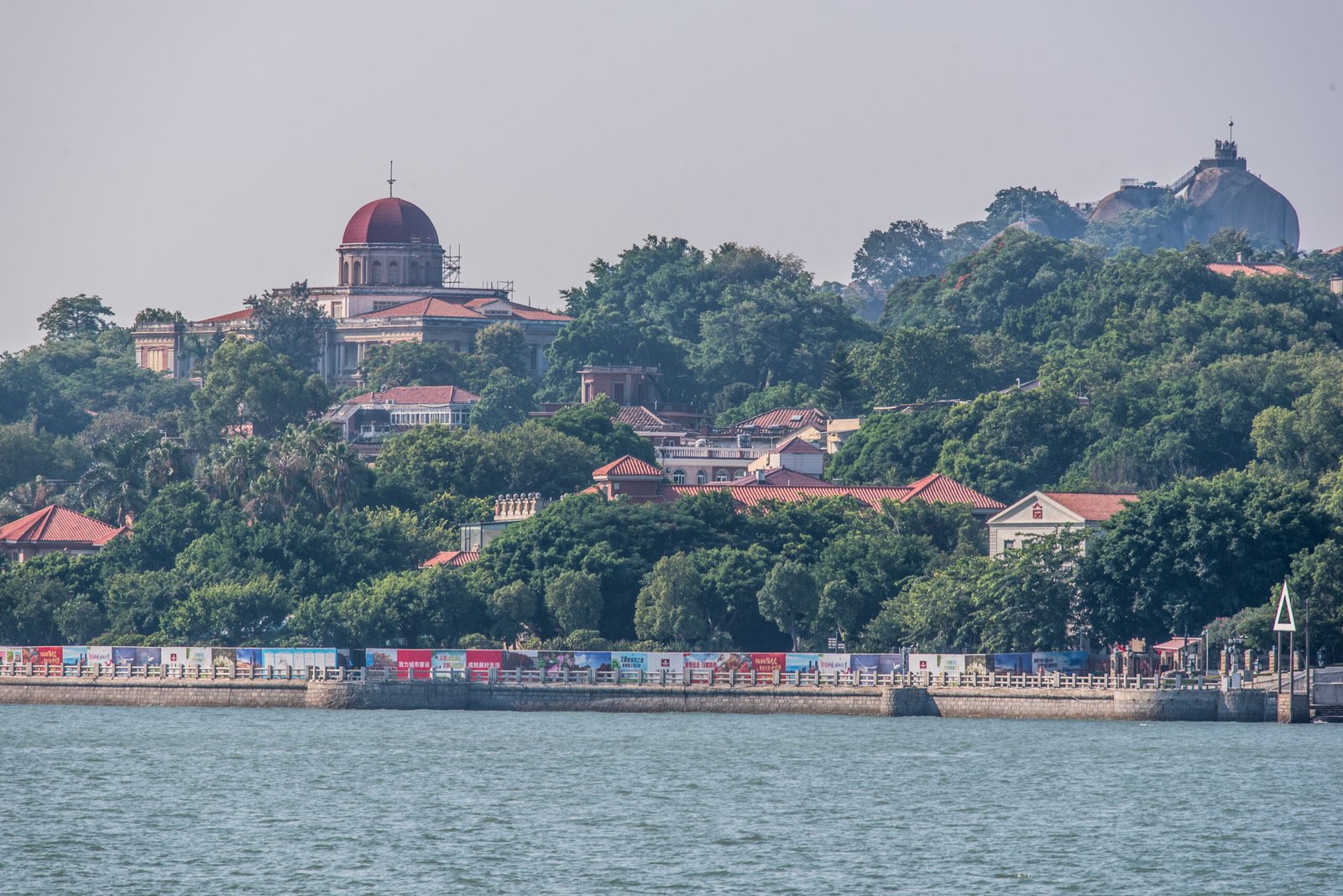
From the ferry the island reads as a green hill scattered with red roofs: the dome of the Bagua Mansion — now the Organ Museum — rides above the trees, with the bare granite of Sunlight Rock behind. Ashore, the lanes climb between verandahed villas, consular compounds and churches, in an eclectic mix that runs from neoclassical porticoes to Amoy’s own hybrid of Southern-Chinese and European building. The absence of traffic is the island’s defining sensation: the soundscape is footsteps, birds and — from open windows and museums — pianos.
For the Italian thread, the Piano Museum holds the consulate’s instrument; the settlement-era consular buildings themselves survive in varying states around the island’s historic core.
Practical information
- Access is by ferry from downtown Xiamen; services run frequently through the day.
- The island is entirely pedestrian — comfortable shoes matter more than any vehicle.
- Expect crowds in Chinese holiday periods; early morning is the quiet window.
- Allow a full day for the lanes, Sunlight Rock, and the organ and piano museums.
Getting there
Kulangsu lies just off downtown Xiamen, Fujian province, south-eastern China; ferries leave from the Xiamen waterfront. GPS: 24.44725, 118.06189 · Open in Google Maps.
Related places and reading
- The former Italian concession of Tianjin — Italy’s one true concession in China
- An Italian Quarter in China: the Tianjin Concession, 1901–1947 — the wider frame
Sources
- English Wikipedia, “Gulangyu” (1902 Land Regulations, thirteen nations, 1942–1945 occupation, UNESCO inscription 8 July 2017, island data, landmarks, access).
- English Wikipedia, “Concessions of Italy in China” (Italian consulate on Gulangyu, the 1902 delimitation charter signed by Italy’s consul, the consulate’s piano in the Piano Museum).
- UNESCO World Heritage List, “Kulangsu, a Historic International Settlement”.
- OpenStreetMap Nominatim (coordinates).
Find it on the map
See this place and what’s around it →Record researched and written by Luigi De Marchi for Cultural Heritage Online, 2026.
📷 Become a Cultural Heritage Online photographer
Share your photos of places: they stay published under your name as the author. The more they're seen, the more you get noticed — and soon a contest will reward the most appreciated photos.
Log in or sign up free to add a photo