The Novecento was an Italian artistic movement born in Milan at the end of 1922. It began as a group of seven painters — Mario Sironi, Achille Funi, Leonardo Dudreville, Anselmo Bucci, Emilio Malerba, Pietro Marussig and Ubaldo Oppi — gathered around the critic and collector Margherita Sarfatti, its promoter and organiser. The group presented itself in 1923 at the Galleria Pesaro; the First Novecento Italiano Exhibition was held in 1926 at Milan’s Palazzo della Permanente. First of all, then, Novecento is painting — a story told in Art in Interwar Italy. This piece is about the movement’s other face: the architecture that translated the painters’ “return to order” into stone and concrete.
The “return to order”
Novecento was born of a precise climate. After the First World War, part of Europe’s artists left the season of the avant-gardes — Futurism, Cubism — to return to the certainties of tradition: the figure, composition, classical order. Historians call the phenomenon the return to order, fed in Italy by reviews such as Valori Plastici and La Ronda and by Metaphysical painting. It was not nostalgic. The idea was to recover the great Italian tradition — classical and Renaissance — and read it with modern eyes, building a language at once rooted in the past and fit for the present. In architecture this meant taking up the elements of classicism — columns, cornices, symmetry — simplifying them and setting them beside twentieth-century materials and techniques.
Nor was the phenomenon only Italian: in the same years much of European art cooled toward the avant-gardes and recovered figure and order — Picasso’s neoclassical season is the obvious parallel. The Italian Novecento is the national version of a continental tendency, felt with particular force in a country that considered itself the direct heir of that tradition.
Giovanni Muzio and a necessary distinction
The spokesman of Novecento architecture in Milan was Giovanni Muzio (1893–1982). From the early 1920s Muzio became the ideological reference of a group of young architects who, in tune with Sarfatti’s pictorial Novecento, demanded a return to order in design as well: measure, proportion, dialogue with tradition against improvisation and decorative excess.
A frequent misunderstanding should be cleared at once: Novecento architecture is not rationalism, and Giuseppe Terragni was not one of its exponents. Terragni belongs to rationalism, a different and partly later tendency tied to the international Modern Movement. Muzio’s Novecento looks at tradition and reinterprets it; rationalism dissolves it into geometric abstraction. Confusing them is the most common error made about the architecture of these years.
The defining features
Formally, Novecento architecture is recognisable by recurring traits: explicit references to classical Roman and Renaissance architecture, reinterpreted in modern key and often reduced to citation or fragment; simple geometric forms and ordered plans; stone and marble set beside reinforced concrete and steel; sober ornament that underlines the structure instead of overwhelming it; measured, solid façades that recall the durability of classical buildings without the rhetoric of State monumentalism.
The difference from nineteenth-century classicism is the method: Novecento does not copy the orders whole, but takes them apart and recomposes their elements on modern buildings, leaving broad bare surfaces between one citation and the next. From this tension between the classical fragment and the modern void comes its character.
Ca’ Brutta, the manifesto (1919–1922)
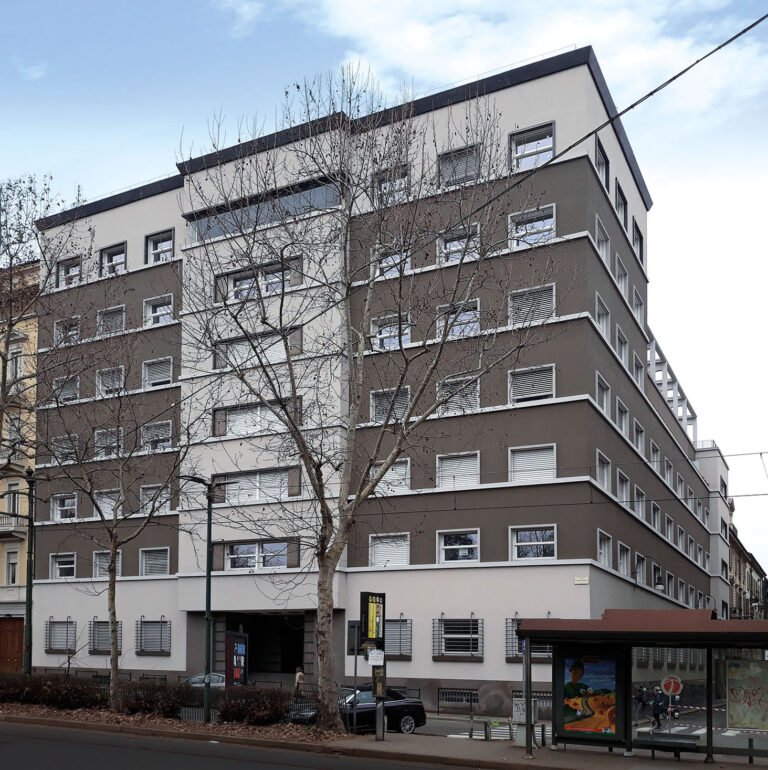
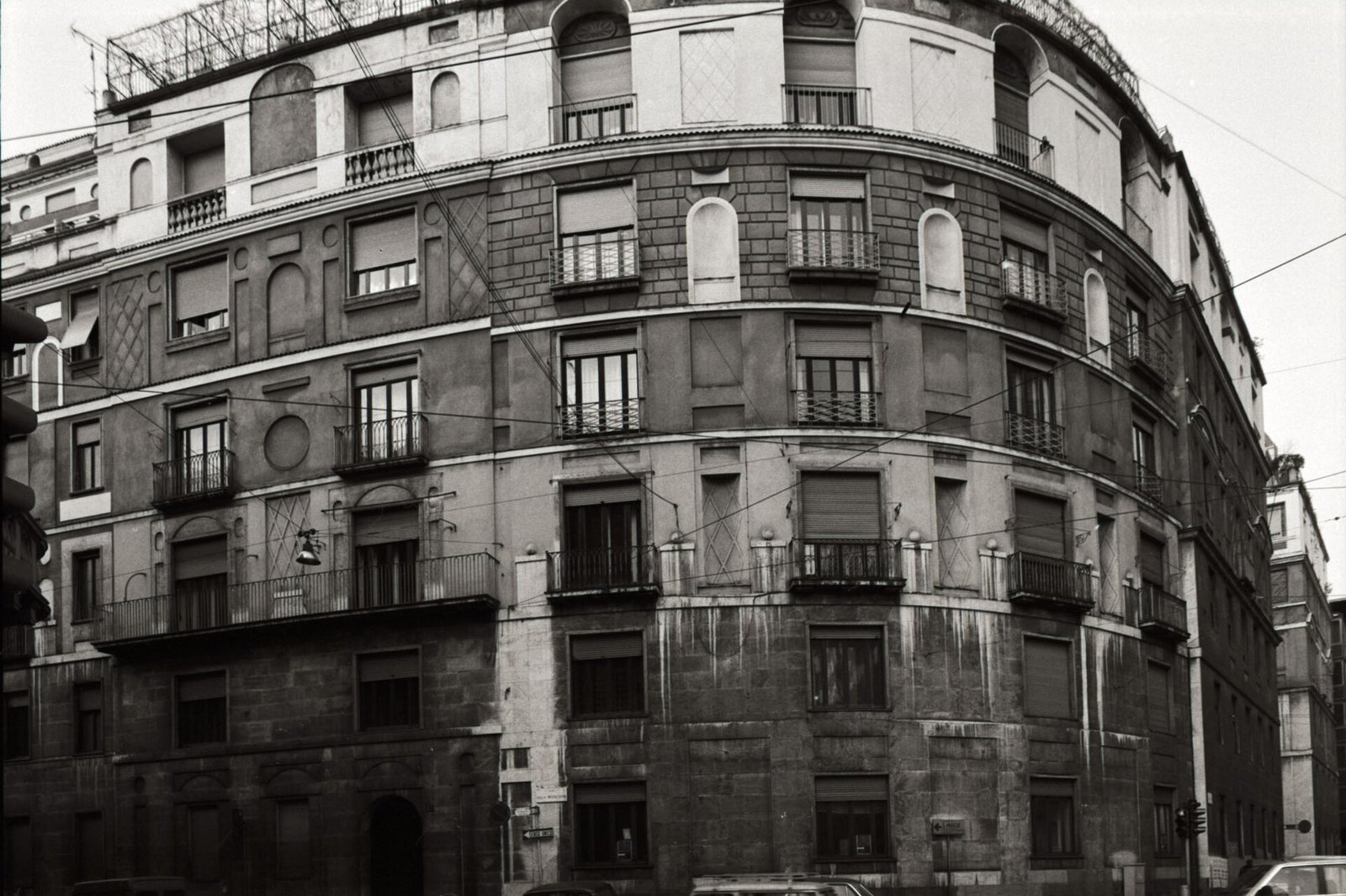
The work that best sums all this up is Ca’ Brutta, the apartment building Giovanni Muzio built between 1919 and 1922 at the corner of Via della Moscova and Via Turati in Milan. Muzio broke the classical language into pieces — cornices, rustication, blind niches, oculi — and recomposed them on a large modern residential building, leaving wide bare walls between the citations. The building wraps the corner with a long, calm front whose most memorable move is the curve turning from one street into the other. The lower floors are treated as a heavy rusticated base; above, the wall is punctuated by windows, small balconies and isolated classical motifs on smooth surfaces. Nothing is academically symmetrical, nothing fully ornamented: the effect springs from the tension between the classical pieces and the modern void around them.
The effect wrong-footed contemporaries: the building seemed neither properly classical nor frankly modern. Criticism was so harsh that the Milanese renamed it Ca’ Brutta — “ugly house” in dialect — an insult that became its name. Time has reversed the verdict: today Ca’ Brutta is considered the built manifesto of the Novecento and one of the key Milanese buildings of the century.
Muzio’s other buildings
After Ca’ Brutta, Muzio remained for decades a protagonist of Milanese architecture, applying the same method to public and cultural buildings, several of them documented in the archive: the Palazzo dell’Arte, seat of the Milan Triennale (1932–1933), among his most celebrated works; the Università Cattolica del Sacro Cuore, where he measured himself against the pre-existing Bramante-school cloisters; and the Palazzo del Popolo d’Italia in Piazza Cavour (1938–1942), built for the newspaper founded by Mussolini and today known as Palazzo dell’Informazione.
Through these works Muzio’s language evolved, from the experimental decomposition of Ca’ Brutta to progressively more compact and monumental fronts. The Palazzo del Popolo d’Italia belongs to his late phase, on the eve of the war, and shows how close Novecento had by then come to the era’s monumental language. It is also a building tied to a precise political function, and should be known for what it is: a document of architecture and history together.
Three roads: Novecento, rationalism, monumentalism
Italian architecture between the wars was not one block, and Novecento is only one of its directions. Keeping the three main ones distinct helps read the buildings for what they are: Muzio’s Novecento — a measured recovery and reinterpretation of the classical tradition; the rationalism of Giuseppe Terragni — geometric essentiality and functionalism in dialogue with the European Modern Movement; and the monumentalism of Marcello Piacentini — classicism in rhetorical, celebratory key, the official language of State architecture, explored in a dedicated piece. The three coexisted in the same years, sometimes on the same building sites, and partly clashed; the wider frame is in Architecture and Power in Fascist Italy.
Rise, decline, and what remains
As an organised tendency, Novecento had a relatively short arc. After the 1923 debut and the 1926 exhibition the painters’ group quickly reached prominence, sustained by Sarfatti’s tireless work — and that very centrality drew criticism from all sides: from the rationalists, who judged it too bound to the past, and from the partisans of a more traditional, rhetorical art, who found it too modern. By the mid-1930s the movement had lost its cohesion, not least as Sarfatti’s role was cut back. In architecture, though, its lesson did not disappear: it lived on in the work of individuals — Muzio first among them — and in the measured way of standing between tradition and modernity that long marked Milanese building.
Novecento’s buildings largely still stand and are still in use: homes, universities, cultural institutions in the living fabric of the cities, Milan above all. Cultural Heritage Online documents these places as historical sources — describing what they are, who designed them and when, neither celebrating nor condemning.