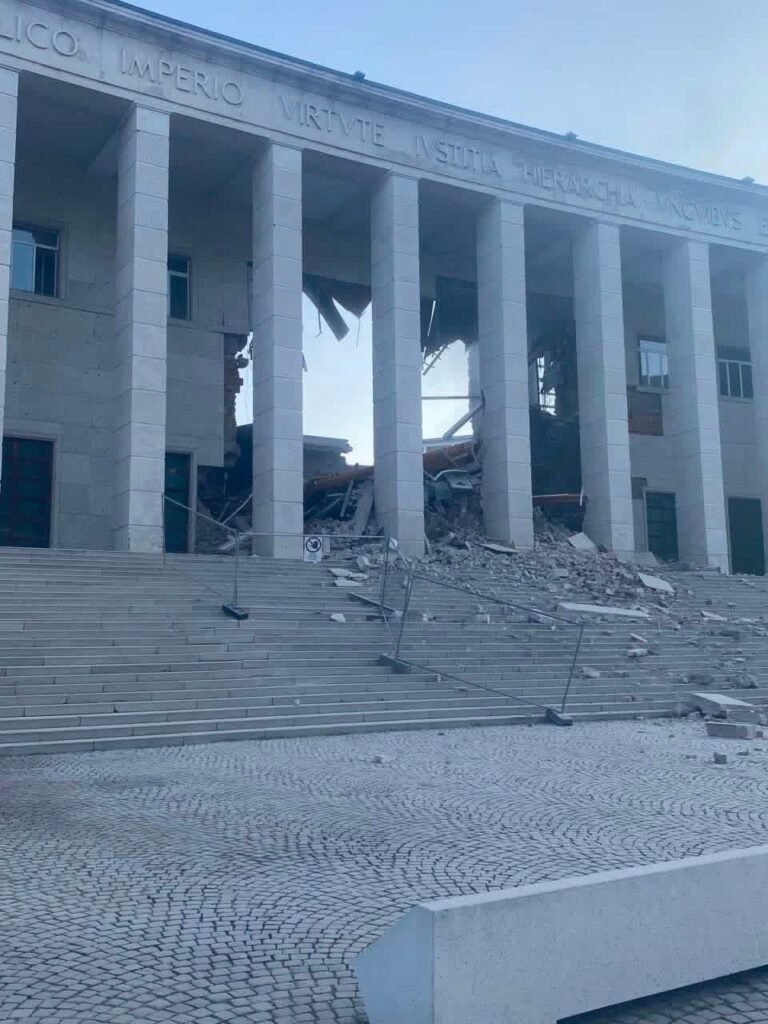
Between the late 1920s and the 1930s the world of Italian art exhibitions was reorganised into a system. It was not merely a matter of hosting shows: institutions, calendars, juries and public purchases formed an apparatus that reached artists in every province and steered their careers. The State’s role grew steadily, and promoting Italian art at home and abroad became a declared objective.
That this system also served to project an image of national identity and to build consensus is the settled reading of the historiography — Ruth Ben-Ghiat and Emily Braun among others. It is an analysis, not a value judgement; what follows reconstructs the facts, keeping documented record and interpretation explicitly apart. Nor was the projection only internal: between 1935 and 1937 the regime organised exhibitions of Italian art in other European capitals, using art as an instrument of international cultural policy — a way of making Italy talked about beyond its borders, in dialogue and in competition with the other European powers.
The Venice Biennale and the birth of the Film Festival
The oldest of these institutions was the Venice Biennale, founded in 1895 as the great international showcase of contemporary art. In 1930 the Biennale was turned into an autonomous public body, coming under more direct state control and extending its activities beyond the figurative arts.
It was in this frame that, in 1932, the International Exhibition of Cinematographic Art was born: the first edition ran from 6 to 21 August 1932 on the terrace of the Hotel Excelsior at the Venice Lido. It is the oldest film festival in the world. The Biennale and its new film section were the country’s international window, bringing to Venice audiences, press and works from across Europe and beyond.
The Rome Quadriennale and the syndicate exhibitions
On the national side the linchpin was the Quadriennale of National Art in Rome, first held in 1931 at the Palazzo delle Esposizioni: the great review that every four years was to take stock of living Italian art. Around five hundred artists exhibited, and for the first time at that scale a painter could apply to a jury rather than wait for a personal invitation — a detail that says much about the passage from a world of studios and patrons to a system regulated by the State. The Futurists were given a dedicated room.
More capillary, and arguably more decisive for artists’ daily lives, were the syndicate exhibitions organised by the Fascist National Syndicate of Fine Arts (established 1927) at provincial, interprovincial and national level; the first national syndicate show was held in Florence in 1933. Repeated every year in dozens of cities, these reviews governed access to exhibitions, public purchases and the market: for a painter or sculptor in the provinces, admission could mean the difference between a career and silence.
The Exhibition of the Fascist Revolution (1932)
The case in which art, architecture and power intertwined most tightly was the Exhibition of the Fascist Revolution (Mostra della Rivoluzione Fascista), opened at Rome’s Palazzo delle Esposizioni on 28 October 1932 for the tenth anniversary of the March on Rome, and kept open until 1934. It was not strictly an art exhibition but a historical-propaganda display on the history of Fascism; yet it was here that the regime called on some of the best-known artists and architects of the moment.
The nineteenth-century building’s façade was redesigned by Adalberto Libera and Mario De Renzi, who turned it into a monumental screen with four great metallic fasces; Giuseppe Terragni designed the room dedicated to 1922, Mario Sironi contributed photomontages and displays, Enrico Prampolini plastic-decorative works. The exhibition registered some four million visitors. That it was conceived as a device to “capture the masses” is the historiography’s reading; as a matter of record, it remains one of the most studied examples of art placed in the service of the representation of power.
Art, identity, propaganda
The exhibitions of the period had a double nature. On one side they were real artistic platforms, where very different languages coexisted — the solid classicism of the Novecento promoted by Margherita Sarfatti, the dynamics of the Second Futurism and aeropainting, the tonal painting of the Roman School, the first abstract researches: a wide spectrum, from realism to Futurism. The regime, as the scholarship notes, never imposed a single State art. On the other side, the shows were instruments of national identity and consensus: they served to display Italy to itself and to the world, and to bind artistic life to the institutions.
Part of the production on display was celebratory: monumental works staging heroic themes, labour, the myth of Rome, the figure of the leader. In some reviews — the Exhibition of the Fascist Revolution, and later the colonial and wartime displays — the propaganda component was explicit, with works celebrating military campaigns or depicting the regime’s adversaries. We record this for what it is: documented content of those exhibitions, to be described, not endorsed.
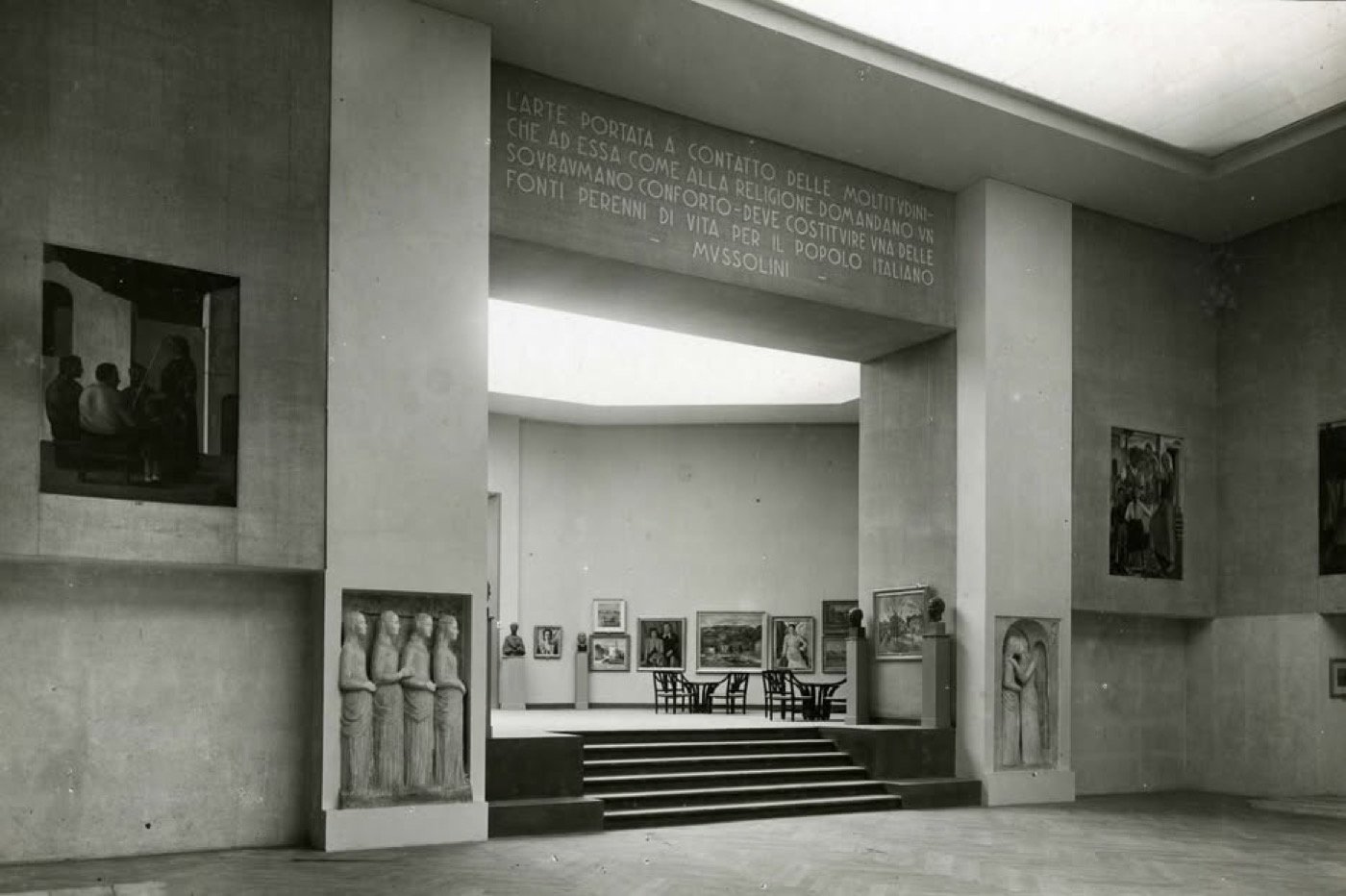
The inscription running above the hall in the opening photograph fixes the idea: art as a “perennial spring of life for the Italian people”. It is worth noting a tension. In 1923, opening a Novecento exhibition, Mussolini had declared he had no wish to encourage “anything that might resemble a State art”; ten years later, the public and collective function of art was proclaimed openly. Much of the cultural history of the period runs between those two sentences.
What remains
Of that exhibition system a vast body of documents and works survives, conserved and studied by the institutions that organised the shows: the ASAC, the historical archive of the Venice Biennale; the archive of the Rome Quadriennale; the Central State Archive, which holds the materials of the Exhibition of the Fascist Revolution; and the museums that keep the paintings and sculptures then on display.
These are precious sources because they document, at close range, the mechanisms by which a regime built its image and organised culture. Cultural Heritage Online treats them as such: it describes what these exhibitions were, who designed them and when, neither celebrating nor condemning. The movements and artists that crossed those halls are the subject of a companion piece, Art in Interwar Italy; Sironi’s graphic work is explored in Secret Sironi.