
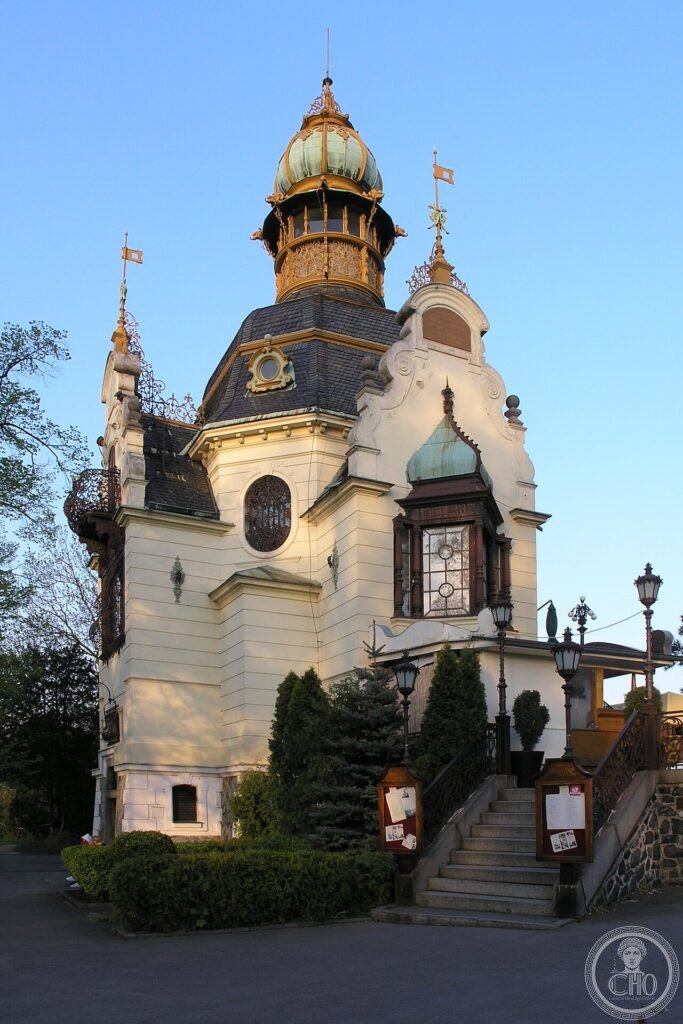

Built to sell cast iron, it ended up selling a view: the Hanau ironworks’ exhibition pavilion of 1891 now stands on the Letná heights, its filigree balconies overlooking the whole sequence of Vltava bridges.
At a glance
The Hanavský Pavilion was created for the General Land Jubilee Exhibition of 1891 as the display pavilion of the princely Hanau ironworks at Komárov — a building that was itself the product on show. Architects Otto Hieser and Josef Hercík dressed a pioneering cast-iron structure in neo-baroque forms laced with early Art Nouveau decorative and figural motifs, the whole cast in the client’s own foundries. Celebrated as the first cast-iron building in Prague, it drew crowds at the exhibition — Emperor Franz Joseph I among them — and was afterwards given to the city and re-erected on the Letná plateau above the Vltava, where it serves today as a restaurant.
Key facts
- Built: 1891, for the Jubilee Exhibition in Prague
- Designers: Otto Hieser and Josef Hercík; construction supervised by František Červinka; modelling by Zdeněk Emanuel Fiala
- Client: The princely Hanau ironworks, Komárov — Prince William of Hanau personally showed Emperor Franz Joseph I through the pavilion on 1 October 1891
- Structure: Cast iron, celebrated as the first cast-iron building in Prague
- Style: Neo-baroque with early Art Nouveau motifs
- Location: Letenské sady (Letná Park), above the Vltava
- GPS: 50.09364444, 14.41259722 — View on Google Maps
- Today: Restaurant with panoramic terrace
History
The 1891 Jubilee Exhibition was Bohemia’s great industrial self-portrait, and the Hanau ironworks arrived with the most persuasive advertisement imaginable: a pavilion whose every arch, baluster and ornament was cast in their own foundry. The gamble worked — the pavilion became one of the exhibition’s favourites, and when the emperor toured the grounds that October, Prince William of Hanau guided him through in person.
After the exhibition closed, the pavilion was presented to the City of Prague and moved from the exhibition grounds to the edge of the Letná plateau — a promontory position that turned an industrial showcase into a belvedere. It has been a café-restaurant for most of its life since, surviving neglect and restoration cycles, and remains one of the best places in the city to understand what cast iron meant to the nineteenth century: a material that could be spun into lace and still hold up a building.
What you see
The pavilion is small — a central domed hall with wings and terraces — but every surface works. Cast-iron columns, arches and balustrades carry dense neo-baroque ornament shading into the vegetal curves of the coming Art Nouveau; the figural details were modelled by Zdeněk Emanuel Fiala. The green-and-gold colour scheme picks the ironwork out against the park. Walk the terrace edge: the panorama sweeps from the Old Town across the full sequence of Vltava bridges, with the Charles Bridge stacked behind its neighbours — the postcard shot of Prague’s river.
Practical information
- Operating restaurant — the exterior and the terrace viewpoint are the attraction for architecture visitors
- The bridge panorama is best in morning light or at dusk when the city lights come on
- Reservations advisable for terrace tables at sunset
Getting there
The pavilion stands at the western end of Letná Park. From Malostranská metro station, climb the zig-zag path up the Letná slope (10 minutes); from the Old Town, cross the Čech Bridge and take the stairs up the plateau. Trams along Milady Horákové serve the park’s northern edge.
Nearby
- Letná Park and the Metronome — the plateau’s landmark on the former Stalin monument plinth, 15 minutes east
- Prague Main Station (Fanta Building) — Josef Fanta’s Art Nouveau station hall across the river
- Municipal House — the summit of Prague Art Nouveau, 20 minutes away
- Hlahol Building — Josef Fanta’s choral society house on the embankment
Sources
- Muzeum císaře Franze Josefa I. (franz-josef.cz) — exhibition history, designers, imperial visit, relocation
- Prague City Tourism / prague-stay — building description and current use
- Wikidata Q187177 — coordinates and 1891 date
Find it on the map
See this place and what’s around it →Record researched and written by Luigi De Marchi for Cultural Heritage Online, 2026.
📷 Become a Cultural Heritage Online photographer
Share your photos of places: they stay published under your name as the author. The more they're seen, the more you get noticed — and soon a contest will reward the most appreciated photos.
Log in or sign up free to add a photoIs this page about you?
This page is read by travellers and heritage enthusiasts who find it on Google. Tell us how you are connected to this place and we will take it from there.