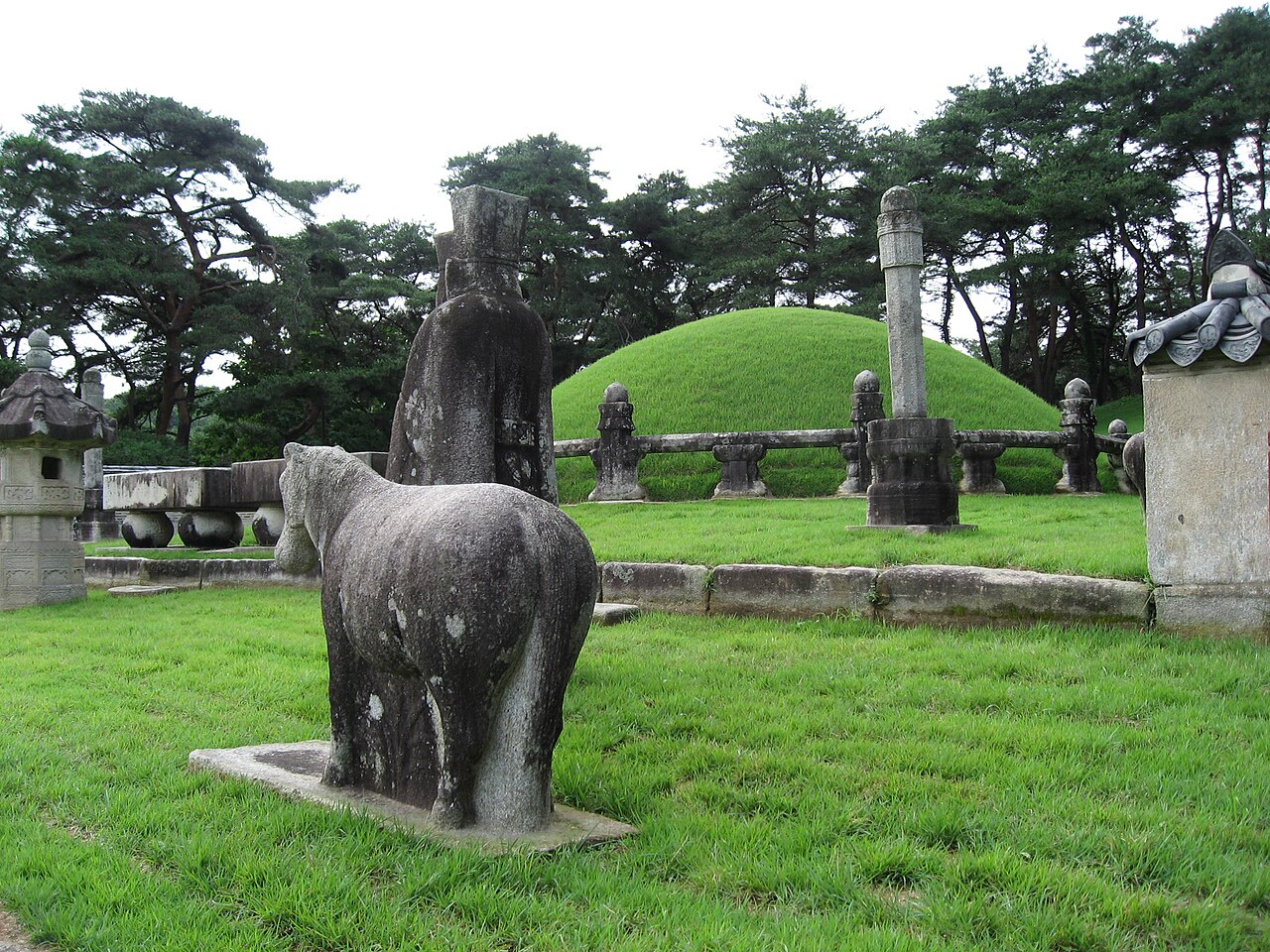
The Royal Tombs of the Joseon Dynasty, inscribed by UNESCO in 2009, protect forty royal tombs across eighteen locations distributed in the hills around Seoul and Gyeonggi Province — the burial sites of the twenty-seven kings (and their queens and secondary queens) of the Joseon dynasty (1392–1897 CE, the longest-reigning dynasty in Korean history at approximately 519 years), constituting the most complete surviving royal burial system in East Asia and one of the few royal tomb traditions in the world where the design principles, ritual protocols, construction manuals, and spatial organisation have been preserved without interruption from the 14th century to the present. Every Joseon royal tomb is laid out according to a three-zone spatial system derived from Confucian ritual principles and pungsu geomancy (풍수지리, the Korean and Chinese system of site selection based on landform, water orientation, and directional auspiciousness): the inner zone (능침 구역, neungchim area), containing the tumulus mound (typically hemispherical, grass-covered, facing south, positioned with the main mountain ridge behind and the water course in front), the protective stone enclosure (곡장, gokjang, a crescent-shaped low wall curving around the back and sides of the mound), and the stone guardian figures (stone sheep, stone tigers, stone civil officials, stone military officials, and stone horses in paired rows descending from the mound on the approach axis); the transition zone (제향 구역), containing the T-shaped ritual hall (정자각, jeongjagak, a distinctive Joseon architectural form used exclusively for royal tomb ritual ceremonies) and the adjacent stele house (비각, bigak, sheltering the carved stone stelae inscribed with the tomb’s dedication and the king’s reign titles); and the outer zone (진입 구역), containing the approach road (홍살문 to 정자각, the ceremonial gate to the ritual hall axis) and the adjacent secondary official buildings.
The royal tomb circuit around Seoul Dongureung · Seooreung · Seolleung · Yeongneung Yeoju — 25 to 95 km
Nine Kilometres east of central Seoul (accessible from Guribeol Station on Seoul Metro Line 8, then 10 minutes by taxi), Dongureung (동구릉, “Eastern Nine Tombs”) in Guri, Gyeonggi Province, is the largest of the Joseon royal tomb clusters, containing nine individual tombs of kings and queens across an 820,000 m² forested estate — the most concentrated landscape of Joseon royal burial architecture surviving anywhere. The first tomb at Dongureung was that of Taejo (태조, Yi Seonggye, r. 1392–1398 CE, the founding king of the Joseon dynasty), selected by Taejo himself in 1408 CE as his future burial site on the basis of a combined assessment by the royal geomancy bureau and the king’s personal inspection; subsequent kings chose burial within the Dongureung compound as the most propitious adjacency to the dynasty’s founder, resulting in the gradual expansion of the estate over 530 years. The Dongureung tumuli range from the compact and simple (the tombs of later queens buried without their royal husbands) to the elaborate (the joint royal tomb Sureung 수릉 of King Munjo and Queen Sinjeong, with flanking stone figures in a wooded setting that represents the highest quality Joseon stone carving of the 19th century). The walking circuit through Dongureung’s forest paths visits all nine tumuli and the T-shaped ritual halls in approximately 2–3 hours; the adjacent royal horticultural plantings (pine, zelkova, and Manchurian oak preserving the 400-year-old tree cover that was maintained around the tombs as part of the ceremonial forest zone) constitute one of the most unusual old-growth urban forest reserves in the Seoul metropolitan area. From Dongureung, the route southeast passes through central Seoul to Seolleung (선릉, in the Gangnam district, approximately 20 km west of Dongureung, accessible from Seolleung Station on Metro Lines 2 and 9, directly beneath Seoul’s modern financial centre) — the joint tomb site of King Seongjong (r. 1469–1494 CE, the 9th Joseon king, whose 25-year reign produced the Joseon legal code Gyeongguk Daejeon, the foundational statute of the dynasty) and his son King Jungjong (r. 1506–1544 CE), an incongruous pocket of 15th-century tumuli and ritual architecture surrounded by skyscrapers in the Teheran-ro business district.
Ninety-Five Kilometres southeast of Seoul (approximately 1 hour 40 minutes by intercity bus from Seoul Station to Yeoju, then taxi to Yeongneung/Yeongneung), Yeongneung (영녕릉, comprising Yeongneung, the tomb of King Sejong the Great, and Nyeongneung, the adjacent tomb of King Hyojong) is the most historically prestigious of all the Joseon royal tombs — Sejong (세종대왕, r. 1418–1450 CE, the 4th Joseon king, who commissioned the creation of Hangul, the Korean phonetic alphabet, in 1443 CE, established the Jiphyeonjeon (Hall of Worthies) as the royal research academy, standardised Korean musical notation, and developed astronomical instruments including the world’s first rain gauge standardised in 1441 CE) is regarded as the greatest ruler in Korean history, and Yeongneung’s remote setting in the Yeoju countryside — surrounded by the Namhan River valley and forested Joseon-period pine hills — preserves the geomantic landscape of mountain-ridge backing and south-facing river orientation that was considered the most auspicious possible tomb siting. The adjacent Sejonglnuneung Sejong Exhibition Hall provides the most comprehensive interpretation of Sejong’s reign and of the Joseon royal tomb tradition in English and Korean. For visitors covering the northwest: Seooreung (서오릉, “Western Five Tombs”) in Goyang, Gyeonggi Province (approximately 25 km northwest of central Seoul, accessible from Neunggok Station on Metro Line 3 plus bus), contains the second-largest royal tomb cluster (five tombs plus adjacent queens’ burial grounds), including Gyeongneung (the tomb of Queen Jeonghyeon, consort of King Seongjong, whose murder was ordered by Yeonsangun in 1499 CE — the most dramatic episode in Joseon consort history) and Changneung (the joint tomb of King Yeongjo, r. 1724–1776 CE, and his first queen, the longest-reigning Joseon king at 52 years, the father of the tragic Crown Prince Sado whose execution prompted the construction of Hwaseong Fortress).
Practical information
The Royal Tombs of the Joseon Dynasty are managed as individual admission-fee sites by the Cultural Heritage Administration of Korea. Dongureung (Guri) is the recommended starting point for Seoul-based visitors: open Tuesday–Sunday 09:00–18:00 (17:30 last entry), closed Monday, admission fee; the estate map at the entrance identifies all nine individual tombs with English captions. Seolleung (Gangnam) is the most convenient individual tomb for visitors in central Seoul: open Tuesday–Sunday 06:00–21:00 (extended hours due to the urban location), admission fee; 10 minutes walk from Seolleung Metro Station. Seooreung (Goyang) is 30 minutes from central Seoul by Metro Line 3 to Neunggok + bus, open Tuesday–Sunday 09:00–18:00 (17:30 last entry), admission fee; the estate includes a traditional-culture demonstration programme on weekends. Yeongneung (Yeoju) requires half a day from Seoul; the Sejong Exhibition Hall is open Tuesday–Sunday 09:00–18:00 with English-language interpretive panels on Joseon astronomy, music, and language. The English-language “Joseon Royal Tombs” cultural walking tour audio guide (available as a smartphone app through the Cultural Heritage Administration website) covers Dongureung, Seolleung, and Seooreung with detailed commentary on each individual tomb. Best visiting season: spring (March–April, cherry blossom along the approach avenues, wildflowers in the forested zones) and autumn (October–November, the zelkova and oak foliage turning in the tomb estates).
Frequently Asked Questions
What are pungsu geomantic principles and how did they determine the location of Joseon royal tombs?
Pungsu (풍수지리, “wind and water geomancy”) is the Korean adaptation of Chinese feng shui — a system for selecting building sites on the basis of landform configuration, water flow orientation, and cardinal-direction exposure — that was the primary technical framework for locating Joseon royal tombs. The core pungsu principle for tomb siting is the “four guardian spirits” landscape: the tomb should have a main mountain ridge (주산, jusan, “master mountain”) rising directly behind the tomb to the north, providing wind protection; two flanking ridges extending to the east (청룡, cheongnyong, “blue dragon ridge”) and west (백호, baekho, “white tiger ridge”) curving around the tomb like protective arms; and an outer mountain (안산, ansan, “facing mountain”) at a comfortable visual distance to the south, providing enclosure and visual balance. Water (a stream or river) should flow across the front of the site from east to west (in the northern hemisphere, east-to-west surface water flow indicates favourable subterranean drainage conditions). The pungsu assessment of a proposed tomb site was conducted by the Royal Bureau of Pungsu (풍수지리학, a specialised government office staffed by professional geomancers whose examinations were part of the Joseon civil service examination system) — assessors would walk the candidate landscape, take compass bearings on the ridgeline orientations, and rate the site on a scale of auspiciousness that took into account the specific king’s birth year (and the associated numerological relationship to the cardinal orientations), the dynasty’s geomantic needs for longevity, and the accessibility of the site from Seoul for the mandatory quarterly ritual ceremonies. The selection of a tomb site typically took months and involved multiple competing assessments from different geomancers; in some cases, disputes over tomb placement — particularly where pungsu orthodoxy conflicted with logistical accessibility or land ownership — became significant political contests between court factions. The pungsu principles are visible in every Joseon royal tomb: all tumuli face south, all have forested ridge backgrounds to the north, and all have a T-shaped ritual hall positioned on the south-facing slope below the tumulus in the precise orientation required by the pungsu framework. UNESCO’s inscription recognises the Joseon royal tomb landscape as an Outstanding Universal Value in part because the combination of a consistent geomantic design principle applied across forty tombs over five centuries, and the preservation of that landscape against the pressures of Seoul’s urbanisation, is without parallel in East Asian royal burial history.
What is the significance of the stone guardian figures and how do they vary between tombs?
The stone guardian figures (석물, seongmul, “stone objects”) at Joseon royal tombs are a standardised programme of stone sculpture positioned in fixed roles and locations along the approach axis from the T-shaped ritual hall to the tumulus — the most consistent and visually distinctive element of Joseon royal tomb design, and one of the clearest indicators of a tomb’s date and the rank of the individual buried within. The canonical programme for a king’s tomb consists of (in descending order from the tumulus, moving south along the approach axis): two stone sheep (양, yang, positioned immediately flanking the tumulus base, representing agricultural abundance), two stone tigers (호, ho, the same position on the alternate axis — tigers and sheep alternate in the rings), two stone civil officials (문인석, muninseok, positioned approximately midway down the approach, representing the Confucian administrative hierarchy), two stone military officials (무인석, muinseok, paired with the civil officials), and two stone horses (마, ma, positioned between the officials and the tumulus gate). The paired arrangement — always in mirror symmetry flanking the central approach axis — reflects the Confucian principle of balanced opposition (left and right, civil and military, animal and human) that structures Joseon ceremonial space. The quality and stylistic details of the stone sculpture are the primary indicator of a tomb’s date: early Joseon tombs (15th century) have stone figures with simplified, almost schematic features in the Chinese Han-dynasty tradition; mid-Joseon tombs (16th–18th century) develop increasingly detailed facial carving, more naturalistic proportions, and more elaborate court costume details; late Joseon tombs (19th century, particularly the tombs at Dongureung) have the most technically accomplished stone carving in the series, with detailed facial portraits, finely carved armour and court robes, and large scale (some figures exceed 2 metres in height). The stone figures of queens’ tombs (왕비릉) and crown princes’ tombs follow a simplified programme — typically just the paired civil and military officials without the sheep and tigers — reflecting the strict Joseon protocol hierarchy that differentiated funerary honours by rank within the royal family. The stone-figure programme was maintained throughout the Joseon period without significant disruption, making the 40-tomb collection a 500-year visual history of Korean stone carving in the court tradition.
Why are the Joseon royal tombs well preserved compared to royal tombs in other countries?
The Joseon royal tombs’ exceptional state of preservation — forty tombs across eighteen locations, virtually all with their original stone guardian figures, T-shaped ritual halls, and forested estate zones intact after 600 years — is the result of a combination of specific Joseon institutional practices and 20th-century historical contingencies that together produced a preservation outcome without close parallel in East Asian royal burial history. The primary factor is the continuity of the Joseon ritual calendar: the dynasty maintained quarterly ritual ceremonies (제사, jesa) at each royal tomb throughout its 519-year existence, which required the continued staffing of tomb wardens (능참봉, neungchambong, a specialised mid-rank government post responsible for maintaining the tomb estate, protecting the forested buffer zone from timber cutting, and preparing the ritual hall for ceremonial use), the continuous management of the ceremonial forest (the timber restrictions that prohibited cutting in the tomb estate zone preserved the old-growth forest that now surrounds each tomb), and the continuous repair of the stone figures and architectural elements. The ritual system did not end with the dynasty: the last Joseon emperor’s grandson (Yi Won, b. 1962) and the Jeonju Yi clan association still conduct ceremonial rites at the royal tombs, providing institutional continuity. The second factor is the geological protection of the tumulus construction method: Joseon royal tombs are not burial chambers in the ground (as most European and Chinese royal tombs are) but rather stone burial chambers built at ground level and then covered with the earth mound — this construction method, combined with the compacted earth mound and the stone perimeter wall (gokjang), makes the tombs effectively immune to the collapse from above and flooding from below that destroyed most underground burial chambers in China and Europe. The Joseon tombs were systematically looted during the Imjin War (1592–1598 CE) Japanese invasions — Korean records describe the Japanese army opening several tombs and removing grave goods — but the mound structures themselves were not damaged, and the grave goods that had not been looted were reinterred and the mounds restored after the war. The 20th-century contingency is the location of most tomb estates within the Seoul metropolitan area: the rapid urbanisation of the Gyeonggi Province hinterland in the 1960s–1990s surrounded the tomb estates with suburbs but did not penetrate them, because the Cultural Heritage Administration designated the estates as protected zones in 1963 (shortly after the founding of the Republic of Korea’s cultural heritage system). This protection was maintained through two generations of urban development pressure, resulting in the distinctive landscape of forested old-growth estate zones surrounded by dense apartment blocks that characterises the Seolleung, Seooreung, and other Seoul-area royal tomb sites today.
Sources
- S1 — UNESCO World Heritage Centre — Royal Tombs of the Joseon Dynasty (Ref. 1319) — https://web.archive.org/web/20230601000000/https://whc.unesco.org/en/list/1319/
- S2 — UNESCO World Heritage Centre — Statement of Outstanding Universal Value (Ref. 1319) — https://whc.unesco.org/en/list/1319/
Spotted an error? Write to editorial@culturalheritageonline.com and we correct it the same day.