The White Monuments of Vladimir and Suzdal, inscribed in 1992, preserve the white-stone churches of the Vladimir-Suzdal principality — the cultural capital of medieval Russia before the Mongol invasion of 1238 and the architectural model for Moscow’s later development. Vladimir’s Cathedral of the Assumption (1158, with Andrei Rublev’s Last Judgment frescoes) and the golden-domed Kremlin of Suzdal are the finest surviving examples of pre-Mongol Russian architecture.
White Monuments of Vladimir and Suzdal: Pre-Mongol Russian Architecture Vladimir Region, 200 km northeast of Moscow
The White Monuments of Vladimir and Suzdal, inscribed in 1992 under criteria (i), (ii), (iv), and (vi), encompasses eight architectural monuments in the towns of Vladimir, Suzdal, and Bogolyubovo — the greatest surviving buildings of the Vladimir-Suzdal principality (1157–1238 CE), which was the most powerful and culturally productive state in medieval Russia before the Mongol conquest and the subsequent rise of Moscow. The inscription covers: the Cathedral of the Assumption (Uspensky Sobor) in Vladimir (1158–1189, with the original white limestone exterior and the Last Judgment fresco cycle by Andrei Rublev, 1408); the Cathedral of Saint Demetrius (Dmitrievsky Sobor) in Vladimir (1194–1197, the most elaborately carved white stone exterior in Russia, with over 600 relief carvings of saints, animals, and fantastical beasts on the three facades); the Golden Gate of Vladimir (1164, the triumphal entrance to the city, the most important example of Russian military architecture of the pre-Mongol period); the Church of the Intercession on the Nerl (Pokrova na Nerli, 1165, at Bogolyubovo, 10 km from Vladimir) — a single-domed white stone church in a meadow at the confluence of the Nerl and Klyazma rivers, considered the most perfect example of Russo-Byzantine church architecture; the Kremlin of Suzdal with the Cathedral of the Nativity (1222–1225); and the Nativity Monastery (Rozhdestvenshy Monastery), the Spaso-Evfimiev Monastery, and the Pokrovsky (Intercession) Monastery in Suzdal.
Suzdal: Museum City of Medieval Russia Suzdal, 35 km north of Vladimir
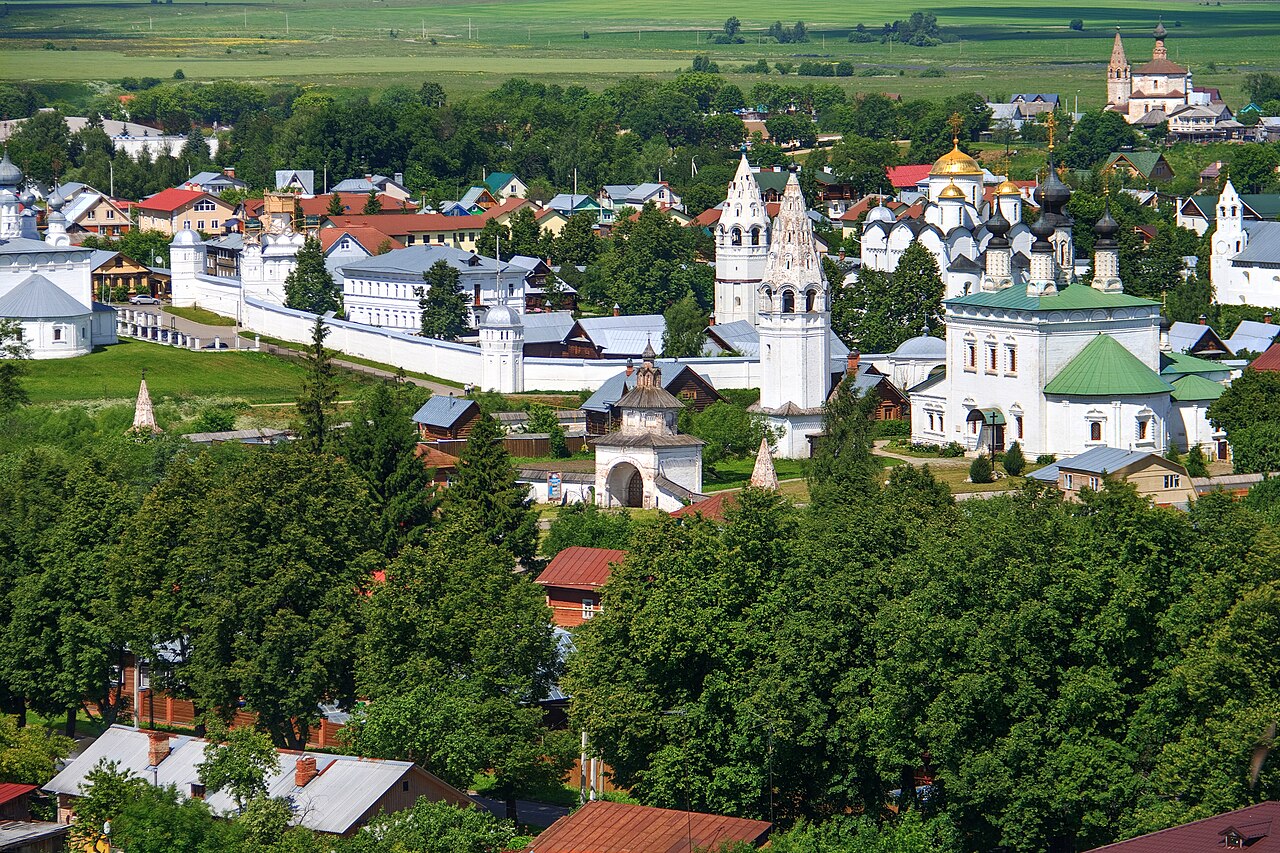
Suzdal is the most completely preserved medieval Russian town — a city of 10,000 inhabitants (it has never grown larger) that contains over 30 churches and five monasteries, all built between the twelfth and nineteenth centuries within a small historic area that has never been industrialised or densely developed. The Suzdal Kremlin (the fortified precinct on a bend of the Kamenka River) contains the Cathedral of the Nativity (built 1222–1225 by Yuri II of Vladimir, on the site of an earlier twelfth-century church), a five-domed cathedral of white limestone with a distinctive later crown of blue-painted domes with gold stars added in the seventeenth century, and the eighteenth-century Bishop’s Court, now the Vladimir-Suzdal Museum Reserve. The Spaso-Evfimiev Monastery (founded 1352, substantially rebuilt in the sixteenth and seventeenth centuries) is the most imposing monastic fortress in Suzdal, its crenellated walls of red brick enclosing the sixteenth-century Cathedral of the Transfiguration (Preobrazhenskiy Sobor, with a notable sixteenth-century fresco cycle), a tall belfry, and the tomb of Prince Dmitri Pozharsky (the leader of the Russian national militia that expelled the Polish occupiers from Moscow in 1612). The Pokrovsky (Intercession) Convent (founded 1364) was from the sixteenth century the exile destination for disgraced tsarinas: Solomonia Saburova (the wife of Vasily III, exiled in 1525 when she bore no children), Eudoxia Lopukhina (the first wife of Peter the Great, confined here from 1698 when Peter divorced her to marry Catherine), and other royal women are buried in the convent’s Cathedral of the Intercession.
Vladimir: City of the Golden Gate and Rublev’s Frescoes 🚌 ~35 mins south
Vladimir, 35 km south of Suzdal and 200 km northeast of Moscow (2 hours by high-speed Sapsan or Lastochka train), is the principal city of the Vladimir-Suzdal inscription and the most important medieval Russian city after Novgorod and Kiev. The Cathedral of the Assumption (Uspensky Sobor, 1158, enlarged 1189) served as the main cathedral of all Russia from the late twelfth century until the Cathedral of the Assumption in the Moscow Kremlin was built in 1479; the Metropolitan of Moscow visited Vladimir for major celebrations until 1328 when the metropolitan see moved permanently to Moscow. The Last Judgment fresco cycle by Andrei Rublev (1408), commissioned by Prince Vasily I after the cathedral had been sacked and partially burned, is the most important surviving work of Russian medieval painting in situ — Rublev’s masterpiece, though his most famous individual icon (the Old Testament Trinity, c. 1411) is in the Tretyakov Gallery in Moscow. The Golden Gate of Vladimir (1164), built by Andrei Bogolyubsky as the ceremonial entrance to the city, is the only surviving example of the ceremonial city gate type in medieval Russia; its small gate church at the top was used by the prince’s guards and now contains a military historical exhibition.
Practical information
Vladimir is 200 km northeast of Moscow; Lastochka express trains from Moscow Kursky station take approximately 1.5–2 hours. Suzdal is 35 km north of Vladimir by bus (40 minutes, frequent service) or car (30 minutes). Both cities can be combined in a one-day excursion from Moscow, though two days is recommended to do justice to the Suzdal monasteries. The Vladimir-Suzdal Museum Reserve operates the principal monuments; combined tickets covering Vladimir Cathedral, Suzdal Kremlin, and Spaso-Evfimiev Monastery are available. The Church of the Intercession on the Nerl (at Bogolyubovo) requires a 10-minute walk from the village; it is open April–October (the meadow floods in spring). The best season is May–September; the Russian winter (November–March) offers atmospheric snow-covered domes but some monuments close or have reduced hours. The Suzdal Cucumber Festival (second weekend of July, celebrating the town’s traditional cucumber pickling industry) is a charming local cultural event.
Frequently Asked Questions
Are Vladimir and Suzdal UNESCO World Heritage Sites?
Yes. The White Monuments of Vladimir and Suzdal were inscribed in 1992 under criteria (i), (ii), (iv), and (vi). The inscription covers eight specific monuments in Vladimir, Suzdal, and Bogolyubovo — not the entire towns, but the specific pre-Mongol and early post-Mongol monuments of the Vladimir-Suzdal principality. Russia has 30 UNESCO World Heritage Sites in total (as of 2024).
Who was Andrei Rublev and why are his Vladimir frescoes significant?
Andrei Rublev (c. 1360/1370–c. 1427/1430) is the greatest Russian medieval painter — a monk of the Trinity-Sergius Monastery whose work defined the “Muscovite style” of icon painting that dominated Russian visual culture from the fifteenth to the seventeenth century. His most famous icon (the Old Testament Trinity, c. 1411, in the Tretyakov Gallery) is considered the greatest work of Russian visual art. His Last Judgment fresco in the Vladimir Cathedral (1408) — painted with his collaborator Daniil Chyorny for Prince Vasily I as a work of post-Tatar spiritual restoration — is the largest surviving work of the Muscovite school in situ, preserved in the west vaults of the cathedral. Rublev was canonised by the Russian Orthodox Church in 1988 as a saint of the Athonite tradition; the 1966 Andrei Rublev film by Andrei Tarkovsky (considered one of the greatest films in cinema history) is a biographical meditation on his work and historical context.
What is the Church of the Intercession on the Nerl and why is it famous?
The Church of the Intercession on the Nerl (Tserkov Pokrova na Nerli, 1165) at Bogolyubovo is the most celebrated pre-Mongol Russian church — a single-domed white limestone church built by Andrei Bogolyubsky at the confluence of the Nerl and Klyazma rivers as a memorial to his son Izyaslav, who died in battle in 1164. It stands alone in a water meadow that floods in spring (the church was designed with a sloped meadow bank that functions as a floodwater dyke), its reflection in the water producing the image that defines the Russian landscape painting tradition’s ideal of a church in nature. The church’s carved stone programme (the prophet David playing a psaltery, surrounded by lions and birds in the south tympanum) is the most graceful example of the Romanesque-influenced Vladimir-Suzdal stone carving tradition. It is now managed as part of the UNESCO inscription and opens to visitors April through October; in winter, the frozen river and snow-covered domes are equally beautiful.
Sources
- S1 — Brumfield, William Craft. A History of Russian Architecture. University of Washington Press, 1993. ISBN 978-0-295-97394-4.
- S2 — Alpatov, Mikhail. Andrei Rublev and the Art of Medieval Russia. Iskusstvo, 1972. ISBN 978-5-02-017503-7.
Spotted an error? Write to editorial@culturalheritageonline.com and we correct it the same day.