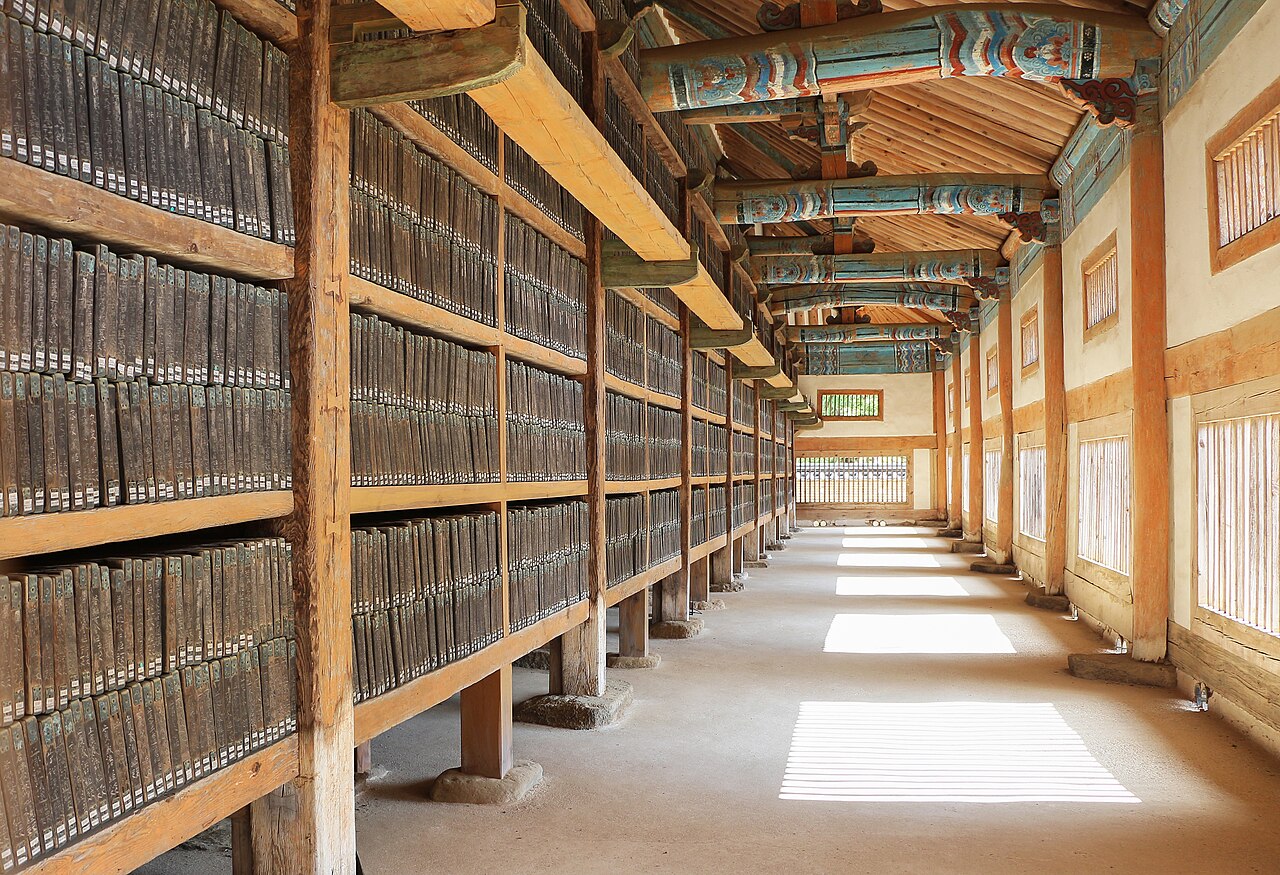
The Janggyeong Panjeon at Haeinsa Temple, inscribed by UNESCO in 1995, preserves the repository buildings constructed in the 15th century on Mount Gaya (Gayasan) in South Gyeongsang Province to house the Tripitaka Koreana — 81,258 woodblocks carved between 1237 and 1248 CE containing the most complete and accurate surviving collection of Buddhist scriptures in the world, representing 52,330,152 Chinese characters and weighing approximately 280 tonnes. The inscription’s Outstanding Universal Value rests not on the woodblocks themselves but on the four repository buildings (Sudarajang Hall, Beopbojeon Hall, Dongjae Hall, and Seojae Hall) whose 13th–15th century designers achieved a climate-control system of such sophistication that the woodblocks have survived 750 years without significant deterioration: a combination of latticed window geometry that modulates airflow differently at floor and ceiling level, salt-and-charcoal-and-soil floor composition that regulates humidity by absorbing and releasing moisture, and building orientation and roof depth calibrated to prevent direct sunlight from reaching the block surfaces.
Mount Gaya to the Silla Buddhist heartland Gyeongju Historic Areas · Bulguksa Temple · Gayasan National Park — 80 to 130 km
Eighty Kilometres east of Haeinsa across the Sobaek Mountains by road (approximately 1.5 hours from the Haeinsa IC on Expressway 12 to the Gyeongju IC), the Gyeongju Historic Areas (경주역사유적지구, inscribed 2000) represent the capital of the Unified Silla Kingdom (668–935 CE) that was the political and spiritual context for the Tripitaka Koreana’s creation: the Korean Buddhist scholastic tradition whose systematic collection and carving of the Tripitaka in 1237–1248 CE was the Goryeo dynasty’s continuation of the Unified Silla period’s extraordinary output of Buddhist art, architecture, and scholarship. The Gyeongju inscription covers five zones including the Tumuli Park (대릉원, Daereungwon), 23 royal burial mounds up to 22 metres in height concentrated in the historic city centre, and the Royal Palace site of Wolseong. Haeinsa’s own foundation legend traces the temple to 802 CE under the Silla kings Aejang and Sunsun; the Tripitaka Koreana woodblocks were transferred to Haeinsa in 1398 CE from the Ganghwa Island repository where they had been carved during the Mongol invasions, and the Janggyeong Panjeon buildings on Haeinsa’s highest terrace were constructed specifically to receive and preserve them. From the Haeinsa mountain approach, the 1.5-hour expressway drive to Gyeongju can be combined with a visit to the Seokguram Grotto and Bulguksa Temple (also UNESCO-inscribed 1995), located on Mount Toham approximately 10 km east of Gyeongju city centre. Bulguksa’s twin granite staircases — the Blue Cloud Bridge (Cheongun Bridge) and the White Cloud Bridge (Baegun Bridge) — represent the same 8th-century Silla Buddhist architectural tradition as Haeinsa’s founding period.
One Hundred and Thirty Kilometres southeast of Haeinsa along the Nakdong River valley (approximately 2 hours from the Haeinsa IC to Busan city centre), Busan is the regional gateway for international visitors arriving on the Busan-Gimhae International Airport and the terminus of the KTX high-speed railway from Seoul (approximately 2.5 hours). Haeinsa Temple is most efficiently accessed from Daegu City (대구광역시, approximately 60 km north of the temple via Expressway 12, or 1 hour by bus from Dongdaegu Bus Terminal to the Haeinsa terminal near Gayasan National Park), which is connected to Seoul by KTX (approximately 1.5 hours from Seoul Station to Dongdaegu). The Gayasan National Park (가야산국립공원) surrounding Haeinsa encompasses 76.3 km² of mountain terrain, including the peak Chilbulbong (七佛峰, 1,433 m) and multiple hiking trails leading from the Haeinsa temple precincts into the mountain forest. The UNESCO inscription’s designated area covers specifically the Janggyeong Panjeon repository buildings and the immediately surrounding temple terrace, not the full Haeinsa temple complex; but access to the Janggyeong Panjeon requires passage through the full temple complex (approximately 45 minutes walking from the lower car park), making the entire Haeinsa site effectively part of the visitor experience.
Practical information
Haeinsa Temple is located in Hapcheon County, South Gyeongsang Province, approximately 80 km west of Daegu. Direct buses from Daegu Seobu Bus Terminal to Haeinsa (approximately 1.5 hours) run several times daily. The Janggyeong Panjeon repository buildings are on the highest terrace of the Haeinsa complex and are viewable from the courtyard below; the interiors containing the woodblocks are not open to the public (access is restricted to designated temple personnel for conservation reasons), but the buildings’ exterior ventilation lattices, roof geometry, and the wooden block rows visible through the screens can be examined closely. The main Daejeokgwangjeon Hall (대적광전) containing a gilt Buddha triad is open for visitors. Opening hours: approximately 08:00–17:30 (seasonal variation). The Haeinsa Heritage Museum, in a separate building near the main gate, presents the Tripitaka Koreana production process with replica woodblocks and explanatory materials in Korean and English. Temple stay programmes (templestay) are available at Haeinsa with overnight meditation and ritual experience. Best visiting season: late April to early June (azalea bloom on the approach path) and October (autumn foliage on Mount Gaya). The temple precincts are enclosed within a mountain forest that requires approximately 20–25 minutes’ walk from the lower car park, or visitors may take a shuttle van to the upper car park (approximately 5 minutes below the main gate).
Frequently Asked Questions
How does the Janggyeong Panjeon climate-control system work and why has it preserved the woodblocks for 750 years?
The Janggyeong Panjeon’s passive climate-control system is the most studied pre-modern conservation engineering achievement in Korea and one of the most sophisticated traditional building climate systems documented anywhere in the world. The four repository buildings are arranged in a north-south pair on the highest terrace of Haeinsa, oriented with their long axes roughly east-west and their primary ventilation windows facing north and south. The window lattices on the north and south elevations are sized differently on each building’s upper and lower sections: the lower windows are larger to admit air flow at floor level, while the upper windows are smaller, creating a differential pressure gradient that draws cool air in at the base and allows warm, humid air to exit at the eave level. The result is a continuous passive air exchange that prevents the accumulation of moisture at the woodblock surfaces without requiring mechanical systems. The floor composition (a layer of charcoal, a layer of salt, a layer of compacted soil, and a surface of sand) was designed by the original builders with explicit awareness of its moisture-regulating function: charcoal absorbs humidity when the ambient moisture level rises and releases it when the level drops, salt similarly draws and releases moisture, and the soil layers buffer the response to prevent rapid humidity swings. Modern environmental monitoring (installed by the Korean Cultural Heritage Administration in the 1990s and 2000s as part of a systematic conservation study) has confirmed that the interior humidity of the Janggyeong Panjeon rarely exceeds 60% relative humidity or drops below 30% — the optimal range for the preservation of the lacquered woodblocks — without any active mechanical climate control. A parallel climate-control experiment conducted in the 1980s, when a modern air-conditioned concrete repository was constructed for a portion of the woodblocks, produced faster deterioration than the traditional repository: the temperature and humidity control was less stable because the building did not respond to external conditions in the same buffered way as the earth-floor traditional building, and the wooden woodblocks shrank and cracked under the artificially stable conditions.
What is the Tripitaka Koreana and why was it carved twice?
The Tripitaka Koreana (팔만대장경, Palgwandaejangyeong, “Eighty-Thousand Tripitaka”) is the most complete surviving collection of the Buddhist canon in the world, comprising the Tripitaka (the Three Baskets of Buddhist scriptures — the Vinaya, the Sutras, and the Abhidharma), supplementary texts, and the scholastic commentaries (Chinese shu 疏) that constitute the Korean Buddhist hermeneutical tradition. The designation “Koreana” distinguishes it from the Chinese Tripitaka editions (the Kaibao edition of 983 CE, which was the source for the First Goryeo Tripitaka, and the Khitan Liao edition of the 10th–11th centuries); the Korean edition is valued by East Asian Buddhist scholars as the most textually accurate and complete because its editors compared multiple Chinese, Chinese, and Chinese manuscript traditions and recorded their textual criticism in the margins of the woodblocks. The canon was carved twice: the First Goryeo Tripitaka was carved between 1011 and 1087 CE at Cheongju and later transferred to Ganghwa Island, where it was destroyed by the Mongol invasions of 1232 CE; the Second Goryeo Tripitaka (the surviving Tripitaka Koreana) was carved between 1237 and 1248 CE on Ganghwa Island by order of Goryeo King Gojong as both a devotional act (seeking Buddhist merit to repel the Mongols) and a diplomatic statement (the Goryeo court in Mongol-occupied territory asserting its cultural legitimacy through the production of the most ambitious Buddhist textual project in Korean history). The woodblocks were carved from birch, dried for 3 years before engraving to prevent warping, engraved with approximately 23 Chinese characters per line by teams of professional scribes, lacquered after engraving to prevent moisture absorption, and finally fitted with wooden end-caps. Each of the 81,258 blocks measures approximately 24 cm × 70 cm × 2.8 cm and represents one side of a double-sided printing unit; the total text runs to approximately 52 million Chinese characters in 1,516 titles and 6,804 volumes.
What makes the Haeinsa mountain location significant for the preservation of the Tripitaka Koreana?
The transfer of the Tripitaka Koreana from the Ganghwa Island coastal repository to Haeinsa on Mount Gaya in 1398 CE was a deliberate protective measure by the early Joseon court (the Joseon dynasty had replaced the Goryeo dynasty in 1392 CE and inherited the woodblocks along with the state). The Ganghwa Island coastal location had been strategically chosen for the Mongol-era carving as a naval defensive position (Ganghwa Island in the Han River estuary was the Goryeo court’s refuge during the Mongol invasions of 1231–1259 CE), but the coastal environment’s higher humidity, salt air, and exposure to piracy and fire made it unsuitable for long-term conservation. Mount Gaya’s inland mountain forest provides multiple conservation advantages: the mountain forest humidity is lower than coastal humidity (Korean mountain forests average 55–65% relative humidity compared to 70–80% for coastal environments), the mountain microclimate shows smaller daily temperature swings than coastal sites (because the forest canopy and soil mass buffer solar radiation), and the mountain location provides natural fire protection (the surrounding forest creates a firebreak and the elevated position reduces the risk of flood or attack). Haeinsa has survived numerous fires — the temple buildings have burned and been rebuilt multiple times, most recently after a major fire in 1817 CE that destroyed most of the lower temple complex — but the Janggyeong Panjeon and the Tripitaka Koreana have survived each fire because their position on the uppermost terrace, separated from the main temple buildings by stone walls and a fire-resistant zone, prevented the fires from reaching the repositories. The most critical survival event was the Korean War: in September 1951 CE, a South Korean Air Force pilot named Kim Young-hwan refused orders to firebomb Haeinsa (which was occupied by North Korean troops at the time) specifically to avoid destroying the Tripitaka Koreana, receiving a military reprimand for disobeying orders but saving the woodblocks. The action has been commemorated in Korean military history as one of the most significant acts of cultural heritage protection in the war.
Sources
- S1 — UNESCO World Heritage Centre — Haeinsa Temple Janggyeong Panjeon, the Depositories for the Tripitaka Koreana Woodblocks (Ref. 737) — https://web.archive.org/web/20230601000000/https://whc.unesco.org/en/list/737/
- S2 — UNESCO World Heritage Centre — Statement of Outstanding Universal Value (Ref. 737) — https://whc.unesco.org/en/list/737/
Spotted an error? Write to editorial@culturalheritageonline.com and we correct it the same day.