
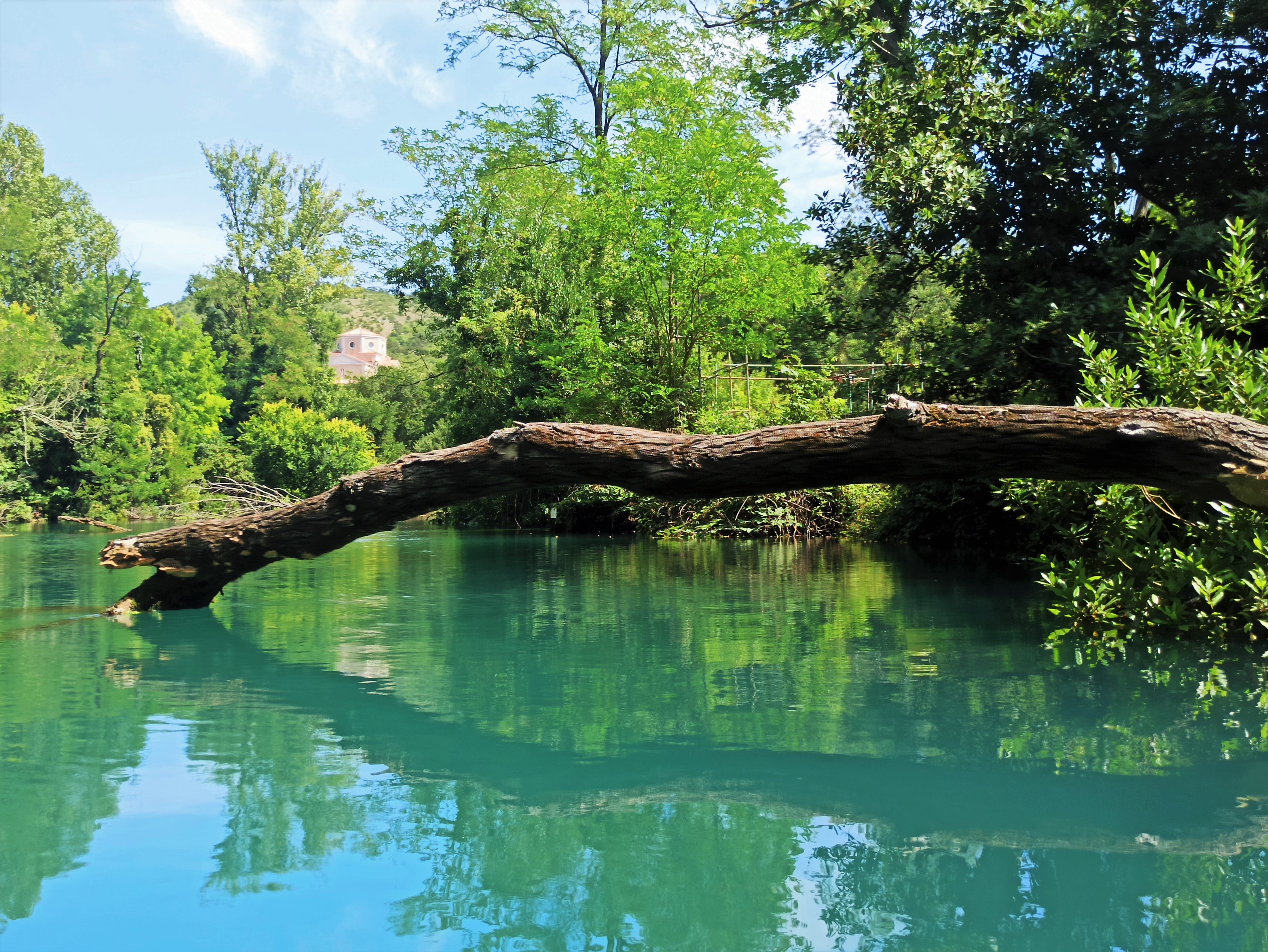
The Timavo River emerges from underground near San Giovanni di Duino in Friuli Venezia Giulia, Italy, representing one of the country’s most unusual hydrological phenomena. Celebrated by Virgil in the first book of the Aeneid for its “nine mouths” where it erupts from the mountain with great noise, the Timavo flows only 2 kilometres on the surface before emptying into the Gulf of Trieste, making it the shortest river in Italy that reaches the sea.
The river originates in Croatia at the foothills of Mount Nevoso, where it is called Reka (meaning “River”). After travelling 37 kilometres, it disappears into a large sinkhole near Vreme in Slovenia, beneath the ruins of Školj Castle. From there begins its mysterious underground journey: descending through the narrow St. Canziano Gorge (Škocjanske Jame), the river flows approximately 40 kilometres underground, passing through the Trebiciano Abyss at 329 metres depth, before resurfacing near San Giovanni di Duino.
A Sacred Spring in Classical Antiquity
When the Timavo reappears, it does so with considerable force through three springs near the Basilica of San Giovanni in Tuba, surrounded by ancient cypress, poplar, and plane trees. The area has been a site of religious significance since antiquity. Local populations venerated Hercules, Saturn, Spes Augusta (Hope), Liber Augustus, and the god Temavus at these springs, which emerged mysteriously from the earth.
Modern Visitation and Historic Landmarks
The spring area now attracts school groups and visitors, particularly in late September when autumn foliage colours the surrounding vegetation. Wildlife includes frogs, ducks, swans, mullet, and sea bream. The nearby Church of San Giovanni in Tuba, one of the oldest in Friuli Venezia Giulia, contains a fifth-century paleo-Christian mosaic floor in its apse.
On a rocky outcrop near the springs stands a monument featuring two bronze wolves, commemorating the “Wolves of Tuscany” regiment that fought here during the Tenth Isonzo Battle in the First World War. The site is easily accessible from State Road 14 near Duino Aurisina, with free parking available a few hundred metres from the spring area.
On video
Frequently asked questions
Why is the Timavo called a “hidden river”?
The Timavo flows underground for approximately 40 kilometres through the Škocjanske Jame caves and Trebiciano Abyss, remaining largely invisible beneath the surface until it resurges near San Giovanni di Duino. Its underground course is not fully mapped and represents one of the most remarkable karst phenomena in Europe.
What did Virgil say about the Timavo?
In the first book of the Aeneid, Virgil described the Timavo emerging with “nine mouths” like a turbulent sea, erupting from the mountain with great noise and flooding the fields with resounding water, distinguishing it from other historians who cited only seven mouths.
When is the best time to visit?
Late September is recommended, when autumn foliage transforms the surrounding vegetation of cypress, poplar, and plane trees into colours characteristic of the season.
Sources
- S1 — Magris, Claudio. Danube: A Sentimental Journey from the Source to the Black Sea. Harvill Press, 1989. ISBN 978-1-86046-823-0.
- S2 — Morris, Jan. Trieste and the Meaning of Nowhere. Faber & Faber, 2001. ISBN 978-0-571-20782-4.
Spotted an error? Write to editorial@culturalheritageonline.com and we correct it the same day.


