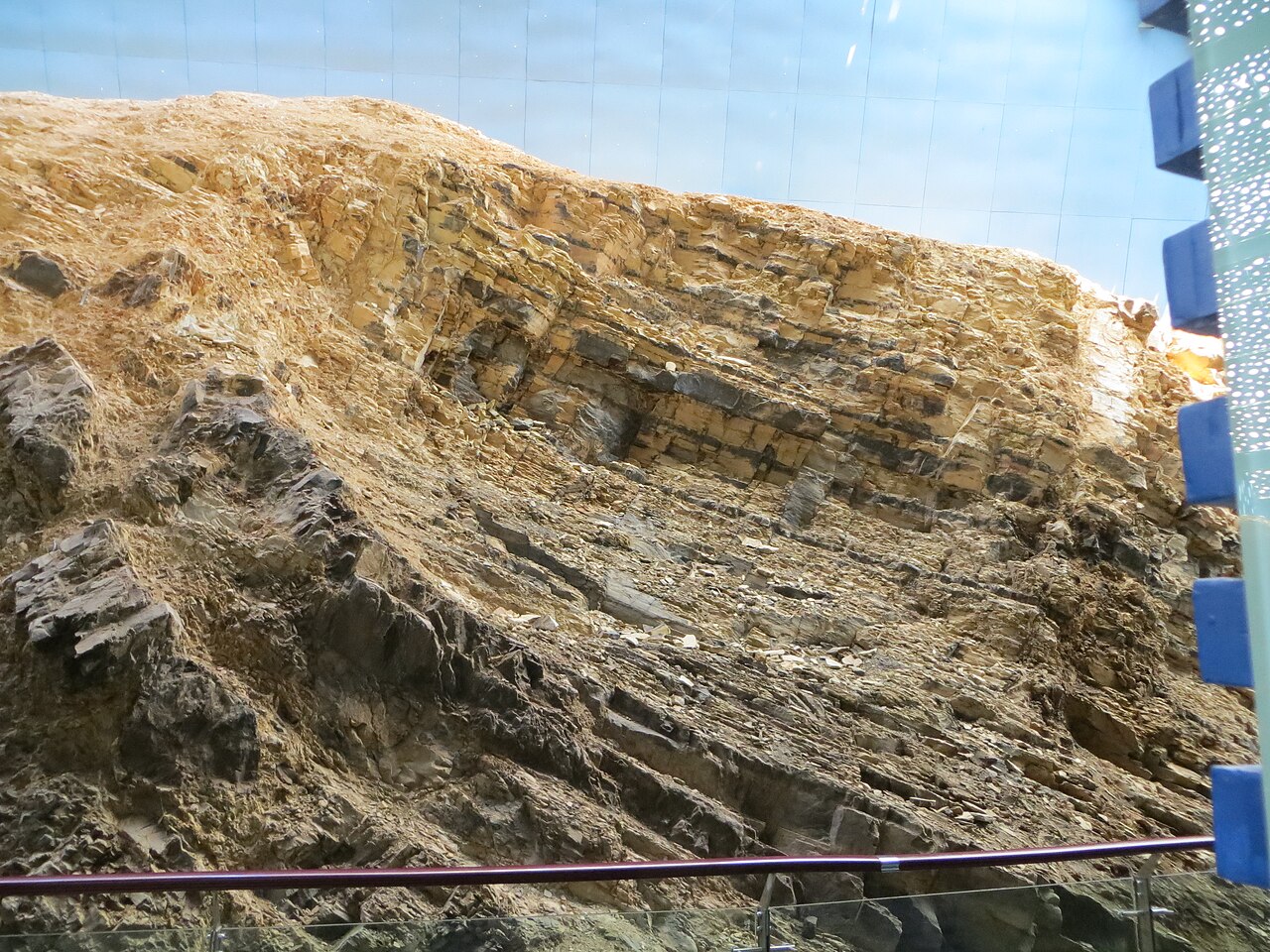
The Chengjiang Fossil Site, inscribed by UNESCO in 2012, is a 512-hectare area of Cambrian-period mudstone on Maotian Hill in Chengjiang County, Yunnan Province, approximately 50 kilometres southeast of Kunming — the most complete and exceptionally preserved fossil record of the Cambrian Explosion (approximately 520 million years ago), the evolutionary event in which nearly all major animal body plans (phyla) appeared in the fossil record within a geologically brief period of approximately 20 million years. The Chengjiang Biota (the assemblage of approximately 250 species recovered from the Maotian Hill mudstone since the first discovery by the palaeontologist Hou Xianguang in 1984) preserves soft-body anatomical details of Cambrian marine animals that do not survive in standard carbonate rock preservation: complete digestive tracts, neural tissue, sensory organs, gill structures, and muscle bundles have been recovered from the Cambrian mudstone in three-dimensional cellular detail, making the Chengjiang Biota the most informationally rich record of animal life at the dawn of complex multicellular organisation. The site’s Outstanding Universal Value rests on this preservation quality: the Chengjiang fossils document 16 of the approximately 35 currently recognised animal phyla in their earliest-known forms, including chordates (the phylum to which vertebrates — and therefore humans — belong), represented at Chengjiang by Haikouella (a jawless fish-like chordate, approximately 520 million years old) and Yunnanozoon, and the enigmatic Hallucigenia, Anomalocaris, and Opabinia species that represent extinct body plans without living descendants.
Yunnan’s natural and cultural heritage: from Cambrian seas to Naxi cosmology Three Parallel Rivers Yunnan · South China Karst Shilin · Fuxian Lake — 60 to 250 km
Sixty Kilometres northeast of the Chengjiang Fossil Site by road (approximately 1 hour from Chengjiang to Kunming City via the G85 Expressway), Kunming City is the regional transport hub and the base for most visitors to the site. The Chengjiang Fossil Site is accessible from Kunming by coach or taxi (approximately 1 hour); the Chengjiang Fossil Museum (澄江化石地博物馆, Chengjiang Huashi Di Bowuguan, opened 2019, designed as a swooping “ray” structure partially embedded in the hillside above the fossil site) is the primary visitor facility and holds the world’s largest collection of Chengjiang Biota specimens in purpose-built climate-controlled display conditions — a significant upgrade from the Yunnan University Palaeontology Research Centre (Kunming) where the original finds were held before the dedicated museum was constructed. The site itself (the actual Maotian Hill fossil-bearing mudstone outcrop) requires a separate guided tour available from the museum entrance. From Kunming, the South China Karst’s Shilin Stone Forest component (inscribed 2007, 90 km southeast of Kunming) is accessible on the same road corridor as the Chengjiang Fossil Site — Chengjiang is approximately 55 km southeast of Kunming, while Shilin is 90 km southeast — making a combined Chengjiang/Shilin day trip feasible from Kunming (approximately 4 hours total, with early morning departure). Both sites are in the same geological context: the Chengjiang mudstone basin (the Maotian Hill Cambrian Sea, approximately 520 million years ago) and the Shilin Stone Forest (Permian limestone karst, approximately 270 million years ago) are separated by 250 million years of geological time but occupy adjacent terrain in the same Yunnan plateau zone.
Two Hundred and Fifty Kilometres northwest of the Chengjiang Fossil Site by road and HSR (approximately 2.5 hours from Kunming South to Lijiang South on the Dali-Kunming HSR), the Three Parallel Rivers of Yunnan Protected Areas (inscribed 2003) represent the biodiversity and tectonic heritage of the same Yunnan-Guizhou plateau that preserves the Chengjiang Cambrian fauna. The geological connection between the Chengjiang marine fauna and the Three Parallel Rivers’ contemporary biodiversity is the Yunnan plateau’s role as a repeated biological refugium: just as the Chengjiang shallow-sea environment preserved the Cambrian Explosion’s fauna in exceptional detail by a rapid burial event (a submarine mudslide that entombed the living community in anaerobic mud, blocking scavenging decomposition), the Three Parallel Rivers’ Hengduan Mountain zone preserved Pleistocene ice-age refugia that maintained temperate and subtropical species communities during the glacial maxima. The theme connecting both inscriptions is Yunnan’s function as a geologically and biologically extraordinary zone of preservation — from Cambrian soft-body fossils to Pleistocene refugia biodiversity. From Kunming, the Three Parallel Rivers’ Lijiang component (the nearest access point via HSR) is reached in approximately 2.5 hours, with connection from Lijiang to Tiger Leaping Gorge by coach (approximately 2 hours).
One Hundred Kilometres west of the Chengjiang Fossil Site by road (approximately 1.5 hours from Chengjiang to Yuxi and then to Fuxian Lake via the Yunnan provincial road network), Fuxian Lake (抚仙湖, Fuxian Hu, the deepest freshwater lake in Yunnan Province and the second deepest in China at 155.7 metres maximum depth) is ecologically significant for the same geological reason that the Chengjiang Fossil Site is palaeontologically significant: the Yunnan plateau’s lake basins (Dian Chi, Er Hai, Fuxian Hu) preserve ancient biodiversity records in their water columns and sediments that document the region’s evolutionary history in ways analogous to what the Chengjiang mudstone preserves for the Cambrian period. Fuxian Lake’s unique endemic fish fauna (the Sinocyclocheilus cave fish, the Yunnan blind cave fish) documents the evolutionary specialisation that occurs in isolated lake basins over millions of years — the same isolation principle that produced the Chengjiang Biota’s remarkable species diversity in an isolated Cambrian coastal sea embayment. Fuxian Lake is not UNESCO-inscribed but is on China’s Tentative List for possible future nomination; it is accessible from Kunming by road (approximately 1.5 hours via the G85 south) or from Chengjiang (approximately 30 minutes west of the fossil site) as a same-day extension.
The Cambrian context: Yunnan, Guizhou, and the fossil heritage of South China South China Karst Libo Guizhou · Ancient Tea Horse Road Sichuan-Yunnan — 300 to 500 km
Three Hundred Kilometres northeast of the Chengjiang Fossil Site by road and coach (approximately 4–5 hours from Kunming to Guiyang via the G60 Expressway or the Guiyang-Kunming HSR, approximately 2 hours), Guiyang City in Guizhou Province is the gateway to the South China Karst’s Libo component (inscribed 2007) and the Huangguoshu Waterfall Scenic Area (National Geopark). The geological context connecting the Chengjiang Fossil Site and the Guizhou karst landscape is the Cambrian-Ordovician marine sedimentary belt that underlies the Yunnan-Guizhou plateau: the same shallow-sea environment that produced the Chengjiang Biota’s fauna (the Cambrian Yuanshan Formation mudstones) is also the source rock for the younger Ordovician and Silurian limestone formations that were subsequently karstified to produce the South China Karst’s current landforms. The Cambrian seas of the Chengjiang period were thus the precursor environment to the marine limestone deposition that, after 500 million years of burial, uplift, and dissolution, produced the tower karst of Guilin and the stone forest of Shilin. From Kunming, Guiyang is reached by the Guiyang-Kunming HSR (approximately 2 hours from Kunming South to Guiyang North).
Practical information
The Chengjiang Fossil Site covers 512 hectares of protected fossil-bearing mudstone on Maotian Hill (Maotianshan, 帽天山) in Chengjiang County, Yuxi Prefecture, Yunnan Province, approximately 55 kilometres southeast of Kunming City. The Chengjiang Fossil Museum (adjacent to the fossil site on the Maotian Hill base, opened 2019, 42,000 square metres of exhibition space) is the primary visitor entry point; guided tours to the actual fossil site (a 1-kilometre walk from the museum entrance up the Maotian Hill slope to the working fossil exposure zone) are included in the museum admission. The museum itself has English-language signage and holds approximately 20,000 fossil specimens, of which approximately 2,000 are on permanent display. Kunming is the practical base for visiting Chengjiang; access from Kunming is by express coach from Kunming East Bus Station (approximately 1.5 hours to Chengjiang County town) or by taxi/private car (approximately 1 hour on the G85 Expressway). The Chengjiang area has limited hotel options; most visitors day-trip from Kunming. Kunming Changshui International Airport (KMG) is one of the busiest airports in Southwest China, with connections to major Chinese cities and international routes (Bangkok, Singapore, Kuala Lumpur, Yangon, Vientiane). Best visiting season: March–May and September–November (pleasant plateau temperatures, 15–22°C); the Yunnan plateau’s frequent afternoon thunderstorms in the rainy season (June–September) can make outdoor fossil site visits uncomfortable. The Chengjiang County town has a small Old Town quarter with Qing-period commercial streets worth 1–2 hours of exploration.
Frequently Asked Questions
What is the Cambrian Explosion and why is the Chengjiang Biota considered the most important fossil record of this event?
The Cambrian Explosion (approximately 538–518 million years ago) is the period in Earth’s evolutionary history during which the major animal body plans — the phyla, the highest-level taxonomic groupings of the animal kingdom (Arthropoda, Chordata, Mollusca, Echinodermata, Annelida, and approximately 30 others) — appeared in the fossil record within a geologically brief interval of approximately 20 million years. Before the Cambrian Explosion, the fossil record shows only microbial life and a limited diversity of soft-bodied organisms (the Ediacaran biota, 635–538 million years ago); after it, the basic body plan diversity of the entire animal kingdom is established. Why the Cambrian Explosion occurred remains one of the fundamental unsolved questions of evolutionary biology — proposed explanations include changes in atmospheric oxygen levels (enabling larger body sizes and more active metabolisms), changes in ocean chemistry (enabling calcium carbonate shell mineralisation), the evolution of predation (driving an evolutionary arms race in which both predator and prey evolved increasingly specialised anatomies), and the evolution of binocular vision (Trilobites have compound eyes in the earliest Cambrian fauna, which would have driven rapid coevolution of prey species’ defensive adaptations). The Chengjiang Biota is considered the most important fossil record of the Cambrian Explosion because of the combination of its age (approximately 520 million years ago, at the peak of the explosion event rather than its later stages), its taxonomic diversity (approximately 250 species representing 16 of the approximately 35 animal phyla), and its exceptional soft-body preservation (the Cambrian mudstone burial event preserved muscular, neural, and digestive tissue in three-dimensional relief rather than simply the mineralised hard parts that survive in typical marine sediments). The combination of age, diversity, and preservation quality makes the Chengjiang Biota scientifically superior to the other major Cambrian soft-body fossil sites — the Burgess Shale in British Columbia, Canada (inscribed 1981 as a UNESCO component), which is approximately 508 million years old (younger than Chengjiang), and the Sirius Passet in Greenland, which is similarly aged to Chengjiang but much less species-diverse.
Who discovered the Chengjiang Biota and what was the process of its scientific recognition?
The Chengjiang Biota was discovered on July 1, 1984, by the Chinese palaeontologist Hou Xianguang (侯先光, then a graduate student of Yunnan University under the supervision of Professor Zhang Wentang) during a systematic survey of Cambrian sedimentary outcrops in the Chengjiang area. Hou recovered the first specimens — including the enigmatic arthropod Naraoia and the soft-bodied worm Alalcomenaeus — from the Maotian Hill outcrop on the first day of the survey, and immediately recognised that the extraordinary preservation quality of the specimens (complete soft anatomy visible in three-dimensional relief on the mudstone surface) was exceptional. The Chengjiang Biota’s scientific significance was recognised rapidly within the palaeontological community: Hou Xianguang’s 1987 paper in Science describing the initial finds prompted international research teams from Cambridge University, Uppsala University, and the University of New South Wales to begin collaborative excavation and systematic taxonomic description of the fossil fauna in the 1990s. The systematic description of the Chengjiang fauna is still ongoing — approximately 250 species have been formally described by 2024, but new species continue to be discovered in the Maotian Hill mudstone at a rate of approximately 5–10 per year. The 2012 UNESCO inscription, supported by the scientific community’s strong endorsement of the site’s Outstanding Universal Value, was the culmination of 28 years of systematic excavation and research that established the Chengjiang Biota as the most informationally complete record of the Cambrian Explosion known to science. The 2021 Nobel-adjacent recognition of the significance of this type of research — when the palaeontologist Andrew Knoll’s work on Precambrian life was awarded the Crafoord Prize in Biosciences, citing Chengjiang alongside the Burgess Shale as foundational evidence — confirmed the site’s central place in the history of evolutionary biology.
What is the most unexpected or scientifically surprising organism recovered from the Chengjiang fossil site?
Among the approximately 250 species recovered from the Chengjiang mudstone, the organisms that have most significantly revised scientific understanding of animal evolution are the early chordates — the species that represent the earliest known members of the phylum Chordata, to which all vertebrates (including humans) belong. Haikouella lanceolata (described 1999 from approximately 300 specimens recovered from the Maotian Hill mudstone) and Yunnanozoon lividum (described 1995) are both approximately 520 million years old and display anatomical features that place them at or near the base of the chordate family tree: a notochord (the precursor of the vertebral column), segmented muscle blocks (myomeres), a pharyngeal gill apparatus, and possible evidence of a simple brain and cranial nerves. The existence of recognisable chordate organisation in an animal 520 million years old — only approximately 18 million years after the beginning of the Cambrian Explosion — demonstrates that the evolutionary distance from the Cambrian Explosion’s first complex animals to the vertebrate body plan was achieved much more rapidly than previously believed. Before the Chengjiang discoveries, the earliest confirmed chordates were from the Ordovician period (approximately 480 million years ago); the Chengjiang early chordates extended the chordate fossil record back by approximately 40 million years. The discovery also created scientific controversy: some palaeontologists argue that the Chengjiang species identified as chordates may instead represent primitive hemichordates (the phylum ancestral to both echinoderms and chordates) whose chordate-like features are convergent rather than homologous. The debate has been productive — it has driven a reexamination of the phylogenetic criteria for identifying chordates in soft-body fossil material, producing a body of comparative morphological methodology that benefits the interpretation of all Cambrian soft-body fossil sites. The controversy itself demonstrates the scientific value of the Chengjiang Biota: the quality of preservation is sufficient to sustain detailed anatomical arguments that would not be possible from the fragmentary remains typical of other Cambrian sites.
Sources
- S1 — UNESCO World Heritage Centre — Chengjiang Fossil Site (Ref. 1388) — https://web.archive.org/web/20230601000000/https://whc.unesco.org/en/list/1388/
- S2 — UNESCO World Heritage Centre — Statement of Outstanding Universal Value (Ref. 1388) — https://whc.unesco.org/en/list/1388/
Spotted an error? Write to editorial@culturalheritageonline.com and we correct it the same day.