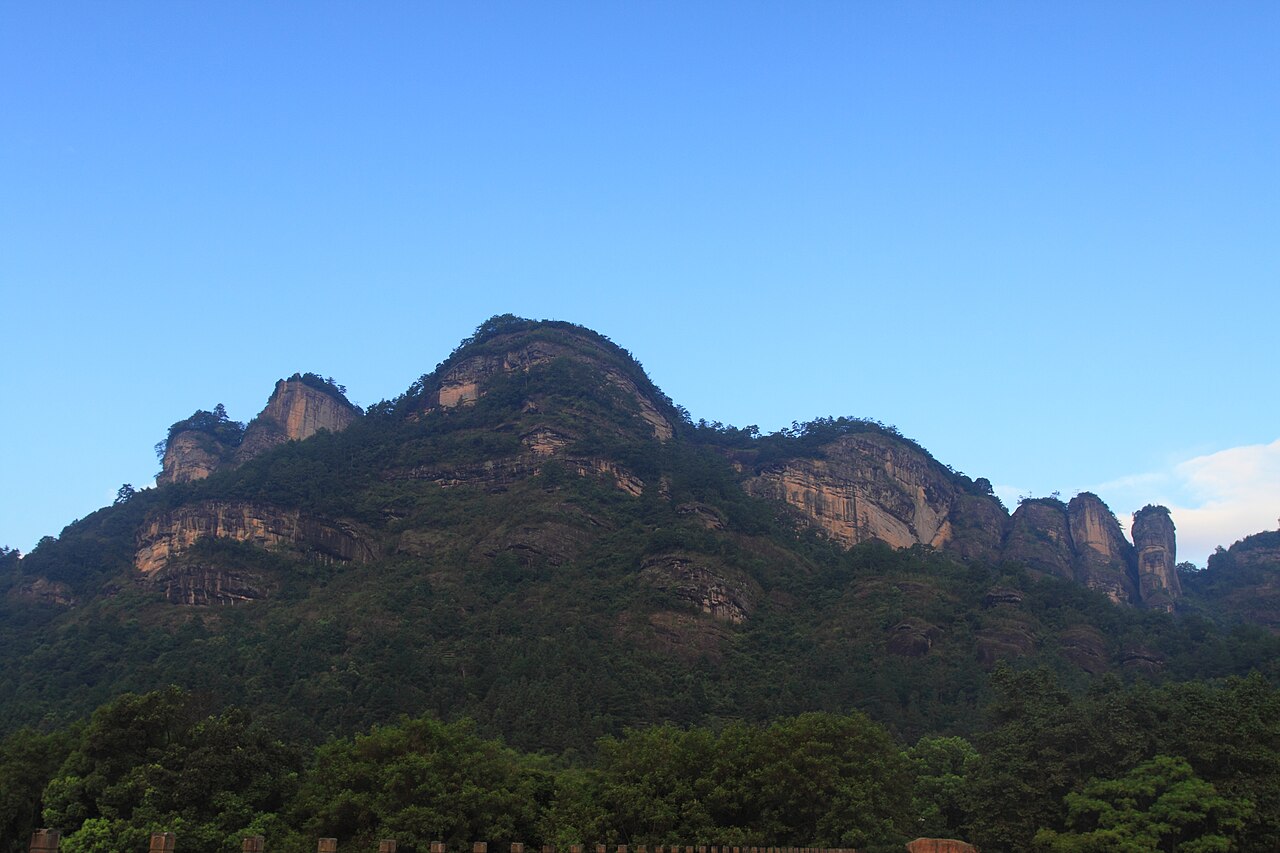
Mount Wuyi (Wuyi Shan), inscribed by UNESCO in 1999 as a mixed cultural and natural site, is the most significant landscape in southeastern China for the intersection of natural scenery, biological diversity, and Confucian intellectual history: a 99,975-hectare protected area in Wuyishan City, Fujian Province, whose red sandstone Danxia peaks (the highest reaching 2,158 metres at Huanggang Mountain) and the Nine-Bend River (Jiuqu Xi) winding 9.5 kilometres through the mountain gorges beneath the vertical cliff faces have been the subject of Chinese landscape poetry and painting since the Han dynasty (206 BCE–220 CE). The Wuyi inscription’s Outstanding Universal Value rests on three simultaneously present elements: first, the exceptional biological diversity of the South China subtropical mountain zone (2,527 recorded plant species, 475 vertebrate species, and one of Asia’s most intact remaining examples of south subtropical forest); second, the Zhu Xi Academy and the Neo-Confucian philosophical tradition inaugurated at Wuyi in the Song period; and third, the Wuyi Dawang (Great King) Daoist cult centred on Wuyi’s oldest cliff-face inscriptions and the sacred architecture of the Taoyuan Dong (Peach Blossom Grotto) area — all three traditions coexisting in the same landscape.
The southeastern highlands: from Fujian’s mountains to the Yangtze corridor Lushan · Huangshan · Tulou Fujian — 150 to 300 km
One hundred fifty kilometres north of Mount Wuyi by road (approximately 2 hours from Wuyishan City via the G70 Fuyin Expressway toward Nanchang, then north toward Jiujiang), the Lushan National Park (inscribed 1996) in Jiangxi Province documents the cultural mountain tradition at its most complex — 1,600 years of Buddhist, Confucian, and modern political history on a single mountain above Poyang Lake. The Confucian connection between Lushan and Wuyi is direct and biographically documented: the philosopher Zhu Xi (1130–1200 CE) held his two major academic positions at the White Deer Grotto Academy (Bailudong Shuyuan) on Lushan and at the Wuyi Academy (Wuyi Jingshe) on Mount Wuyi — both academies were re-established and intellectually shaped by Zhu Xi within 10 years of each other (White Deer Grotto 1179, Wuyi Jingshe 1183). The Neo-Confucian philosophical works that Zhu Xi wrote at Wuyi — including the commentary on the Four Books that became the mandatory examination curriculum for the Chinese civil service from 1313 to 1905 — were composed in a landscape context that he explicitly described as conducive to philosophical contemplation: the Nine-Bend River provided the setting for the “Nine-Bend Boat Songs” (Jiu Qu Zhuge Ci), nine poems in which each bend of the river corresponds to a philosophical theme of the Neo-Confucian programme. Lushan is accessible from Wuyishan City by road (approximately 3.5 hours via Nanchang) or by flight from Wuyishan Airport to Nanchang and then bus.
Two hundred kilometres northeast of Mount Wuyi by high-speed rail (approximately 1.5 hours from Wuyishan North Station to Huangshan North on the Hefei-Fuzhou HSR), the Huangshan (Yellow Mountain) inscription (inscribed 1990) in Anhui Province is the landscape that the Wuyi painters’ tradition treated as its northern companion: the Wuyi school of literati landscape painting (centered on the Nine-Bend River scenery) and the Huangshan school (centered on the granite pinnacles of southern Anhui) were the two dominant landscape traditions of the 17th-century Jiangnan region, and many painters worked in both — the Anhui painter Hong Ren (Jianjiang, 1610–1664 CE), the greatest Huangshan master, was also deeply influenced by the Wuyi mountain-river tradition that had been canonised by the Song painting school’s treatment of the Nine-Bend River as a subject of philosophical landscape. The two mountains are geologically contrasting: Wuyi’s red Danxia sandstone (sedimentary, water-eroded into round-shouldered peaks and narrow gorges) versus Huangshan’s granite (igneous, weather-fractured into sharp pinnacles and isolated rock columns) — the contrast was explicitly thematised by Chinese painters as the difference between the yin aesthetic of the red-earth southern landscape and the yang aesthetic of the grey-stone northern highlands. From Wuyishan North, Huangshan North Station is reached in approximately 1.5 hours on the Hefei-Fuzhou HSR.
Two hundred eighty kilometres south of Mount Wuyi by high-speed rail (approximately 2 hours from Wuyishan North to Longyan area on the Haixi HSR, then 30 minutes by road to the Tulou area in Yongding County), the Fujian Tulou — Rural Dwellings in Fujian (inscribed 2008) — document the Hakka and Min vernacular communal fortified architecture of the same Fujian Province mountain zone that produced the Wuyi inscription. The Fujian Tulou are rammed-earth communal houses of circular (roundhouse) or rectangular plan, typically 3–5 storeys high and housing 200–600 people from a single clan in a single structure, built by Hakka migrant communities in the mountain zones of western Fujian (Yongding and Nanjing Counties) from the Song through Qing periods. The Hakka migrants who built the tulou were the same community that Zhu Xi’s Neo-Confucian programme was simultaneously reaching through the examination system: the tulou’s clan communal structure (all residents sharing the same surname, the same ancestral hall in the central courtyard, and the same Confucian clan governance code) is the architectural expression of the Neo-Confucian emphasis on clan solidarity and hierarchical social order that Zhu Xi’s Wuyi Academy was propagating through the same Fujian Province at the same time. From Wuyishan City, the tulou are most efficiently reached by road or flight to Longyan/Fuzhou and then local transport.
Three hundred kilometres south-southwest of Mount Wuyi by road and rail (approximately 3 hours from Wuyishan City to Fuzhou or Xiamen, then 1 hour to the Gulangyu Island ferry), the Historic International Settlement of Gulangyu Island (inscribed 2017) in Xiamen, Fujian Province, documents the most complete example of the multicultural colonial settlement that developed in Chinese treaty ports after the First Opium War (1842). Gulangyu Island (1.87 square kilometres) was designated a foreign settlement in 1903 and became the residence of consulates, churches, missionary schools, commercial companies, and private residences of 13 different national communities — British, American, German, Japanese, Dutch, Spanish, French, Austrian, Belgian, Portuguese, Norwegian, Swedish, and Danish — alongside an established wealthy Chinese merchant class. The island’s 931 surviving historic buildings (documented in the UNESCO boundary) represent all the major late 19th–early 20th century architectural styles: British colonial, German Wilhelmine, American Queen Anne, Baroque Revival, Southern Fujian brick courtyard (Minnan traditional), and various hybrid “Indo-Pacific” colonial forms. From Wuyishan City, Gulangyu Island is accessible by high-speed rail to Xiamen North (approximately 2.5 hours) then subway and ferry to the island (approximately 30 minutes).
Northwest toward the Yangtze and inland to Jiangxi and Hunan Classical Gardens Suzhou · Ancient City Pingyao · Longmen Grottoes — 500 to 700 km
Three hundred fifty kilometres northwest of Mount Wuyi by road and high-speed rail (approximately 3 hours from Wuyishan North to Nanchang, then 2 hours to Hangzhou East, total approximately 5 hours from Wuyishan to Suzhou), the Classical Gardens of Suzhou (inscribed 1997, extended 2000) are the other site where Zhu Xi’s Neo-Confucian legacy is most directly visible in built form. The scholars and officials who built Suzhou’s gardens were graduates of the examination system whose curriculum Zhu Xi’s Wuyi Academy had shaped: the Master of Nets Garden (Wangshiyuan), the Lingering Garden, and the Humble Administrator’s Garden were all built by retired officials whose philosophical formation — in Zhu Xi’s Neo-Confucian synthesis, which dominated the examination curriculum from 1313 — was the same intellectual tradition that the Wuyi Mountain landscape had nurtured. The biographical connection is less direct than the Wuyi-Lushan link (Zhu Xi lived at both Lushan and Wuyi but not in Suzhou), but the intellectual genealogy is immediate: the Suzhou garden tradition emerged from the same cultural programme that Zhu Xi’s Wuyi Academy exported through the examination system across China in the 13th–15th centuries. From Wuyishan North, Suzhou is reached by high-speed rail via Nanchang and Hangzhou (approximately 5 hours).
Four hundred kilometres north of Mount Wuyi by high-speed rail (approximately 2.5 hours from Wuyishan North via the Hefei-Fuzhou HSR to Hefei, then 1 hour to Nanjing South), the Imperial Tombs of the Ming and Qing Dynasties (inscribed 2000, extended 2003) at Nanjing — specifically the Xiaoling Mausoleum of the Hongwu Emperor (construction 1381) — document the founding of the dynasty whose examination system institutionalised Zhu Xi’s Wuyi Neo-Confucian philosophy as the mandatory intellectual framework for all Chinese governance from 1368 to 1905. The Ming Hongwu Emperor (Zhu Yuanzhang, r. 1368–1398 CE) formalised the Four Books commentary system (based on Zhu Xi’s interpretations) as the examination curriculum; this decision, made at his Nanjing capital in the early Ming period, is the direct institutional expression of the intellectual tradition that Zhu Xi developed at the Wuyi Academy in the 1180s. Every official in every subsequent dynasty — Ming, Qing, and the Republican period’s transitional examinations — studied the Four Books through Zhu Xi’s commentary that had been written at the Wuyi mountain retreat. From Wuyishan North, Nanjing South is reached by HSR via Hefei (approximately 3.5 hours).
Five hundred fifty kilometres northeast of Mount Wuyi by high-speed rail (approximately 4 hours from Wuyishan North via Hangzhou East and Nanjing South to Shanghai Hongqiao), the larger Shanghai-Nanjing-Hangzhou metropolitan cluster offers multiple additional UNESCO inscriptions within a 100-kilometre radius of Shanghai: the Classical Gardens of Suzhou (30 minutes from Shanghai), the Grand Canal (operational canal sections through Suzhou, Wuxi, Changzhou, Zhenjiang, and Yangzhou), and the West Lake Cultural Landscape of Hangzhou (1.5 hours from Shanghai). The accumulated cultural heritage of the Yangtze Delta — Grand Canal, Suzhou Gardens, West Lake, and the Ming tombs at Nanjing — constitutes a UNESCO cluster that can only be understood in relation to the intellectual tradition Wuyi anchors: all four inscriptions are products of the same Jiangnan (Lower Yangtze) literati culture whose most intellectually sophisticated 12th-century expression was the Neo-Confucian philosophy written in the mountain landscape of Wuyi. From Wuyishan, Shanghai is most efficiently reached by the Hefei-Fuzhou HSR to Fuzhou and then HSR north (approximately 5 hours total), or via flight (approximately 1.5 hours).
Practical information
Mount Wuyi is in Wuyishan City, Nanping Prefecture, northern Fujian Province. The nearest high-speed rail station is Wuyishan North Station on the Hefei-Fuzhou HSR (Hefu HSR), approximately 12 kilometres from the Wuyi Scenic Area east entrance; shuttle buses connect the station to the scenic area entrance (approximately 25 minutes). From Fuzhou (Fujian’s capital), high-speed rail to Wuyishan North takes approximately 1.5 hours; from Xiamen, approximately 2.5 hours; from Hangzhou East, approximately 1.5 hours. Wuyishan City also has a domestic airport (Wuyishan Airport, WUS) with connections to Beijing, Shanghai, Guangzhou, and other major Chinese cities. The Wuyi Scenic Area’s main visitor experience is the Nine-Bend River bamboo raft (Jiuqu Xi Piaoliu): a 9.5-kilometre downstream float on a bamboo raft guided by local raftsmen, passing beneath the red sandstone cliffs and the clifftop hanging coffin sites (chuan guan zang, the Shang-Zhou period coffins placed on ledges 50–200 metres above the river by an unknown pre-Han culture — the most striking and least explicable archaeological feature of the Wuyi landscape). The raft journey takes approximately 2 hours and is the defining visitor experience; advance booking required in peak season (April–May, October). The Tianyou Peak (Cloud Summit Peak) climb (approximately 1.5 hours from base to summit, 408 metres) offers the best aerial view of the Nine-Bend River and the nine principal peaks from above. The Wuyi Palace (Wuyi Gong) at the base of Daxiao (Big King) Peak is the administrative centre of the Daoist Wuyi cult, with the oldest continuously occupied site on the mountain. Best visiting seasons: April–May (warm, flowering season, river levels optimal for rafting) and October–November (autumn colour, clear days after the typhoon season). July–August brings peak visitor numbers and summer heat; Wuyi has a local mountain climate and rain can close raft operations without warning.
Frequently Asked Questions
What are the hanging coffins at Mount Wuyi and who placed them there?
The hanging coffins (Chuan Guan Zang, 船棺葬, “boat coffins”) at Mount Wuyi are wooden coffins carved from single logs into boat-shaped forms, placed on narrow rock ledges and in natural cavities in the cliff faces of the Nine-Bend River gorge at heights of 50–200 metres above the river. Approximately 18 sites with identifiable coffin placements survive along the Nine-Bend River cliff faces, of which 10 are still visible from the rafting route; the coffins were placed by a pre-Han culture (2,500–4,000 years ago based on radiocarbon dating of wood samples) whose identity remains uncertain. Archaeological analysis of the surviving coffins (which contain bronze tools, bamboo baskets, textiles, and human skeletal material) suggests a Bronze Age culture that occupied the Wuyi region before the Han dynasty’s incorporation of Fujian into the Chinese administrative system. The most current scholarly hypothesis attributes the coffins to the Min Yue (Minyue) people — a non-Han ethnic group who occupied Fujian and the coastal areas of Zhejiang during the Shang-Han period (approximately 1600 BCE–0 CE) and who maintained a distinct material culture including bronze-casting, silk weaving, and cliff-face burial until the Han Emperor Wu (r. 141–87 BCE) destroyed the Min Yue kingdom in 110 BCE and forcibly relocated the population to the Yangtze Valley. The mechanism for placing 100–300 kg wooden coffins on narrow cliff ledges at 50–200 metre heights remains physically unexplained: no surviving rope or scaffolding material has been found at the placement sites, and all proposed delivery methods (lower from above by rope, raise from below by bamboo scaffolding, place during lower river levels that have since risen) have logistical difficulties. The mystery of the coffin placements is one of the most discussed unsolved problems in Chinese prehistoric archaeology.
What is Zhu Xi’s significance and why was Mount Wuyi central to his philosophical work?
Zhu Xi (朱熹, 1130–1200 CE) is the most influential Chinese philosopher of the post-Tang period — the synthesiser who unified Confucian moral philosophy, Buddhist meditative discipline, and Daoist cosmological theory into the Neo-Confucian (Lixue, “School of Principle”) system that governed Chinese intellectual life from the 12th to the 19th century. Zhu Xi’s synthesis was adopted as the official state philosophy by the Yuan dynasty in 1313 (when the Four Books with Zhu Xi’s commentaries were mandated as the civil examination curriculum) and maintained in that position by the Ming and Qing dynasties until the last imperial examination in 1905 — making Zhu Xi’s interpretations of Confucian thought the compulsory intellectual formation of every Chinese government official for approximately 600 years. Mount Wuyi was central to Zhu Xi’s philosophical work for two reasons. The practical reason: the mountain’s remote location and existing academic reputation (Song Confucians had been attracted to Wuyi’s scenery since the 10th century) made it an appropriate location for the kind of retreated scholarly community Zhu Xi wanted to establish — away from the pressures of court politics and the intellectual fashions of the examination circuit. The philosophical reason: Zhu Xi’s Neo-Confucian concept of ge wu (格物, “investigation of things”) held that moral knowledge was gained not through abstract reasoning but through direct engagement with the natural world — the structured observation of mountain, river, and seasonal process as a path to understanding the universal principle (li, 理) that undergirds both the natural world and human moral life. Mount Wuyi’s Nine-Bend River — whose nine bends Zhu Xi interpreted as nine philosophical principles in his “Nine-Bend Boat Songs” — was not merely the setting for his scholarship but the primary subject of his philosophical method: the mountain landscape was the text he was reading.
What is the biological significance of the Mount Wuyi nature reserve?
The Mount Wuyi Nature Reserve (within the larger Wuyi Scenic Area and World Heritage Area boundary) is classified by the IUCN as one of the most biologically rich temperate and subtropical forest systems in Asia, with 2,527 documented plant species (approximately 280 species per square kilometre, one of the highest plant density figures for any similarly sized Asian protected area), 475 vertebrate species (71 mammal species, 256 bird species, 73 reptile species, 46 amphibian species, 40 fish species), and an estimated 5,000–10,000 insect species. The reserve’s exceptional biodiversity results from its location at the junction of four biogeographical zones: the Central China Subtropical Zone (east Jiangxi, north Fujian), the South China Tropical Zone (coastal Fujian, Guangdong), the Himalayan-Hengduan Highland Zone (western Sichuan, Yunnan), and the Eastern China Temperate Zone (Anhui, Zhejiang). This junction position means that Wuyi’s forests contain species whose ranges ordinarily do not overlap — Sichuan-type conifers (Cathaya argyrophylla, the Silverleaf Cathaya, a tertiary relict conifer otherwise found only in isolated patches in Hunan and Guangxi) coexist with tropical-affinity species of the Fujian coast within the same 99,975-hectare boundary. The reserve is the type location (location where the species was first described) for more than 1,000 species of plants and animals, including the Chinese alligator (Alligator sinensis, now critically endangered) and the Wuyi horned toad (Xenophrys wuyi, described 2020) — the continued description of new species from the reserve in the 21st century confirms its role as one of China’s most incompletely surveyed biodiversity reservoirs.
Sources
- S1 — UNESCO World Heritage Centre — Mount Wuyi (Ref. 911) — https://web.archive.org/web/20230601000000/https://whc.unesco.org/en/list/911/
- S2 — UNESCO World Heritage Centre — Statement of Outstanding Universal Value (Ref. 911) — https://whc.unesco.org/en/list/911/
Spotted an error? Write to editorial@culturalheritageonline.com and we correct it the same day.