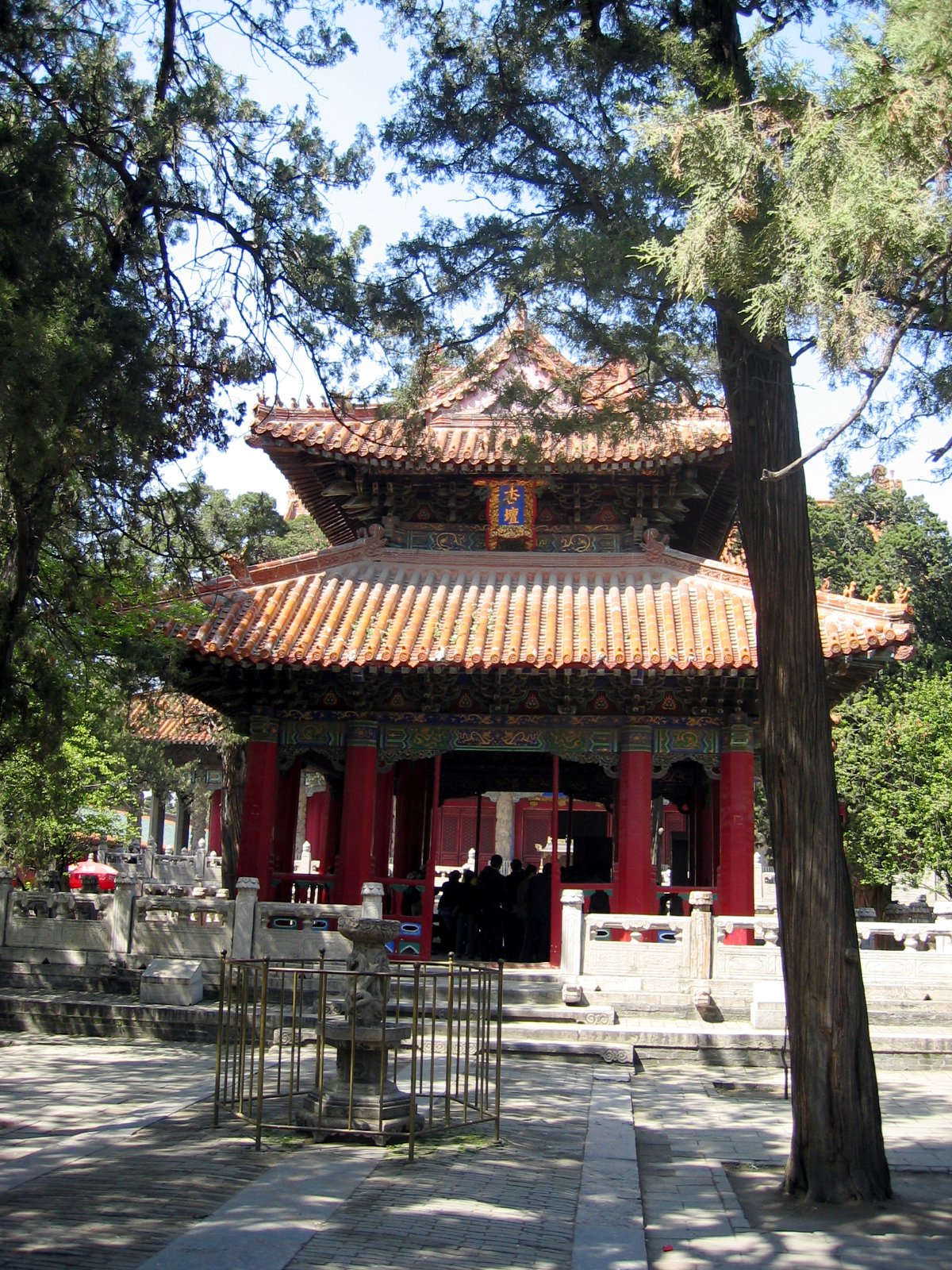
The Temple and Cemetery of Confucius and the Kong Family Mansion in Qufu were inscribed as a UNESCO World Heritage Site in 1994. The temple complex covers 21.8 hectares with 466 rooms across successive gated courtyards; the cemetery immediately north has received the burials of Confucius’s direct descendants across 77 generations and contains over 100,000 graves, making it the largest family burial ground in continuous use anywhere in the world. Confucius was born in Qufu in 551 BCE, died there in 479 BCE, and was first commemorated with a three-room shrine built on the site of his residence the year after his death; Han Emperor Gaozu personally came to pay homage at the tomb in 195 BCE.
Southern Shandong: two UNESCO inscriptions within 100 kilometres 45–80 km, 1–1.5 hours by bus or rail
Mount Taishan (Tai Shan) received its UNESCO inscription in 1987 under both cultural and natural criteria—one of the first mixed inscriptions awarded in China. The mountain lies 80 kilometres north of Qufu, reachable in approximately 90 minutes by bus via Tai’an city or by connecting train to Tai’an station. Taishan rises to 1,545 metres and has served as the site of the Feng and Shan imperial ceremonies since at least the Han dynasty; 72 emperors are recorded as having performed these rites to assert dynastic legitimacy, communicating with Heaven from the summit and with Earth at an adjacent secondary peak. The 6,293 stone steps of the traditional eastern ascent route were carved over successive dynasties; Tang Emperor Xuanzong ordered a 1,008-character inscription cut into the cliff face at Jingshi Valley in 726 CE and had the cliff sealed afterwards so that no subsequent ruler could exceed its length. The summit area contains a cluster of shrines, stele gardens and the Bixia Yuanjun temple complex, and summit hotels allow predawn positioning for the sunrise that has been the site’s defining experience since at least the Tang period. A visit to both Qufu and Taishan makes a coherent two-day excursion from either Jinan or from the Beijing–Shanghai high-speed rail corridor: Qufu for the Confucian civic and funerary tradition, Taishan for the parallel tradition of imperial cosmological ritual in the same Shandong landscape. The two sites are linked thematically as well as geographically: Confucius himself climbed Taishan and is recorded in the Analects as observing that the world looked small from the summit.
The Grand Canal of China was inscribed in 2014 as a serial property covering 27 component sites across eight provinces. The canal’s Shandong section passes through Jining, 45 kilometres west of Qufu, accessible by bus in under an hour. Jining sits at the hydraulic summit of the entire canal system—the highest point the canal had to cross—and the Ming-period engineers who solved this problem constructed four reservoirs in the Shandong hills to maintain navigable water levels across the watershed dividing rivers flowing north to the Yellow River from those draining south to the Huai and Yangtze basins. The technical achievement, completed between 1411 and 1415 under the direction of Song Li, kept the canal operational for grain transport from the south to Beijing for over 500 years. The Jining canal zone retains Ming and Qing lock infrastructure alongside stretches of the active waterway still used for freight; the historic sluice gates at Nanwang, one of the canal’s original 38 regulated points, are accessible on the northern outskirts of the city. For visitors based in Qufu, the Jining canal section adds a working hydraulic-engineering dimension to a Shandong circuit otherwise dominated by Confucian and imperial ritual traditions. The combination is historically apt: the Grand Canal’s commercial traffic through Jining made the southern Shandong region prosperous enough in the Ming period to sustain the elaborate Kong family patronage networks that funded much of the Qufu complex’s Qing-era reconstruction.
Regional extensions: ancient capitals and transcultural connections 350 km west by rail, and an international connection to South Korea
The Ruins of Yin in Anyang were inscribed in 2006 and document the last capital of the Shang dynasty, occupied from approximately 1300 to 1046 BCE, in Henan Province 350 kilometres west of Qufu. Anyang is reachable by high-speed rail in approximately three hours via Jinan and Zhengzhou. The site is the source of oracle bones—turtle plastrons and ox scapulae used for divination by the Shang court—inscribed with a script that is the direct ancestor of the characters used in modern written Chinese. Over 150,000 oracle bone fragments have been recovered since 1899; the texts document royal genealogies, military campaigns, astronomical observations and crop records that allow historians to date Shang reigns with considerable precision. The royal tomb of Lady Fu Hao, discovered intact in 1976 and dated to around 1200 BCE, yielded 468 bronze ritual vessels, 755 jade pieces and 6,900 cowrie shells; oracle bone inscriptions independently document Fu Hao as a military commander who led campaigns of up to 13,000 soldiers, making her the earliest named female military leader whose existence is confirmed by contemporary written sources. The Yin Xu Museum opened on the site in 2005 to consolidate decades of dispersed finds. The connection to Qufu is not merely geographic: the oracle bone script from Anyang is the earliest layer of the written Chinese tradition that Confucius himself sought to transmit, preserve and codify in the 5th century BCE; visiting the Shang capital before the Confucian complex gives the 6th-century BCE philosopher his full textual and ritual prehistory.
The Seowon: Korean Neo-Confucian Academies, inscribed in 2019, are not reachable by a short excursion from Qufu—they are located across nine sites in South Korea, most clustered in the North and South Gyeongsang provinces of the Korean peninsula—but they represent the most direct institutional lineage of the Confucian educational tradition that originated in Qufu. Neo-Confucianism, the philosophical synthesis developed by Zhu Xi (1130–1200 CE) and his predecessors during the Song dynasty, was transmitted to the Korean Joseon court in the 14th century and reshaped in the Korean context into the seowon: private academies that combined Confucian ritual veneration of named scholars with a curriculum based on the Four Books and Five Classics that Confucius himself had edited and compiled. The Byeongsan Seowon near Andong (founded 1613), the Dosan Seowon near Andong (founded 1574 in honour of Yi Hwang, Korea’s foremost Neo-Confucian scholar) and the Sosu Seowon in Yeongju (founded 1543, the oldest surviving example) each maintain the spatial grammar—lecture hall, dormitory, ritual shrine, pond—that derives directly from the Confucian academy model systematised after Qufu. Travellers who have covered Qufu and then visit South Korea will recognise the Kong Family Mansion’s courtyard sequence in the spatial logic of the seowon compounds; the inscription of the Korean academies by UNESCO as a complement to Qufu’s inscription a quarter-century earlier makes explicit the transnational continuity of a tradition whose physical origin is the 0.6-hectare house that Confucius occupied in Qufu in the 5th century BCE.
Practical information
Qufu does not have its own high-speed rail station. The nearest high-speed stop is Qufu East (Qufu Dong) station on the Beijing–Shanghai HSR line, 15 kilometres from the city centre; the connection into Qufu takes 20 minutes by taxi or 30 minutes by bus. From Beijing, the journey to Qufu East takes approximately 90 minutes on G-series trains with direct service; from Shanghai, approximately 2.5 hours. From Tai’an (for combined Taishan–Qufu visits), long-distance buses from Tai’an bus station reach Qufu in 60–80 minutes. The three UNESCO-inscribed components—Kongmiao (temple), Kongfu (mansion) and Konglin (cemetery)—are sold on a combined ticket; the temple and mansion are adjacent in the city centre and require 3–4 hours combined, while the cemetery 1.5 kilometres north requires a further 2–3 hours for a proper circuit of its main allée, the tomb of Confucius himself, and the surrounding arboretum of approximately 20,000 ancient cypresses.
April to May and September to October are the best months: mild temperatures, the cypresses in full foliage, and crowds manageable outside Chinese national holidays. Summer (July–August) is hot and humid; the Confucius Cultural Festival in late September draws large crowds to Qufu and coincides with the anniversary of Confucius’s birth (the 28th of the eighth lunar month). Accommodation is concentrated in Qufu city centre within walking distance of the temple gate; the town is small enough that most visitors cover all three components in a single day and use Qufu as a day trip from Jinan or a stopover on the Beijing–Shanghai route.
Frequently Asked Questions
Why does the Cemetery of Confucius contain over 100,000 graves if Confucius had no surviving sons?
Confucius did have a son, Kong Li (also known as Bo Yu, 532–482 BCE), who predeceased him by one year; and a grandson, Kong Ji (Zisi, 483–402 BCE), who became an important philosopher in his own right. The unbroken patrilineal descent continued from these successors for 77 documented generations to the present day. The size of the cemetery reflects both the duration of the lineage—over 2,500 years—and the social significance of bearing the Kong surname as a direct Confucius descendant, a status that carried legal privileges, tax exemptions and hereditary noble rank throughout the Han, Tang, Song, Ming and Qing dynasties. The descendants who held the title of Yansheng Duke (Yansheng Gong), a hereditary position established by the Song emperor in 1055 CE, were required to reside in Qufu and administer both the temple complex and the cemetery; the continuity of residence concentrated successive generations’ burials in the same location. The cemetery grew to cover approximately 200 hectares, enclosed by a 7.25-kilometre perimeter wall. Graves range from simple mounds for collateral branches of the family to elaborate stone-carved memorial complexes for the Yansheng Dukes themselves. The tomb of Confucius is located approximately 500 metres from the main south gate along the central allée, marked by a simple Song-dynasty stele; the surrounding area contains the graves of his son and grandson within a few dozen metres, giving the central zone of the cemetery a three-generation depth that the later, larger Kong burials radiate outward from.
What is the Kong Family Mansion and why did it have a private prison?
The Kong Family Mansion (Kongfu) is the residential compound immediately east of the Temple of Confucius, covering 16 hectares with 463 rooms across a central axis of formal reception halls flanked by domestic quarters and service areas. It served as the official residence and administrative headquarters of the Yansheng Duke, the hereditary head of the Kong clan, from the Song dynasty (11th century CE) until 1948, when the 77th-generation holder of the title, Kong Decheng, relocated to Taiwan. The mansion’s administrative function explains the presence of the internal prison: the Yansheng Duke held judicial authority over the Kong clan members and the surrounding estate workers. Imperial grants progressively expanded this jurisdiction; by the Qing period, the Duke had the authority to conduct trials and impose punishments on clan members without first referring to the county magistrate, a power normally reserved for state officials. The prison, a small set of cells in the eastern service wing, was used for intra-clan disciplinary matters rather than criminal cases of general jurisdiction. The mansion also functioned as a treasury, archive and ceremonial space: the central formal halls were used for receiving imperial edicts and for the preparation of the twice-yearly Confucius memorial ceremonies. The domestic rear quarters preserve the arrangement of a high-ranking Qing official’s household, with separate service areas for kitchens, stables and storage, alongside reception rooms furnished with period Qing furniture, ceramics and paintings that document the lifestyle of one of China’s few continuous aristocratic lineages.
How is Qufu connected to the Confucian academy tradition in South Korea and Japan?
The transmission of Confucian learning from Qufu outward followed two main routes. The direct route was textual: the Four Books and Five Classics that Confucius edited, compiled and taught formed the core curriculum of the Chinese examination system from the Han dynasty and were transmitted to Korea (Baekje, Goguryeo and Silla kingdoms from at least the 4th century CE), Japan (via the Korean kingdoms from the 5th century CE) and Vietnam (via the Chinese administrative presence from the Han period). The philosophical route was later and more transformative: Song-dynasty Neo-Confucianism, synthesised primarily by Zhu Xi (1130–1200), reformulated the classical texts as a metaphysical and ethical system and was adopted by the Joseon dynasty in Korea (1392–1910) as the foundational framework of government, ritual and education. The seowon (private academies) that emerged in Korea from the 1540s onward—nine of which form the 2019 UNESCO serial inscription—maintained the specific spatial arrangement of lecture hall, ritual shrine and residential dormitory that derived from the academy model developed near Qufu. In Japan, the Confucian tradition influenced the Edo-period domain schools (hanko) and the private academies (shijuku) that prepared samurai and commoner scholars; the Yushima Seido in Tokyo, founded 1690, maintains a shrine to Confucius modelled directly on the Qufu temple. None of these international sites claims direct institutional descent from Qufu, but the specific ritual practices, the curriculum, and the spatial logic of Confucian learning sites across East Asia trace back to the teaching compound in Qufu that became the UNESCO inscription.
Sources
- S1 — UNESCO World Heritage Centre — Temple and Cemetery of Confucius and the Kong Family Mansion in Qufu (Ref. 704) — https://web.archive.org/web/20230601000000/https://whc.unesco.org/en/list/704/
- S2 — Qufu Cultural Heritage Administration — https://whc.unesco.org/en/list/704/
- S3 — Kuhn, Dieter. <em>The Age of Confucian Rule: The Song Transformation of China</em>. Harvard University Press, 2009. ISBN: 978-0-674-03661-1.
Spotted an error? Write to editorial@culturalheritageonline.com and we correct it the same day.