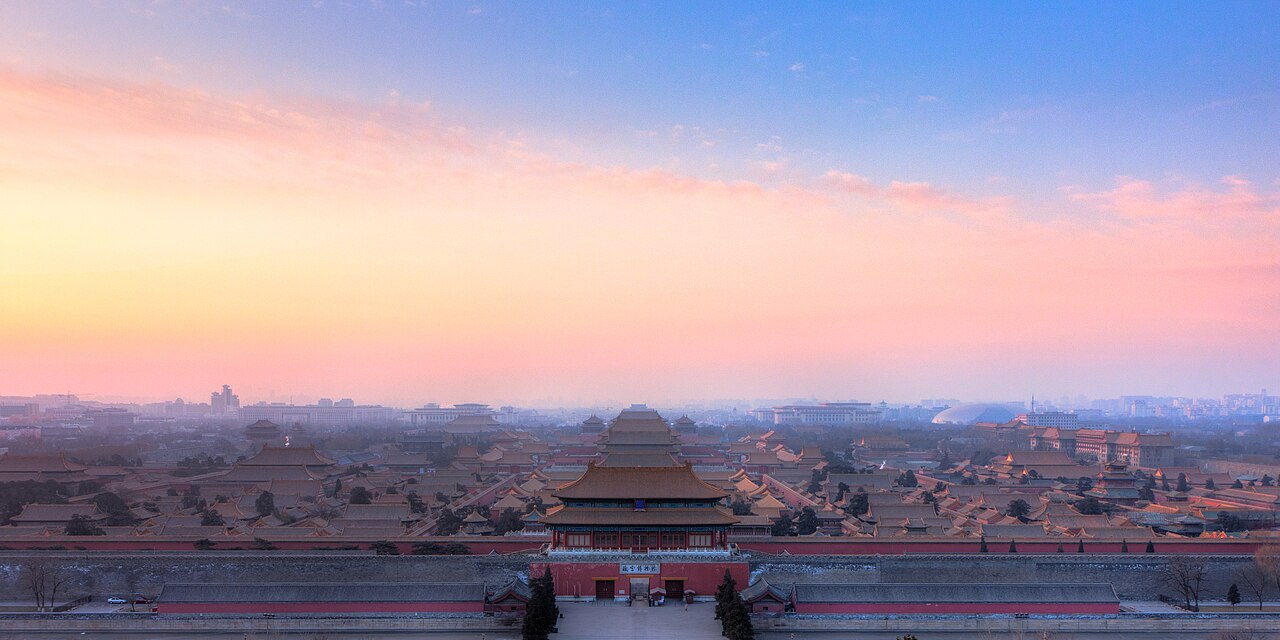
The Imperial Palace of the Ming and Qing Dynasties — the Forbidden City — covers 72 hectares at the centre of Beijing, enclosed by walls 10 metres high and a moat 52 metres wide. Construction ran from 1406 to 1420 under the Yongle Emperor, employing an estimated one million labourers to assemble 980 surviving buildings across 8,886 rooms. The complex served as the seat of Chinese imperial government for 24 emperors across five centuries, until the last emperor, Puyi, departed in 1924.
Within Beijing: Three UNESCO Sites in Under 15 Minutes 4–14 km / 15–30 min by metro
The Forbidden City sits at the intersection of two of Beijing’s most direct metro lines, placing two other World Heritage properties within a single transit leg.
The Temple of Heaven (Tiantan) lies 4 km due south along the city’s historic central axis, reachable in 15 minutes via subway Line 2 (to Qianmen) or a direct walk south through Tiananmen Square. Inscribed in 1998, the 267-hectare complex was built in parallel with the Forbidden City, both completed under the same Yongle Emperor in 1420. Its purpose was specific and non-negotiable: every winter solstice, the emperor walked here in procession to perform sacrifices at the circular Altar of Heaven, taking sole imperial responsibility for the agricultural harvest of the coming year. The Hall of Prayer for Good Harvests — a triple-eaved circular building 38 metres high, standing on a three-tiered marble terrace — was struck by lightning and destroyed in 1889, then rebuilt in 1890 to the original design. The park surrounding the ceremonial structures is enormous: Beijing residents still use its pine groves for morning exercises, and the acoustic trick of the Echo Wall (sound travels clearly along its 193-metre circumference) has been tested by visitors since the 18th century. Allow at least 2 hours for a proper circuit.
The Summer Palace (Yiheyuan) is 14 km northwest, approximately 30 minutes via subway Line 4 to Xiyuan station. Inscribed in 1998, it was reconstructed between 1886 and 1895 on the orders of Empress Dowager Cixi using funds diverted from the Chinese navy — a reallocation whose strategic consequences became apparent during the First Sino-Japanese War (1894–95), which China lost decisively. The 294-hectare park centres on Kunming Lake, an artificial body of water enlarged in 1749 during the Qianlong Emperor’s reign. The lake accounts for roughly three-quarters of the site’s area and was designed so the emperor’s barge could approach the garden buildings at water level. The 728-metre Long Corridor, running along the north shore of the lake, carries more than 14,000 painted ceiling panels depicting scenes from Chinese history, mythology, and landscape. In winter, the lake freezes and was historically used for ice skating by the court.
All three properties share a thematic logic: built under Ming emperors, maintained and expanded by the Qing, and each encoding imperial cosmology in spatial form — the Forbidden City as earthly axis, the Temple of Heaven as the point of contact with divine authority, the Summer Palace as the retreat where that authority rested and refreshed.
Northwest and Southwest: Tombs, Wall, and Prehistoric Cave 50–130 km / 1–2 h by car or tourist bus
The three outer UNESCO properties require more transit time but complete a coherent picture of Beijing’s heritage geography across five different millennia.
The Ming Tombs (Shisanling), 50 km northwest, form part of the Imperial Tombs of the Ming and Qing Dynasties inscription. Thirteen emperors are interred in a valley selected for its topographic alignment: mountains on three sides, a river running south — the configuration favoured by Feng Shui practice as auspicious for imperial burial. The funerary complex covers 120 square kilometres. The approach road, the Sacred Way, is flanked by 36 stone sculptures — animals in pairs, officials in ceremonial robes — each carved from a single block of stone, some weighing over 20 tonnes. The Dingling tomb, excavated between 1956 and 1958, is the only imperial Ming tomb opened for public access; it revealed a cross-shaped marble burial chamber 27 metres underground containing the remains of the Wanli Emperor (died 1620) and two empresses. The speed of the excavation, driven partly by political pressure to show results, meant that thousands of silk garments, lacquer objects, and textiles deteriorated within hours of exposure to air. The lesson is still cited in Chinese archaeological circles as the primary argument for the current moratorium on excavating other closed imperial tombs. Travel time from the Forbidden City: 50 km by car via the G6 expressway, approximately 1 hour in normal traffic.
The Great Wall of China, 70–130 km to the north and northwest depending on the section chosen, was inscribed in 1987. The Badaling section (70 km northwest by the direct G6 expressway, 1.5–2 hours by car or tourist bus from Qianmen) is the most visited stretch in China — approximately 10 million visitors per year — and the best preserved Ming-era construction: walls 7.8–8.5 metres high, towers at roughly 500-metre intervals, a walkway wide enough for five horses abreast. For visitors willing to accept a longer drive (Mutianyu, 90 km northeast) or rougher terrain (Jinshanling and Simatai, 130 km northeast), the Wall becomes less crowded and more physically demanding. Tourist buses to Badaling depart from Qianmen station year-round; the journey takes about 1.5 hours. Timed tickets are required during peak periods and sell out; book the evening before at minimum.
The Peking Man Site at Zhoukoudian, 50 km southwest, was inscribed in 1987. The limestone cave system here yielded fossil evidence of Homo erectus occupation spanning approximately 500,000 to 200,000 years before present, including skull fragments from at least 40 individuals and charred animal bones documenting fire use. The original fossils vanished in December 1941 during an evacuation attempt; only pre-war plaster casts and drawings survive as scientific record. The site museum is thoughtfully organised and rarely crowded; it takes 2–3 hours to walk the cave exteriors and work through the palaeontology exhibits. From the Forbidden City: 50 km southwest via the G4 expressway, approximately 1 hour.
Practical information
The Forbidden City requires advance timed-entry tickets purchased through the official Palace Museum website or WeChat mini-program; daily capacity is capped at 80,000 visitors, and tickets sell out on weekend mornings within minutes of release (tickets go on sale 10 days in advance). The Temple of Heaven requires a separate ticket for the inner ceremonial buildings, though the park grounds themselves carry a lower entry fee. The Summer Palace similarly charges separately for the main park and certain garden areas.
Best season: April–May and September–October. Summer (June–August) is hot and wet, with temperatures frequently exceeding 35°C and afternoon thunderstorms. The Great Wall is best avoided during the October Golden Week national holiday (1–7 October), when Badaling queues can extend several hours.
Getting between properties: subway Lines 1, 2, and 4 serve the three central sites efficiently. For the Ming Tombs, Zhoukoudian, and Great Wall, tourist buses from Qianmen (south of Tiananmen) and Dongzhimen bus stations are cheaper than private taxis and run on fixed schedules. The No. 877/880 bus cluster connects central Beijing to Badaling. Allow a full day for any combination involving the Great Wall; half-days suffice for the Temple of Heaven and Summer Palace individually.
Frequently Asked Questions
How long did it take to build the Forbidden City, and who built it?
Construction of the Forbidden City ran from 1406 to 1420 — fourteen years — under the reign of the Yongle Emperor, the third emperor of the Ming Dynasty. The Yongle Emperor had moved the capital from Nanjing to Beijing in 1403, partly to be closer to the northern frontier and partly to consolidate his political authority after seizing the throne from his nephew in the Jingnan campaign. The palace complex was designed as the earthly reflection of the Purple Forbidden Enclosure, the celestial palace of the Jade Emperor in Chinese cosmology — hence its Chinese name, Zijin Cheng (Purple Forbidden City). Historical sources cite approximately one million labourers drawn from across the empire, including 100,000 skilled craftsmen: tile-makers, carpenters, stone-carvers, and painters. Materials were sourced across the country and transported to Beijing by canal and road: white marble from Fangshan (south of Beijing), timber from the old-growth forests of Yunnan and Sichuan provinces (some trunks requiring two to three years to float downriver to Beijing), and gold-coloured floor tiles fired in kilns at Suzhou from a clay formula that required firing at temperatures exceeding 1,000°C. The gate known as the Meridian Gate (Wumen) — the main southern entrance — has been destroyed by fire three times in the palace’s history, each event interpreted by court officials as a cosmological omen requiring ritual response and a period of emperor’s self-criticism.
Which emperor lived in the Forbidden City the longest without leaving?
The Jiajing Emperor, who reigned from 1521 to 1567, is often cited in this context: he withdrew from active court ritual in his later decades and spent extended periods within the palace precincts or at the Western Park (Xiyuan) adjacent to the Forbidden City, limiting public appearances. However, the most documented case of imperial confinement belongs to the Wanli Emperor (reigned 1572–1620), who is recorded as having ceased personal attendance at court audiences by 1589 — eighteen years before his death — and effectively stopped leaving the palace for state business for approximately twenty years. The reasons given in contemporary accounts combine grief (the death of his favourite consort Lady Zheng was a contributing factor in later years), a dispute with his ministers over the succession, and what some historians characterise as a personal withdrawal from the rituals his role required. The administrative consequences were significant: memorials piled up unanswered, official appointments went unfilled for years, and the court divided into factions operating largely without imperial direction. The Wanli Emperor’s withdrawal is frequently cited by historians of the Ming collapse as a contributing factor in the weakening of central authority that preceded the Manchu conquest of 1644, though this causal link remains debated.
Can you visit all five UNESCO sites near the Forbidden City in one trip to Beijing?
Yes, with a stay of at least four to five days. The practical order depends on which direction you work outward from the city centre. A workable five-day structure: Day 1 — Forbidden City (morning, pre-booked timed ticket) and Jingshan Park immediately north for the panoramic view of the palace (afternoon). Day 2 — Temple of Heaven (morning, walk or subway) and Summer Palace (afternoon, subway Line 4). Day 3 — Great Wall at Badaling or Mutianyu (full day, depart 07:00 from Qianmen by tourist bus). Day 4 — Ming Tombs (morning, car or bus 872 from Deshengmen) and return to Beijing for an afternoon at the National Palace Museum or 798 Art District. Day 5 — Zhoukoudian (morning, bus 917 from Tianqiao), returning by early afternoon. This sequence avoids stacking the two most demanding transit days consecutively. Visitors with only three days should prioritise Forbidden City, Temple of Heaven, and the Great Wall; the Summer Palace, Ming Tombs, and Zhoukoudian can anchor a return visit. Timed tickets for the Forbidden City are the only element requiring advance purchase in most seasons; the Great Wall at Badaling also requires tickets during October Golden Week and the May Day holiday.
Sources
- S1 — UNESCO World Heritage Centre — Imperial Palaces of the Ming and Qing Dynasties in Beijing and Shenyang (Ref. 439) — https://web.archive.org/web/20230601000000/https://whc.unesco.org/en/list/439/
- S2 — Palace Museum Beijing — https://whc.unesco.org/en/list/439/
- S3 — Kuhn, Dieter. <em>The Age of Confucian Rule: The Song Transformation of China</em>. Harvard University Press, 2009. ISBN: 978-0-674-03661-1.
Spotted an error? Write to editorial@culturalheritageonline.com and we correct it the same day.